
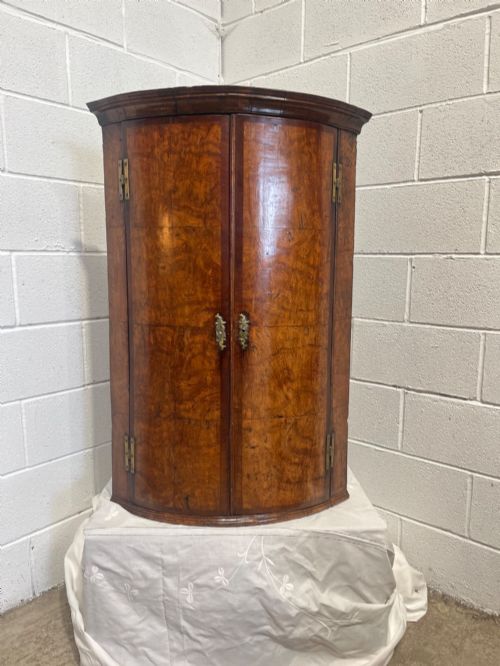
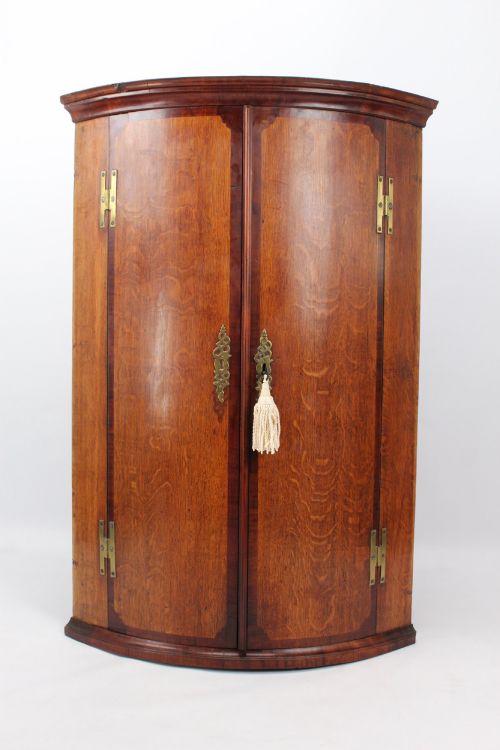
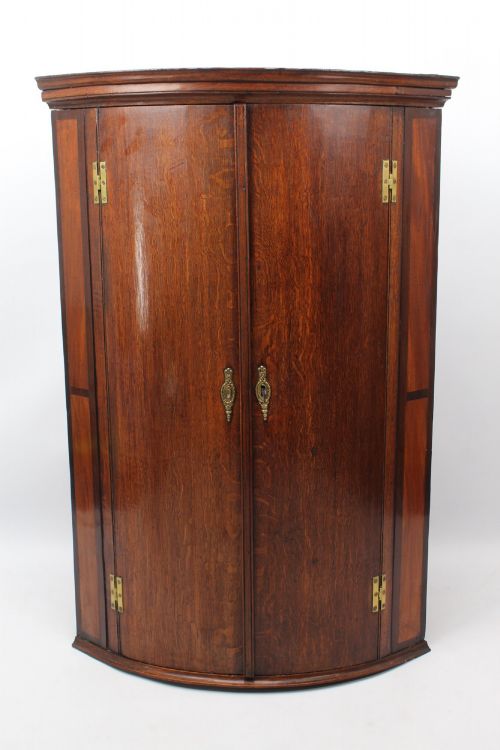


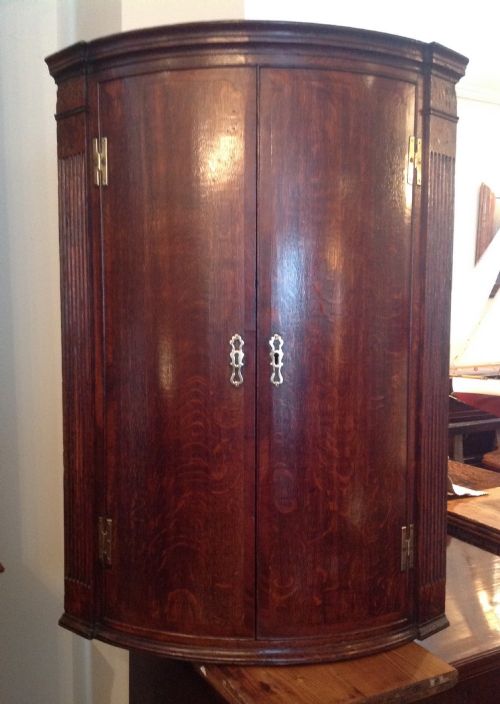


Oak Bowfront Corner Cabinet
An oak bowfront corner cabinet makes clever use of overlooked room space while bringing rich Georgian timber into the interior.
Oak Bowfront Corner Cabinet
An oak bowfront corner cabinet is a fitted or hanging storage piece designed specifically to tuck neatly into the internal intersection of two walls. These items appear most frequently from the Georgian period and the eighteenth century, showing solid vernacular construction scaled for domestic rooms.
The defining feature of these pieces is the rounded or curved front projecting forward from straight side panels that meet at a right angle. The versions met on this page are predominantly oak, often paired with secondary woods like pine or mahogany for internal shelves and backing boards.
Buyers encounter both hanging models designed to mount on walls and standing floor cabinets carrying greater height. Regional pieces, including Welsh examples, sit alongside standard Georgian vernacular forms showing characteristic proportions and timber selection.
How they were made
Cabinet makers built these frames using solid oak for the primary structural carcase and exterior doors, frequently employing pine or mahogany for secondary elements such as interior shelving and backboards. Surfaces often received decorative veneers, including burr oak and mahogany crossbanding, to frame the curved door panels.
Brass hardware, including H-hinges and key escutcheons, functional iron fixtures, and occasionally painted finishes completed the construction. The curved bowfront doors required careful timber selection and joining techniques to maintain the rounded profile without warping over centuries of use.
Several cabinet makers thoughtfully included hidden interior drawers behind the main doors, giving owners a secret spot to misplace their housekeeping money.
What varies in quality
The standard of timber selection marks the primary division between ordinary pieces and superior examples, particularly where figured burr oak or precise mahogany crossbanding frames the front. Rich grain patterns and harmonious matching of veneers across the curved door define the better works.
Construction depth also separates workshop output, visible in the thickness of the oak carcase, the retention of original brass or iron hardware, and the crispness of any carved detailing. Regional variations show differing levels of cabinet making ambition, from plain utilitarian country pieces to more refined urban Georgian commissions.
The Oak Bowfront Corner Cabinet Glossary
- Bowfront
- A convex curved front projecting outward from the frame. This shape softens the hard angles of a room while providing deeper internal storage than a flat-fronted cupboard.
- Crossbanding
- A decorative border technique where thin strips of veneer are laid running perpendicular to the grain of the main panel. It creates a contrasting visual frame around the cabinet door.
- Burr oak
- A specialised timber cut from tree growths containing clustered bud formations, producing highly swirling grain patterns. It was prized by cabinet makers for high-status decorative surfaces.
- Vernacular
- Everyday domestic furniture built by regional craftsmen following local traditions rather than strict high-style metropolitan designs. These pieces emphasise sturdy utility alongside regional character.
- Escutcheon
- A protective plate surrounding the keyhole of a cabinet door. Usually cast in brass, it often contributes to the decorative scheme of the frontage.
Oak Bowfront Corner Cabinet: Frequently Asked Questions
Were these cabinets meant for corners?
Yes, the ninety-degree back panels allow the furniture to slot directly into room corners, making efficient use of space that standard rectangular cupboards cannot occupy.
This specific geometry distinguishes corner cabinets from wall-hanging or floor-standing bookcases of the same eras.
How do I mount a hanging model?
Hanging models rely on internal fixing points or sturdy back brackets anchored directly into wall studs. Given the weight of solid oak and timber doors, secure wall attachment is essential for safety.
Professional installation ensures the cabinet supports both its own weight and the contents stored inside.
What is the difference between hanging and standing?
Hanging versions are compact units designed to be secured to walls at eye level or above floor furniture. Standing models extend downward to the floor with a dedicated base section, providing greater overall capacity.
Both forms share the curved bowfront profile characteristic of these Georgian storage pieces.
How do I date an eighteenth century piece?
Dating relies on observing construction characteristics such as hand-cut dovetails, timber choices like oak and secondary pine, and the style of brass hardware. Georgian and eighteenth-century examples exhibit specific regional joinery methods.
Comparative study of similar pieces in the archive helps narrow down the period of manufacture.