
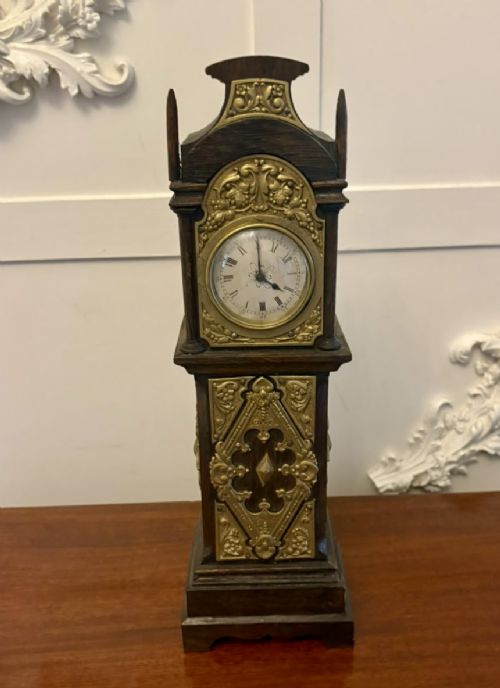


Novelty Mantel Clock
These novelty mantel clock pieces merge timekeeping with mechanical amusement, offering collectors distinct conversation pieces that depart from traditional domestic clock design.
Novelty Mantel Clock
A novelty mantel clock breaks from standard dial-and-case geometry to present timekeeping within sculptural or thematic forms. When browsing novelty mantel clock examples, buyers encounter diverse shapes ranging from architectural lighthouses and animal figures to industrial machinery and nautical instruments.
The material and stylistic range spans from Victorian Gothic Revival and French Regency designs to Art Deco and later twentieth-century creations. Pieces often incorporate mechanical movement, such as swinging figures, electric moving ships, or rolling balls, transforming a simple timepiece into an animated display.
Origins stretch from eighteenth-century workshops to mid-twentieth-century makers, reflecting shifting tastes in domestic decoration and horological ingenuity. Most items seen here bridge the gap between functional desk or mantel timepieces and mechanical curiosities.
How they were made
Construction relies heavily on metals such as brass, bronze, gilt bronze, spelter, and silvered metal, often paired with glass panels and enamel dials. Artisans utilised these materials to cast intricate sculptural housings, ranging from animal figures to industrial lighthouse towers.
One exceptional Victorian-style design incorporates a working clock directly into the centre of its composition, keeping time amidst the novelty.
What varies in quality
The distinction between tiers rests upon the precision of the casting work, the complexity of the animated mechanism, and the finish applied to the metals. Higher-tier examples demonstrate sharper definition in chased bronzes, champleve enamel detailing, and smoother execution of automated movements.
Material selection also dictates the hierarchy, where solid gilt bronze and finely painted enamel dials sit above simpler spelter and silvered metal alternatives. The reputation of the maker and the mechanical sophistication of the movement further elevate a piece above standard production.
Hessen Paris·Andre Guilmet·Barwise London·Thwaites Reed·Jaeger Le Coultre
The Novelty Mantel Clock Glossary
- Automaton
- A self-operating machine or mechanism designed to automatically follow a predetermined sequence of operations, or impress a set of movements. In these clocks, this often manifests as moving ships or figures.
- Champleve
- An enamelling technique in which troughs or cells are sunk in to the surface of a metal object and filled with vitreous enamel. This decoration method appears on select nineteenth-century desk and watch clocks.
- Spelter
- An alloy of zinc and lead or copper, frequently used as a cheaper substitute for bronze in casting figural clock cases. It takes plating and patination well, mimicking more expensive materials.
- Trench Art
- Decorative or utilitarian objects made by soldiers, prisoners of war, or civilians from war scrap and munitions debris. Items from the First World War period reflect this resourceful manufacturing background.
- Gilt Bronze
- Bronze that has been coated with a thin layer of gold or gold amalgam using fire-gilding or electroplating techniques. It provides a durable, bright metallic finish seen on numerous period pieces.
Novelty Mantel Clock: Frequently Asked Questions
How do novelty mantel clocks work?
These timepieces integrate standard clockwork movements with mechanical linkage systems that drive secondary animations. Elements like swinging pendulums shaped as cherubs or rolling balls operate in tandem with the escapement.
Electric or spring-driven motors power specific models, moving miniature ships or lighthouse beams while the primary dial maintains accurate time.
Where should I place a novelty mantel clock?
Due to their sculptural and animated nature, these clocks suit prominent positions where viewers can appreciate their mechanical action. Tabletops, desks, and living room mantels offer stable flat surfaces with adequate clearance for moving parts.
Placement should avoid direct sunlight and damp environments to protect delicate enamel dials, glass panels, and original bronze patination.
How do I date an antique novelty mantel clock?
Dating relies on identifying stylistic markers such as Victorian Gothic Revival motifs, French Regency symmetry, or Art Deco geometric lines. Material choices, including champleve enamel or specific brass alloys, also correspond to manufacturing eras.
Maker signatures inscribed on dials or movements provide the most reliable chronological anchor, linking the object to known working periods of specific workshops.
Are these clocks suitable for daily use?
While many mechanical and electrical models remain functional, their complex moving parts require careful handling and occasional professional servicing. Frequent operation of delicate automatons puts wear on historic gear trains and linkage arms.
Collectors often run them sparingly to preserve original components, treating them primarily as decorative mechanical sculptures.