


Norfolk Coastal Art
Norfolk coastal art captures the salt marshes, busy harbours, and wide skies of East Anglia through nineteenth and twentieth-century watercolours and oils.
Norfolk Coastal Art
Norfolk coastal art brings together maritime views, broadland rivers, and seaside towns rendered in watercolour paint and oil on canvas. When you search for norfolk coastal art, you encounter works dating from the nineteenth century through the mid-twentieth century.
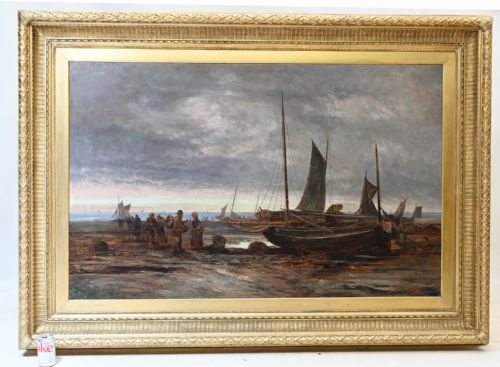
The selections on this page lean heavily towards watercolours on paper and oil paintings depicting specific locations such as Cromer, Brancaster Staithe, and Gorleston-on-Sea. These pieces range from intimate local scenes to large maritime canvases framed in giltwood.
Styles span Victorian marine art and Victorian British landscape through to modern British impressionism. Works by named artists sit alongside broader examples from the British school.
How they were made
Makers utilised watercolour pigment on paper and oil paint on canvas to capture the shifting light of the Norfolk coast. Artists applied washes of watercolour to build transparent atmospheric effects or laid down oil paint with heavier brushwork.
Works frequently employ wooden supports and giltwood frames to house the paintings and watercolours. The combination of paper, board, and canvas reflects the prevailing studio and plein air methods of the nineteenth and twentieth centuries.
Listings feature works spanning the nineteenth and twentieth centuries, including pieces from the 1860s, 1910s, 1920s, and post-war 1960s.
What varies in quality
Quality rests in the precision of the topographical detail and the handling of light across water and sky. Stronger examples capture the specific atmosphere of coastal locations like Blakeney or Cromer with confident brushwork.
The distinction between works lies in the reputation of the artist, the condition of the paper or canvas, and the appropriateness of the framing. Skilled draughtsmanship in watercolours and balanced composition in oils separate standard topographical records from accomplished fine art.
Thomas Bush Hardy·Sir Thomas Newenham Dean·Edward Seago·Frederick William Hattersley·Leslie Rackham·H.E. Tidmarsh·Stephen John Batchelder·Henry Bright·Joseph West
The Norfolk Coastal Art Glossary
- Watercolour
- A paint consisting of pigment suspended in a water-based solution, applied to paper to create transparent washes of colour.
- Giltwood
- Wood that has been coated with gold leaf or a gilt finish, commonly found on traditional picture frames.
- Impressionism
- A style of painting emphasising accurate depiction of light and fleeting visual moments rather than rigid academic detail.
- Marine art
- Artistic representation of ships, maritime scenes, and coastal environments.
- Plein air
- The act of painting outdoors to capture direct observations of natural light and atmosphere.
Norfolk Coastal Art: Frequently Asked Questions
What subjects appear in norfolk coastal art?
These works depict local maritime scenes, harbour shipping, river sailing on the broads, and coastal cliffs. Popular motifs include tidal flats, fishing boats, and seaside towns.
Artists frequently recorded specific geographic points such as Cromer, Brancaster Staithe, and Gorleston-on-Sea, providing a visual record of the region.
How do I care for watercolour paintings?
Watercolour paintings on paper require protection from direct sunlight to prevent fading of the pigments. Framing behind glass with acid-free mounts safeguards the paper from environmental moisture and pollutants.
Displaying these works away from direct heat sources ensures the paper remains stable over time.
How are oil paintings on canvas constructed?
Oil paintings utilise oil paint applied to stretched canvas or wooden panels, often secured within decorative giltwood frames. The medium allows for rich texture and deep colour saturation.
Canvas supports require stable indoor humidity to prevent the fabric from slackening or the paint layer from cracking.
What distinguishes nineteenth-century works from later pieces?
Nineteenth-century pieces tend to follow Victorian landscape and marine traditions with careful attention to topographical detail. They often feature muted palettes and precise draughtsmanship.
Twentieth-century works, particularly post-war examples, lean towards impressionistic brushwork and looser interpretations of light and atmosphere.