

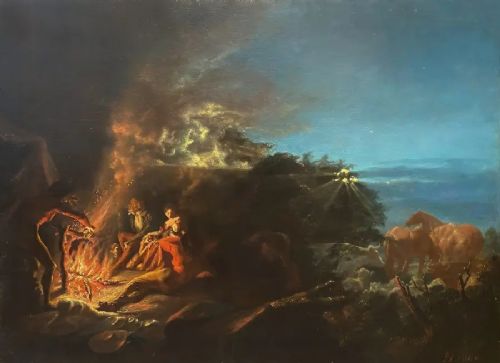
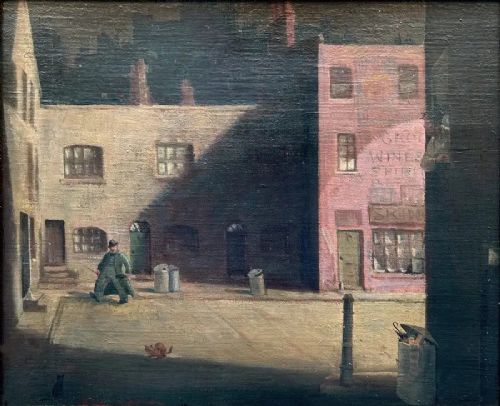


Nocturnal Landscape Oil
These nocturnal landscape oil works capture moonlight on water, ruins and country scenes, offering moody atmosphere and quiet depth.
Nocturnal Landscape Oil
When you search for nocturnal landscape oil, you encounter paintings that focus on night scenes, moonlight and evening atmospheres. These works capture everything from lonely ruins and coastal shipping to moonlit country views.
The pieces listed on this page span the nineteenth century through the mid twentieth century. You find Victorian examples alongside later impressionist and romantic interpretations of the dark.
Subjects range from Scottish lochs and castles to bustling ports and quiet winter fields. Artists use oil on canvas or wood panel to render the specific quality of darkness illuminated by moon or fire.
How they were made
Painters applied oil paint onto prepared canvas or wood panels, sometimes housed in gilt and gesso wood frames. The handling of the medium allows for deep shadows punctuated by pale highlights of moonlight.
Brushwork varies from the tight detail seen in nineteenth-century academic works to the looser application found in later impressionist canvases. Artists built up layers to achieve the dense, atmospheric darkness characteristic of the genre.
Materials across these listings include oil on canvas, wood panel, gesso and gilt wood.
What varies in quality
The success of a nocturnal landscape oil depends on the artist's command of light and shadow. Stronger examples achieve a convincing luminosity in the moon or sky that draws the eye into the composition.
Atmospheric depth separates standard decorative canvases from more accomplished artistic statements. The handling of water reflections, moonlight and silhouettes dictates the overall presence of the work.
Albert Bierstadt·Francisco Sancha·James Bell Anderson·Walter Meegan·William Samuel Horton·George Cole·Owen Bowen·Hubert Thornley·Lillian M Harrison
The Nocturnal Landscape Oil Glossary
- Oil on Canvas
- Pigment mixed with drying oil applied to a woven fabric support. This remains the primary medium for most works in this category.
- Wood Panel
- A rigid wooden support used by artists instead of canvas. Panels often appear in smaller nineteenth-century works.
- Gilt Wood
- Timber framing finished with a thin layer of gold leaf. Many period oil paintings retain their original gilded surrounds.
- Gesso
- A plaster-like mixture applied to wood or canvas to prepare a smooth surface for painting. It often forms the decorative relief on ornate frames.
- Impressionism
- A style focusing on transient effects of light and atmosphere. Several pieces here adopt this approach for night scenes.
Nocturnal Landscape Oil: Frequently Asked Questions
Are frames usually original to the painting?
Some pieces retain their period gilt wood frames, while others have been reframed later. The style of the frame often matches the era of the canvas.
Examining the back of the frame helps determine its age relative to the artwork.
Where should I hang a dark oil painting?
These works benefit from placement away from direct sunlight to protect the pigments and varnish. Wall lighting can enhance the subtle details in shadowed areas.
Darker compositions often stand out well against neutral or muted wall colours.
How do I date a nocturnal landscape?
Dates are indicated by the costume of figures, architectural details, stretcher construction and artist signatures. The style of the frame also provides useful clues.
Comparing the handling of paint with documented works from the same period helps narrow the timeline.