
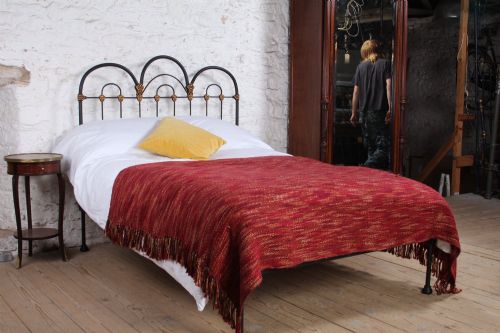


No End Iron Bed
A no end iron bed offers an open, airy silhouette at both head and foot, suiting rooms where floor space feels precious.
No End Iron Bed
The pieces on this page derive from the Victorian era up through the early decades of the twentieth century. Origins span Ireland, France, Spain, and Portugal, presenting forms from simple straight rails to arched shapes and hospital styles.
Most examples combine cast iron components with wrought or forged iron, frequently accented by brass spindles, finials, and decorative clamps. Paint finishes appear in various tones, including dark green and obsidian.
How they were made
Blacksmiths and foundries utilised cast iron for structural castings and detailed joints, combining it with malleable wrought or forged iron for side rails and decorative bars. Brass components like ball finials and caps provided contrast to the darker iron frames.
Joints and clamps held the heavy metal components securely together while allowing the frames to dismantle for transport. Hand-finished painted surfaces protected the metal and added colour, ranging from plain black to shades of green.
No End Iron Bed Retail Price Guide 2026
Typical asking prices for no end iron bed among the pieces listed under this phrase on Sellingantiques today, from the lower quarter to the upper quarter. They describe what is for sale here now, not the wider market.
Listings feature periods spanning from 1890 through 1920, alongside Victorian examples, constructed from cast iron, wrought iron, brass, and painted finishes.
What varies in quality
The refinement of the casting work distinguishes simpler utility frames from more ambitious models. Crisp detailing on iron ornaments and well-turned brass finials indicate greater care during manufacture.
Proportion and shaping define the character of each frame, with thoughtful curves and balanced spindles setting finer examples apart from basic commercial ironwork.
The No End Iron Bed Glossary
- No end bed
- A bed frame possessing low or matching ends rather than a high footboard, which maintains an open view across the mattress. This layout suits compact rooms and makes making the bed straightforward.
- Cast iron
- Molten iron poured into a mould to form rigid structural parts and ornamental details. This material provides substantial weight and allows intricate patterns.
- Wrought iron
- Iron heated and hammered into shape by hand or machine, yielding tough, fibrous bars used for rails and structural framing. It bends rather than snaps under sudden stress.
- Finial
- A decorative terminal knob or spike topping the corner posts of a bed frame. Brass examples frequently accent iron corner pillars.
- Ribbon reed
- A decorative moulding detail resembling a twisted ribbon or reeded band applied to iron components. This ornamentation lifts standard production into more elaborate territory.
No End Iron Bed: Frequently Asked Questions
What is a no end iron bed?
A no end iron bed is a metal bed frame that lacks a tall footboard, featuring either matching low ends or a single headboard design. This configuration creates an open silhouette that does not block sightlines across a bedroom.
Such frames appear in single, double, king, and super king sizes across Victorian and early twentieth-century periods. They offer a practical option for rooms with restricted space or low placement beneath windows.
How do single no end beds join together?
Certain single frames feature specialised brackets or rail attachments designed to lock two identical beds together securely. This allows owners to convert twin beds into a larger king-size sleeping platform when needed.
When separated, each piece functions as an independent single bed suitable for guest rooms or smaller spaces.
What materials make up these beds?
Construction relies primarily on cast iron for structural joints and ornamental castings, paired with forged or wrought iron for the main rails. Brass elements like finials and decorative collars frequently appear alongside the dark metal.
Surfaces often retain painted finishes, including traditional green tones or simple dark coatings applied to protect the iron.
How do I date an iron bed?
Dating relies on examining the assembly methods, style of casting, and decorative motifs present on the frame. Victorian examples often display heavier brass embellishments and elaborate floral details, while early twentieth-century pieces lean towards simpler straight rails or hospital styles.
The presence of original clamps and the specific shaping of the iron components help place a bed within its period of manufacture.