




Nineteenth Century Sporting Art
Nineteenth century sporting art captures the energy of the hunt, the turf, and the kennel through oil paintings, watercolours, and engravings.
Nineteenth Century Sporting Art
Nineteenth century sporting art encompasses works depicting horses, hounds, racing, hunting, and canine subjects from the Victorian era. These pieces record the significant animals, riders, and pastimes of the period through various visual media.
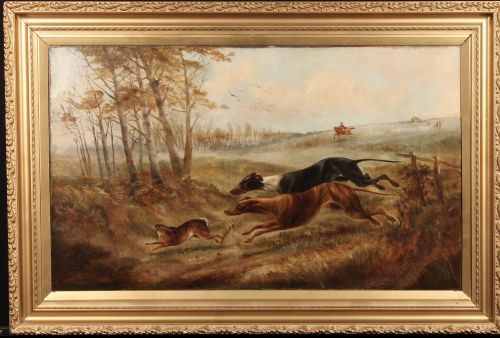
Oil paintings on canvas feature prominently among the listings, alongside hand-coloured engravings, lithographs, and watercolours. Framed works often retain their original giltwood or timber frames.
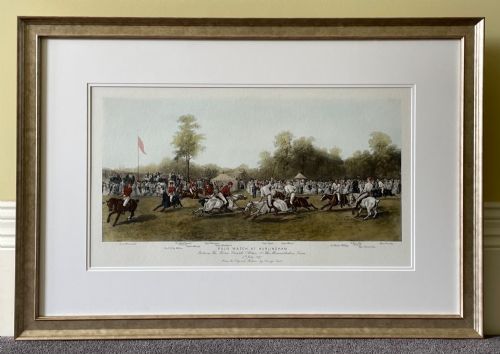
The subjects range from portraits of individual racehorses and favourite dogs to dynamic scenes of fox hunting, polo matches, and hare coursing. Such works offer a direct window into nineteenth-century sporting life and animal husbandry.
How they were made
Artists utilised oil on canvas to build rich, textured depictions of horses, hounds, and landscapes, often applying fine glazes to capture the sheen of coats and the atmosphere of open fields.
Works on paper, including engravings and lithographs, required careful printing techniques and subsequent hand-colouring to bring vibrancy to the printed lines of hunting and racing scenes.
Framing played an integral part in the presentation, with makers enclosing paintings and prints in substantial gilt wood frames that complemented the visual weight of the art.
The selection includes oil paintings, hand-coloured engravings, and lithographs spanning the nineteenth century and the Victorian era.
What varies in quality
The ability of the artist to render anatomical precision in horses, dogs, and human figures separates finer works from standard decorative pieces. Master the handling of movement and expression, and the artwork elevates accordingly.
The condition of the medium itself dictates the standing of a piece, whether through the preservation of the original paint layer on canvas or the crispness of the lines and hand-colouring on paper and engravings.
George Armfield·John Arthur Lomax·Basil Nightingale·William Barraud·Heywood Hardy·Fred Archer·H. Alken·J F Herring
The Nineteenth Century Sporting Art Glossary
- Oil on canvas
- Pigments bound in a drying oil applied to a stretched woven fabric support. This traditional medium allows for depth of colour and varied brushwork.
- Engraving
- An intaglio printing process where an artist cuts lines into a metal plate to hold ink. It produces sharp, highly detailed images on paper.
- Lithography
- A planographic printing method based on the repulsion of oil and water. It enabled the mass production of detailed pictorial prints.
- Giltwood
- Wood carved and coated with gold leaf or a gold-coloured metallic finish. It is commonly found on nineteenth-century picture frames.
- Hand-coloured
- A print or engraving that has received pigment by hand after the initial printing process. This adds individual colour and detail to each sheet.
Nineteenth Century Sporting Art: Frequently Asked Questions
What subjects appear in nineteenth century sporting art?
The subjects focus primarily on horses, dogs, hunting, and racing. Works depict specific events like the Quorn Hunt or polo matches, alongside portraits of named animals and jockeys.
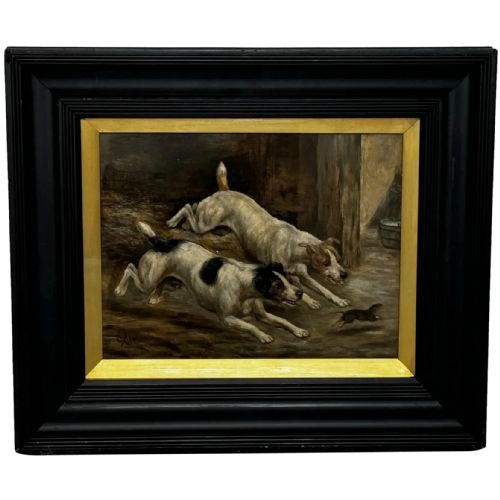
Canine subjects range from terrier ratting scenes to formal portraits of hounds and hunting dogs. These pieces reflect the prominent role of field sports in Victorian society.
How do I distinguish paintings from prints?
Paintings utilise oil on canvas or watercolour applied directly by hand, showing brushstrokes and texture upon close examination. Prints and engravings display ink sitting within printed lines or dots.
Examining the surface under magnification reveals the characteristic plate marks of engravings or the flat, printed nature of lithographs. Framing behind glass typically protects works on paper.
How were these artworks displayed originally?
Nineteenth-century sporting art was typically hung in country houses, estate libraries, and sporting lodges. The heavy giltwood frames suited the domestic architecture of the Victorian period.
These pieces served as records of prized animals and successful hunts, celebrating the owner's sporting pursuits and country life.
How should I care for these pieces at home?
Keep oil paintings and works on paper away from direct sunlight and high humidity to prevent fading and canvas degradation. Stable indoor temperatures protect both the canvas and the wooden frames.
Dust framed pieces gently with a dry, soft cloth. Avoid applying moisture or cleaning agents directly to the painted or printed surfaces.