




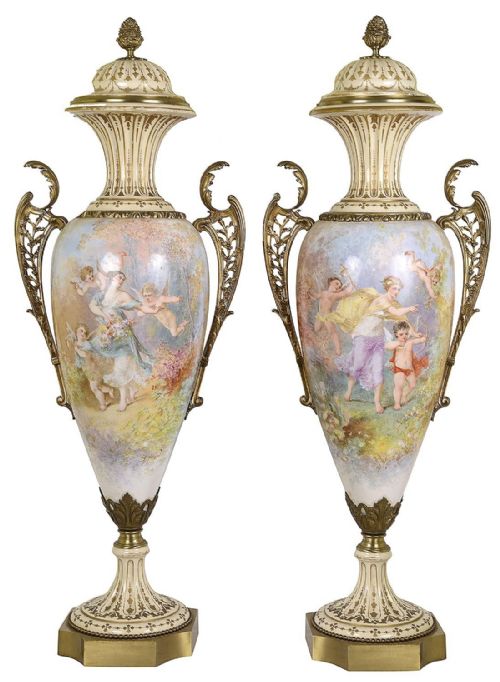


Nineteenth Century Sevres Vases
Nineteenth century sevres vases bring unmistakable French grandeur to a room, combining painted porcelain bodies with heavy gilded mounts.
Nineteenth Century Sevres Vases
When you search for nineteenth century sevres vases, you are looking at ornamental ceramic vessels produced or styled after the famous French factory during the eighteen-hundreds. These pieces include tall lidded urns, garniture sets, and mantel clock combinations that reflect historic French design movements.
The versions you are most likely to meet on this page arrive in pairs and showcase distinct decorative styles such as French Rococo Revival, Neoclassical, and Louis XVI. They range from white and blue porcelain bodies to pink enamel finishes, frequently mounted in gilt bronze or ormolu.
Makers and decorators of this period drew heavily on earlier royal aesthetics, creating decorative items intended for display on mantelpieces and large tables. Their imposing scale and rich gilding mark them as definitive products of nineteenth-century French decorative arts.
How they were made
The foundation of these objects is hard-paste porcelain, shaped into wide rims, lidded urns, and slender bodies before being fired and glazed. Artisans applied rich colour grounds in blue, pink, or white, often reserving panels for detailed painted scenes.
Metal mounts in gilt bronze and ormolu provide structural framing and decorative handles, cast and chased before being gilded to catch the light. Brass and glass components occasionally appear in related garniture pieces and clock housings.
Nineteenth Century Sevres Vases Retail Price Guide 2026
Typical asking prices for nineteenth century sevres vases among the pieces listed under this phrase on Sellingantiques today, from the lower quarter to the upper quarter. They describe what is for sale here now, not the wider market.
One exceptional pair was built large enough and detailed specifically to commemorate Napoleon Bonaparte.
What varies in quality
The standard of the porcelain body and the crispness of the painted detail dictate the artistic merit of the piece. Superior examples display finely controlled ceramic firing alongside hand-painted highlights that remain sharp and clear.
The weight and chasing of the gilt bronze or ormolu mounts separate standard production from exhibition pieces. Heavier cast metal with deep, clean chasing elevates the overall presence of the vase.
The Nineteenth Century Sevres Vases Glossary
- Ormolu
- Gilded bronze used for mounts and decorative trim on nineteenth-century objects. This technique involves applying a gold amalgam to a bronze base.
- Garniture set
- A matched group of three or more decorative vases or urns designed to sit together on a mantelpiece. These sets balance a central large vessel with two smaller flanking pieces.
- Louis XVI Style
- A neoclassical design vocabulary characterised by straight lines, symmetry, and classical architectural motifs. It draws inspiration from ancient Greek and Roman forms.
- Hard-paste porcelain
- A dense, durable ceramic material fired at high temperatures. It forms the smooth, non-porous body typical of quality nineteenth-century French vases.
Nineteenth Century Sevres Vases: Frequently Asked Questions
How are nineteenth century sevres vases displayed?
These vessels typically sit on mantelpieces, pedestals, or large console tables where their height and gilt mounts can command attention. Pairs and garniture sets work best when arranged symmetrically to frame a central mirror or clock.
Because many examples feature delicate painted panels and protruding bronze handles, they require stable surfaces away from high-traffic walkways to prevent accidental knocks.
What is a garniture set?
A garniture set consists of a matched group of ornamental vases, usually comprising a larger central urn and two smaller flanking pieces. These sets were manufactured to create a balanced, decorative focal point on large pieces of furniture.
On this page, you will find porcelain garnitures that combine vases with matching clock housings, reflecting complete nineteenth-century interior schemes.
How do I identify French Rococo Revival pieces?
French Rococo Revival items are identifiable through their flowing, asymmetrical curves, C-scrolls, and naturalistic plant motifs. The style avoids straight lines in favour of dynamic, organic shapes.
On these vases, the style appears in the moulding of the porcelain body and the sweeping design of the gilt bronze handles and bases.
What materials make up these vases?
The primary materials are fired porcelain and cast metal, specifically gilt bronze and ormolu. Porcelain forms the colourful, painted body, while bronze mounts provide structural trim and decorative handles.
Additional materials like brass and enamel occasionally supplement the main construction, particularly in pieces incorporating clock mechanisms or complex garniture frames.