


Nineteenth Century Needlepoint
Nineteenth century needlepoint brings together wool, silk, and canvas in framed pictures, fire screens, samplers, and chairs.
Nineteenth Century Needlepoint
Nineteenth century needlepoint encompasses a diverse range of domestic objects and decorative pieces worked in thread upon canvas, linen, and fabric. Buyers seeking nineteenth century needlepoint will encounter framed wall art, samplers, cushions, chairs, and firescreens created across the Victorian and Regency eras.
The selections span delicate silk pictures and maps alongside robust woolwork panels, Berlin woolwork, and gros-point depictions of figures, scenes, and floral motifs. Many pieces retain their original rosewood, mahogany, giltwood, or walnut frames and supports.
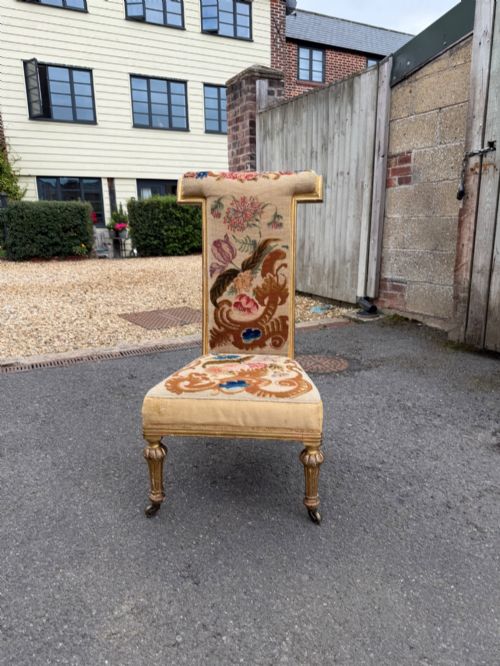
Works originate from English, French, Italian, and German hands, reflecting the domestic pursuits and professional embroidery workshops of the period. Forms range from intimate footstools and prie-dieu chairs to large gilt-framed wall hangings.
Materials and construction
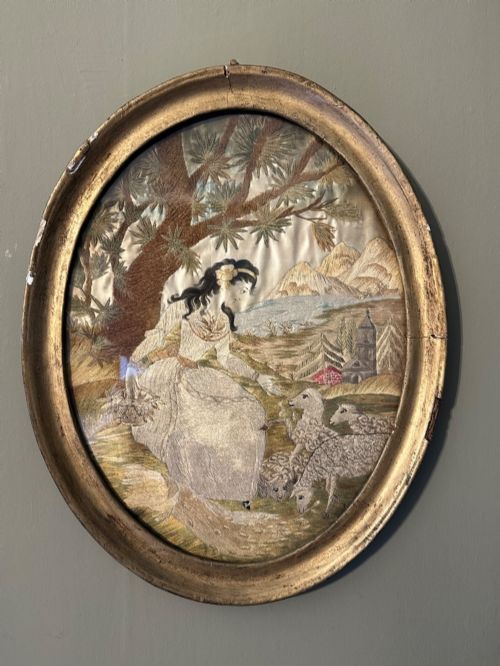
Maker execution relies upon wool, silk, and felt stitched onto canvas or linen grounds using long stitch, cross stitch, and gros-point techniques. Threads are frequently dyed in rich polychrome palettes to achieve pictorial depth in portraits, landscapes, and maps.
Structural mounts incorporate fine timbers such as rosewood, mahogany, satinwood, walnut, and palisander, often shaped into tripod bases for pole screens or carved for chairs and side tables. Frames incorporate giltwood and glass to protect fragile textile surfaces.
Mary Pinfold stitched an ambitious map of England and Wales in eighteen hundred, proving geography was once a formidable embroidery test.
Indicators of quality
Excellence in these textiles rests upon the precision of the stitch work, the complexity of the design, and the vibrancy retained by the wool and silk threads. Finer examples display meticulous shading and detailed anatomical or botanical accuracy.
The supporting furniture or frame dictates overall merit, where dense rosewood, fire-gilt framing, or sophisticated mahogany and walnut carving elevate the textile panel. Original housings and untouched mounting enhance historical integrity.
H Ogden of Manchester
The Nineteenth Century Needlepoint Glossary
- Berlin woolwork
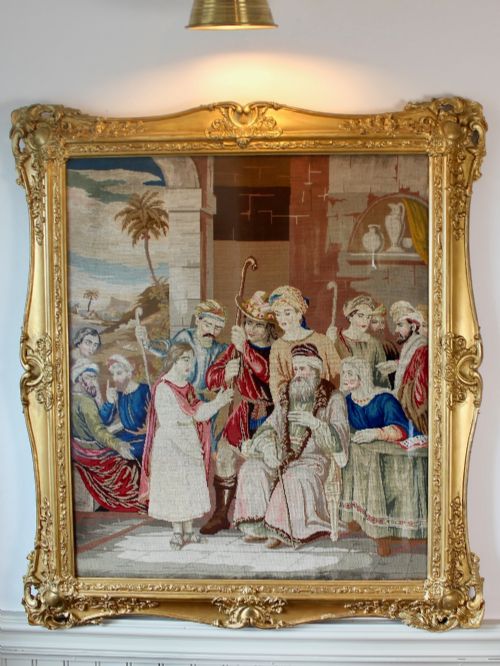
- A type of needlepoint embroidery worked in wool on canvas from printed point-paper grids. This technique gained immense popularity during the Victorian era for brightly coloured pictorial wall hangings and cushions.
- Pole screen
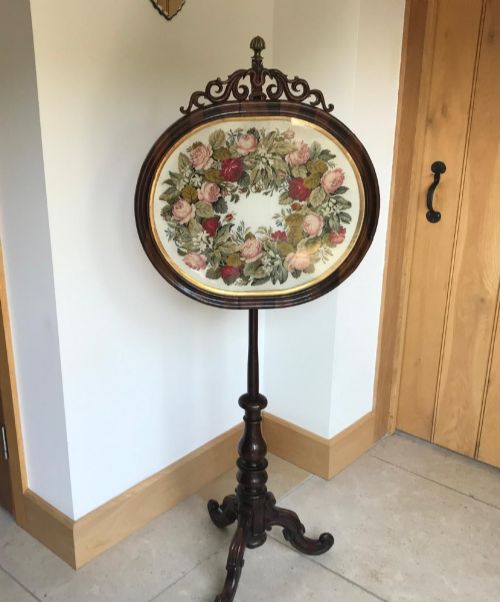
- A freestanding firescreen featuring an adjustable vertical needlework panel mounted on a slender pole with a tripod base. It allowed sitters to shield their faces from hearth heat.
- Samplers
- Embroidered linen or canvas panels worked by individuals to demonstrate proficiency in various alphabets, numerals, and stitches. They often record the maker name and date.
- Gros-point
- A coarse needlepoint stitch worked over multiple canvas threads, producing a durable texture. It frequently forms the background or main body of heavy tapestries and chair seats.
- Prie-dieu
- A devotional prayer chair characterised by a low seat and a high, padded back often upholstered in period needlework.
Nineteenth Century Needlepoint: Frequently Asked Questions
What is Berlin woolwork?
Berlin woolwork is a style of embroidery using brightly coloured wools stitched onto canvas by following gridded paper patterns. It produced vivid pictures, cushions, and wall hangings during the nineteenth century.
These patterns became widely available around the middle of the century, allowing makers to create complex pictorial scenes with shaded depth.
How were pole screens used?
Pole screens stood near fireplaces to protect a person face from the intense radiant heat of an open coal fire. The sliding needlework panel could be adjusted up and down the pole to the desired height.
They served as both functional furniture and a showcase for skilled domestic embroidery.
How do I date a sampler?
Many nineteenth century samplers include stitched names, locations, and exact calendar dates worked directly into the linen or canvas. Stylistic shifts in lettering and motifs also help distinguish Regency examples from later Victorian pieces.
Supporting frames and the fibre type provide additional clues to the decade of creation.
Are these pieces made of silk or wool?
Nineteenth century needlework utilises both silk and wool, frequently combined with felt, linen, and canvas supports. Regency works often feature fine long stitch silk pictures, while Victorian examples lean toward robust woolwork and Berlin wool tapestries.
Finer details in portraits and maps were often rendered in silk thread for sheen.
How do I care for antique needlepoint?
Antique textiles require protection from direct sunlight to prevent the silk and wool threads from fading. Keeping pieces behind glass or away from damp environments preserves the fragile fibres.
Gentle dusting with a soft brush maintains the surface without disturbing historic stitches or wooden frames.