


Nineteenth Century Coastal Painting
Nineteenth century coastal painting captures shores, harbours and maritime life through oils and watercolours.
Nineteenth Century Coastal Painting
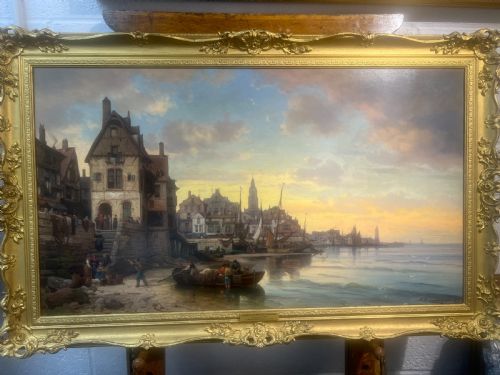
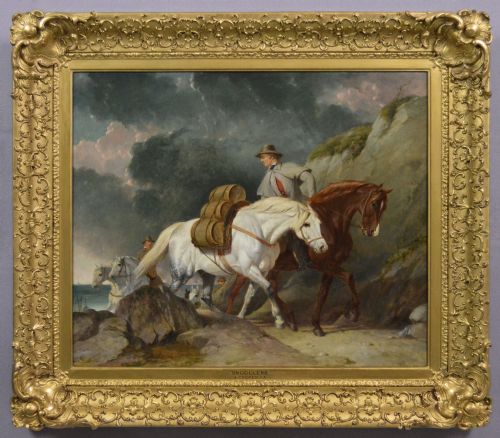
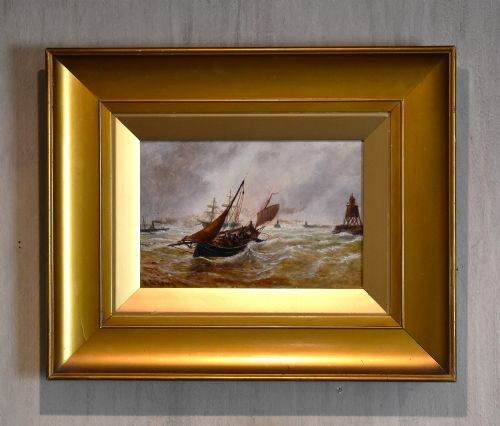
Nineteenth century coastal painting encompasses works depicting shores, harbours, fishing vessels and maritime scenes executed during the Victorian era and adjacent periods. These artworks range from domestic watercolours on paper to substantial oil paintings on canvas depicting British and continental locations.
The selections available lean heavily toward oil paintings and watercolours housed in gilt wood frames, capturing scenes from Filey, Whitby, the Isle of Wight and various continental harbours. Buyers encounter both signed works by known marine artists and accomplished unsigned compositions.
Materials and technique
Artists of this era utilised oil paint on canvas or wood panels, alongside watercolour pigment applied to paper. Canvas supports provide texture and depth for layered oils, while paper suits the translucent washes characteristic of maritime watercolours.
Framing forms an integral part of these pieces, with giltwood and gilt wood frames providing traditional enclosure. The physical structure typically involves stretcher frames for canvases and glass protection for paper watercolours.
Listings feature works spanning the nineteenth century into the early twentieth century, utilising oil on canvas, wood, and paper watercolour.
Distinctions in quality
Quality rests upon the artist's handling of light, atmosphere and maritime movement, distinguishing masterworks from routine studio output. Skilled brushwork captures the transient effects of sunrise, choppy seas and coastal weather with convincing spatial depth.
The preservation of the paint surface and the integrity of the original or period frame influence the standing of a piece. Works retaining their untouched canvas surfaces and period giltwood framing command greater attention from collectors.
Charles Euphraisie Kuasseg·Abraham Cooper RA·Bernard Benedict Hemy·Jean-Baptiste Olive·Thomas Bush Hardy·Thomas Rose Miles·William Edward Webb
The Nineteenth Century Coastal Painting Glossary
- Oil on canvas
- Pigment bound in drying oil applied to a woven fabric stretched across a wooden frame. This medium allowed artists to build rich textures and deep tones suitable for dramatic marine scenes.
- Watercolour
- Water-soluble pigment suspended in a fine medium, applied to paper. It produces luminous, transparent effects favoured for coastal sketches and atmospheric seascapes.
- Giltwood
- Wood carved and covered with a thin layer of gold leaf or metallic gilt. These ornate frames provide period context and complement the tones of the paintings they enclose.
- Marine art
- Artistic genre depicting ships, shipping, sea views and coastal activities. It forms the primary subject matter of maritime paintings from this century.
Nineteenth Century Coastal Painting: Frequently Asked Questions
How do I care for a coastal oil painting?
Keep the canvas away from direct sunlight and steady humidity levels to prevent cracking in the paint layer. Dust the surface gently with a soft, dry brush without applying pressure to the pigment.
Avoid using liquid cleaners on either the canvas or the gilt wood frame. Professional conservation should be sought if the paint surface requires cleaning or stabilization.
What subjects appear in these paintings?
Artists recorded busy harbours, fishing fleets, masted ships in choppy seas and quiet sandy shores. Scenes often feature local figures engaged in coastal trades like net hauling or boat building.
Locations range from British coastal towns such as Whitby and Filey to continental European harbours and waterscapes.
Are watercolours as durable as oils?
Watercolours on paper require protection behind glass to shield the pigments from atmospheric moisture and dust. They are more sensitive to light exposure than oil paintings on canvas.
Properly framed and kept out of direct sunlight, these works remain stable for generations.
How can I identify the period of a frame?
Period frames often display traditional gesso preparation and hand-carved ornamentation matching the Victorian era of the artwork. The backboards and fixings usually show age-appropriate oxidation and materials.
Original frames frequently bear minor wear consistent with age, which collectors value as a sign of authenticity.