


Nineteenth Century Coastal Landscape
A nineteenth century coastal landscape captures the light and weather of the shore through nineteenth-century oils and watercolours.
Nineteenth Century Coastal Landscape
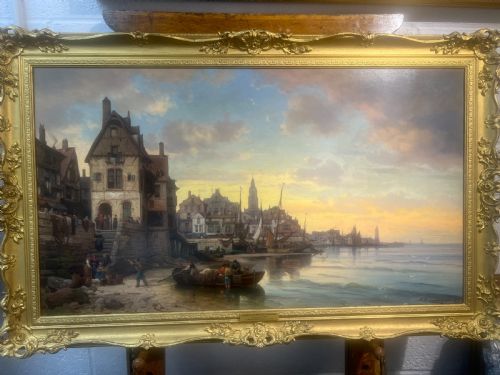
A nineteenth century coastal landscape presents maritime views, beaches, harbours, and fishing ports through the eyes of period artists. These works record the changing tides, shipping activity, and coastal paths from Britain, France, and Italy.
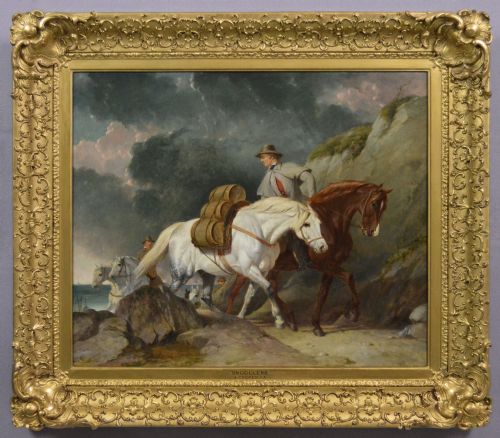
Most pieces on this page are oil paintings on canvas or watercolours on paper, often housed in period frames. The subjects range from bustling harbours with boats to quiet shores and cliff paths.
How they were made
Artists utilised oil paint on canvas or watercolour on paper to capture the luminosity of the sea and sky. Pigments were applied with brushwork that varied from tight academic detail to looser impressionistic strokes.
Frames of gilt wood and gesso were constructed to complement the paintings, utilising carved ornamentation and gold leaf to finish the piece.
Several artists captured horses working alongside smugglers and fishermen on the tide-swept shores.
What varies in quality
Quality rests in the artist's handling of light, atmosphere, and spatial depth within the coastal scene. Stronger works convey the motion of water and the expanse of sky with assurance.
The framing also influences the overall character, as original gilt wood frames with intact gesso enrich the presentation of the painting.
Abraham Cooper RA·Jean-Baptiste Olive·Charles Malfroy·Thomas Rose Miles·William Edward Webb
The Nineteenth Century Coastal Landscape Glossary
- Gesso
- A plaster-like mixture applied to wood frames as a base for gilding. It provides a smooth surface for intricate moulding.
- Gilt Wood
- Wood treated with a thin layer of gold leaf or metallic powder. This finish was standard for framing fine art of the period.
- Watercolour
- A paint consisting of colour suspended in a water-soluble binder, used on paper. It creates luminous and translucent effects.
- Post-Impressionism
- An art style following Impressionism that extends its boundaries while retaining a vivid use of colour. It appears in several continental works.
Nineteenth Century Coastal Landscape: Frequently Asked Questions
What subjects appear in these paintings?
These works depict harbours, fishing ports, beaches, and coastal paths with boats and shipping activity.
Scenes range from British coastal towns like Whitby and Filey to continental waters in France and Italy.
Are these works painted on canvas?
Many pieces utilise oil paint on canvas, while others are watercolour paintings on paper.
Both mediums capture the maritime atmosphere and light characteristic of the nineteenth century.
How do I identify the period?
Periods are identified through the artistic styles, such as British Impressionism and Victorian Romanticism, alongside the materials used.
Dates and artist signatures inscribed on the canvases or watercolours further confirm the era.
How should I display them?
These framed artworks suit wall display in spaces with controlled lighting to protect oil paint and paper from direct sun.
The existing gilt wood frames are designed to complement the palette of each coastal scene.