
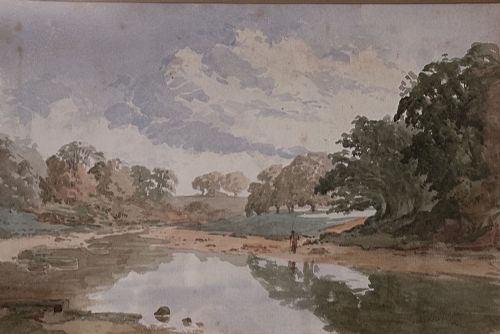


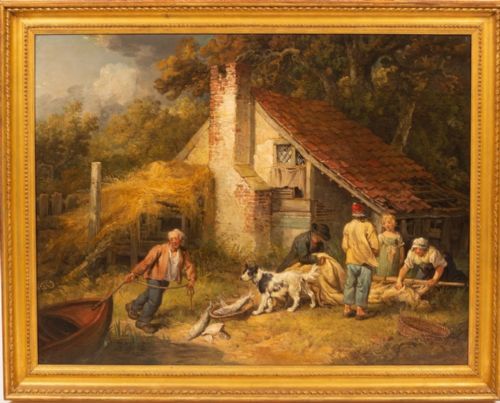


Fishermen Oil Artwork
These fishermen oil artwork pieces capture maritime life on canvas and panel, offering a glimpse into coastal scenes that collectors prize for their atmospheric depiction of working harbours and rivers.
Fishermen Oil Artwork
When you search for fishermen oil artwork, you encounter painted scenes depicting marine labourers, coastal harbours, and riverbanks at work. These pieces span from the nineteenth century through to the middle decades of the twentieth century, reflecting varied European artistic traditions.
You are most likely to meet nineteenth-century works and pieces from the 1920s, 1930s, and 1940s on this page. These range from French post-impressionist coastal views to British marine paintings and Victorian genre scenes.
The subjects focus on the daily labour of fishermen, whether packing for market, bringing in the catch, or navigating harbour scenes. Each canvas records a specific regional approach to light and water, from the Cornish coast to Normandy and the Côte d'Azur.
Materials and methods
These works utilise oil paint applied to canvas, wood panels, or wood boards to capture the texture of sea, sky, and coastal rocks. The application ranges from smooth academic brushing to the textured marks of post-impressionism.
Many of these paintings are housed in their original gilt wood or gilded frames, which complement the tonal palette of the oil paint. The combination of oil medium and wooden support has allowed these coastal scenes to endure across the centuries.
Several fishermen managed to haul their catch onto canvas without spilling a single drop of paint.
Assessing quality
The distinction between standard works and superior examples lies in the confidence of the brushwork and the handling of light across water and figures. A stronger painting conveys the atmospheric conditions of the harbour or river with economy and precision.
Compositional balance and the integration of the figures into their maritime environment separate more accomplished works from simpler decorative pieces. The relationship between the original frame and the canvas also contributes to the integrity of the piece.
Gustave Vidal·André Prévot-Valéri·James Kyd·Sonia Mervyn·Fred Dade
The Fishermen Oil Artwork Glossary
- Oil paint
- A slow-drying paint made by mixing pigments with oils such as linseed. This medium allows for rich colour blending and varied surface textures on canvas or panel.
- Canvas
- A heavy woven fabric stretched across a wooden frame to serve as a durable surface for oil painting. It remains the most common substrate for historical marine works.
- Post-Impressionism
- An art movement following impressionism that extends its parameters while rejecting its limitations. Artists working in this style focus on expressive brushwork and symbolic colour.
- Genre painting
- The pictorial representation of scenes from everyday life. In this context, it depicts fishermen and coastal workers engaged in daily tasks.
Fishermen Oil Artwork: Frequently Asked Questions
How do I date an antique fishing painting?
Dating relies on stylistic evidence, stretcher construction, and canvas preparation methods typical of specific periods like the nineteenth century or the 1930s. Signatures and framing materials often provide additional clues to the era of creation.
Examining the back of the panel or canvas frequently reveals historical labels, stamps, or dealer marks that help narrow down the decade.
Where were these coastal scenes typically painted?
These works originate from various European coastal and river locations, including Cornish fishing ports, the Normandy coast, and the Côte d'Azur. Artists often travelled to working harbours to capture authentic maritime labour.
Regional schools, such as the Newlyn School or the Hague School, developed distinct palettes influenced by the local light and weather conditions.
How should I care for an oil painting on wood panel?
Wood panels require stable environmental conditions with minimal fluctuations in humidity and temperature to prevent warping or cracking of the support. Keep the piece away from direct sunlight and heat sources.
Dusting should be performed gently with a soft, dry brush, avoiding any moisture or cleaning solutions on the painted surface.
What is the difference between canvas and panel works?
Canvas offers flexibility and resilience on a stretched wooden frame, allowing for larger compositions and textured impasto application. Wood panels provide a rigid, smooth foundation favoured by artists seeking fine detail.
Both supports require different conservation considerations, particularly regarding how the material responds to atmospheric changes over time.