

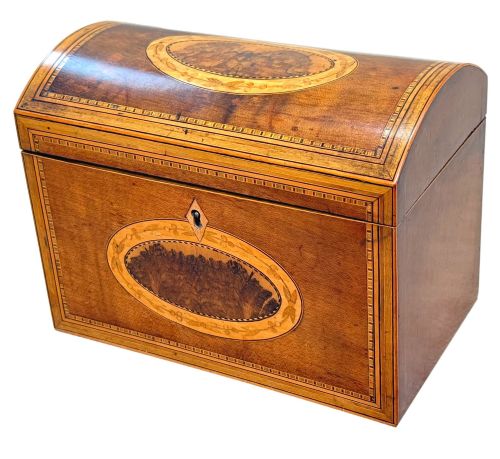
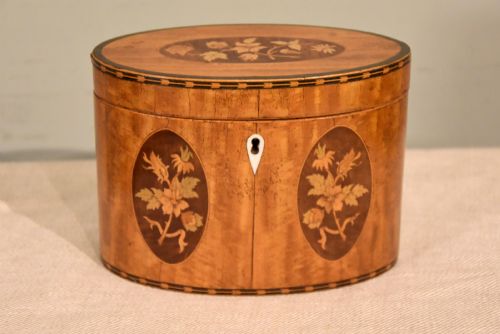


Neoclassical Wooden Box
These neoclassical wooden box pieces bring balanced proportion and fine inlay into a room, offering both decorative presence and storage utility.
Neoclassical Wooden Box
The versions you are most likely to meet on this page rely on contrasting veneers and precise geometric stringing. They represent a tradition of functional storage elevated by ornamental woodwork.
How they were made
Cabinet makers utilised dense hardwoods such as mahogany, satinwood, and harewood as the primary structural foundations. These timbers provided stable surfaces capable of taking sharp mouldings and fine inlay work.
Craftsmen applied contrasting woods like boxwood and ebony alongside bone and brass to create crisp classical motifs and banded borders. Surfaces were smoothed and polished to highlight the natural grain patterns of the figured timber.
Neoclassical Wooden Box Retail Price Guide 2026
Typical asking prices for neoclassical wooden box among the pieces listed under this phrase on Sellingantiques today, from the lower quarter to the upper quarter. They describe what is for sale here now, not the wider market.
Listings feature items spanning the eighteenth century, the Regency era, and the Edwardian period, constructed in mahogany, satinwood, and harewood.
What varies in quality
The standard of a piece depends largely on the precision of the timber selection and the execution of the inlay. Superior examples display tightly figured grains and meticulously fitted contrasting stringing that remains flush with the surface.
Proportion and the handling of classical details set finer items apart from simpler utilitarian boxes. A thoughtful arrangement of veneers elevates a standard storage vessel into a composed work of decorative art.
The Neoclassical Wooden Box Glossary
- Satinwood
- A pale, lustrous timber native to tropical regions, frequently utilised for its golden sheen and smooth texture in fine cabinet making.
- Inlay
- A technique where pieces of contrasting material are inserted into a recessed wooden surface to form a decorative pattern.
- Stringing
- A thin, narrow line of contrasting wood or bone embedded into the surface of furniture to outline panels and borders.
- Veneer
- A thin layer of finely figured wood applied over a secondary timber base to provide a decorative exterior appearance.
- Caddy
- A small container originally designed for storing tea leaves securely under lock and key during periods when tea was a luxury.
Neoclassical Wooden Box: Frequently Asked Questions
What is a neoclassical wooden box used for?
These boxes primarily served domestic storage functions, holding high-value commodities such as tea leaves, cutlery, or personal trinkets.
Today, they function as decorative objects on side tables while continuing to provide discreet storage for small household items.
How do I identify a Georgian box?
Georgian pieces typically display restrained classical proportions, rectilinear or oval forms, and symmetrical veneer patterns.
Makers from this era favoured woods like satinwood and mahogany, often accented with simple boxwood stringing rather than heavy carving.
What materials are common in these boxes?
The construction relies on hardwoods such as mahogany and satinwood, supported by secondary timbers like oak or pine.
Decoration frequently incorporates contrasting elements including ebony, boxwood, bone, and brass fittings to highlight the classical geometry.
How do I care for wooden boxes?
Keep the wood away from direct heat sources and strong sunlight to prevent the timber veneers from drying out or splitting.
Apply a light application of appropriate furniture wax occasionally to maintain the lustre of the polished surface.