

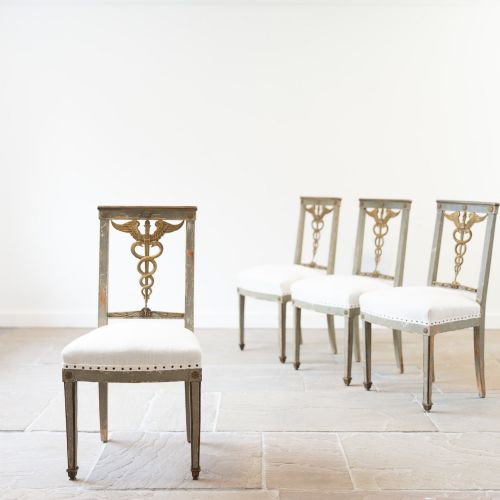
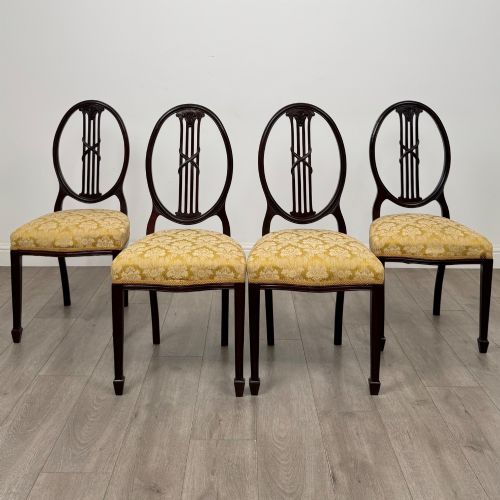
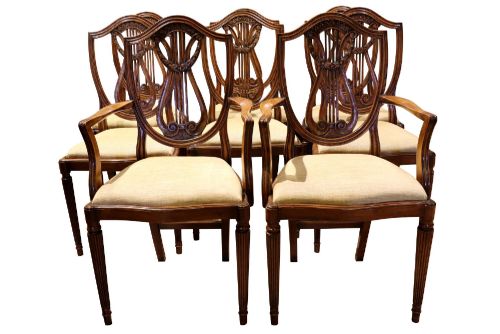
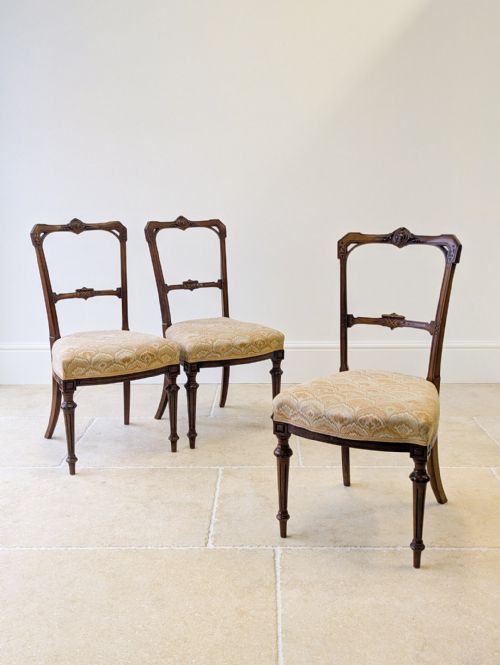


Neoclassical Side Chairs Set
These neoclassical side chairs set options offer balanced proportion and restrained ornament, bringing architectural clarity to a dining room.
Neoclassical Side Chairs Set
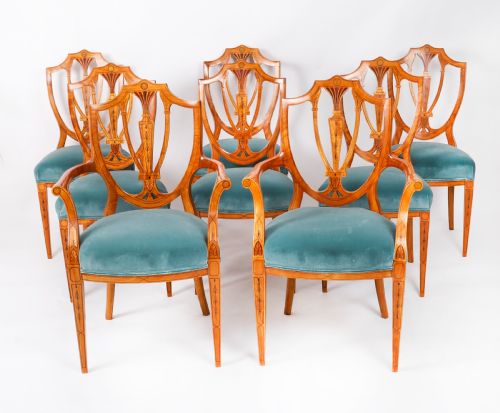
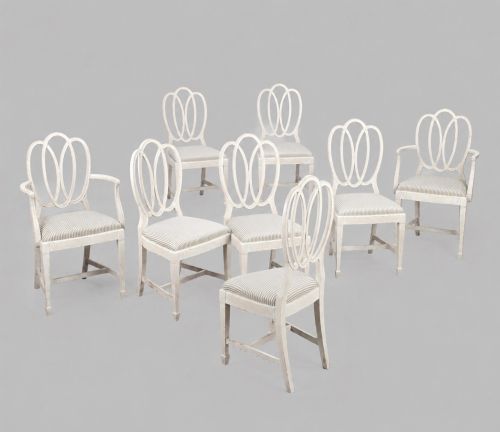
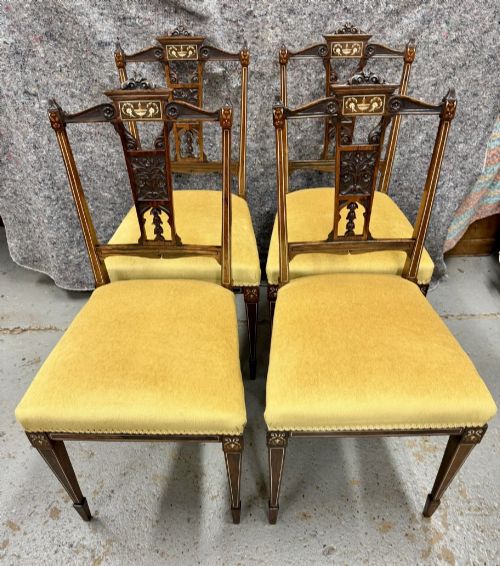
A neoclassical side chairs set brings together matching seating designed with strict symmetry, straight tapered legs and classical motifs drawn from ancient architecture. You will frequently find these groups emerging from later revival periods such as the Edwardian era, alongside pieces dating back to the nineteenth century and the Georgian period.
The configurations vary considerably in size, ranging from intimate sets of three or four up to grand dining sets of ten or twelve pieces. Alongside formal dining chairs, you will encounter salon chairs and oval-backed variants that serve well in reception spaces.
The design vocabulary draws heavily on established eighteenth-century idioms, taking shape through Hepplewhite style shieldbacks, Sheraton style inlay, Louis XVI painted frames and Gustavian influences. These pieces offer a cohesive look around a table while retaining the lighter proportions characteristic of neoclassical seating.
Materials and construction
The framework of these chairs relies predominantly on dense timbers such as mahogany and satinwood, selected for their stability and fine grain. Cabinetmakers also utilised painted wood and carved surfaces, applying subtle finishes that complement the restrained classical lines.
Upholstery forms an integral part of the construction, with seats and backs traditionally finished in fabric, velvet or leather. Skilled craftspeople incorporated cane work into specific continental frames to provide lightweight structural support and visual texture.
Neoclassical Side Chairs Set Retail Price Guide 2026
Typical asking prices for neoclassical side chairs set among the pieces listed under this phrase on Sellingantiques today, from the lower quarter to the upper quarter. They describe what is for sale here now, not the wider market.
Listings feature mahogany, satinwood, painted wood and leather, shaped into Hepplewhite, Sheraton, Louis XVI and Gustavian styles.
Assessing quality in the range
The distinction between ordinary and exceptional sets rests on the crispness of the carving, the precision of the timber inlay and the integrity of the frame construction. Superior examples display clean joinery, balanced proportions and harmonious grain matching across every chair in the group.
Provenance and maker attribution elevate certain sets, particularly when linked to documented firms or notable houses. The condition of original painted surfaces, where present, alongside the fidelity of revival styles to their historical precedents, further separates standard production from finer work.
Cowtan & Sons·Brights of Nettlebed
The Neoclassical Side Chairs Set Glossary
- Lyre Back
- A chair back featuring an open splat shaped like the ancient musical instrument. This motif appears frequently in classical revival dining seating.
- Caning
- Woven rattan or cane material used to form light, supportive panels for seats or backs. It provides both flexibility and a decorative open texture.
- Inlay
- Decorative wood or contrasting material fitted into recesses flush with the surface. It defines panels and outlines structural members on finer dining chairs.
- Tapered Leg
- A support column that diminishes in thickness toward the foot. This linear element is a defining characteristic of neoclassical furniture design.
Neoclassical Side Chairs Set: Frequently Asked Questions
How many chairs come in a set?
Sets vary widely, ranging from intimate groupings of three or four chairs up to larger dining sets containing ten or twelve matching pieces.
Buyers should check the specific listing to confirm the exact count, as numbers differ between dining rooms and smaller salon configurations.
What is the difference between Hepplewhite and Sheraton styles?
Hepplewhite designs often feature shield-shaped backs and graceful curving outlines, whereas Sheraton pieces favour rectangular or oval backs with straight, precise geometry.
Both styles share neoclassical proportions but express classical ornament through distinct structural silhouettes.
Can these chairs be used daily?
These pieces were built for functional use around a dining table or within a reception room, utilising durable hardwoods like mahogany.
While robust, their age and delicate inlay require sensible care and occasional checks on frame stability to ensure longevity.
How do I identify a revival set from an earlier period?
Revival sets often display the machine-finished precision and specific timber handling characteristic of nineteenth-century or Edwardian workshops.
Comparing construction joints, wear patterns and secondary woods helps distinguish eighteenth-century originals from later interpretations.