

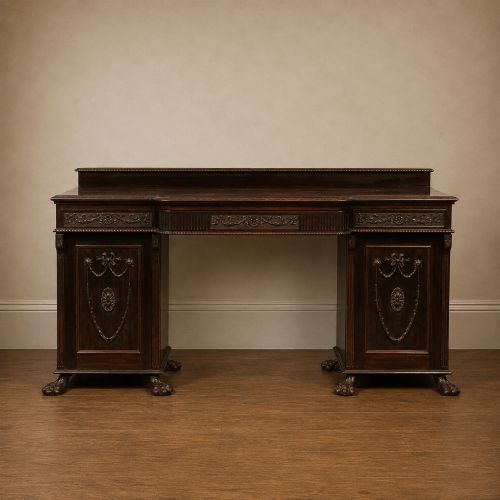
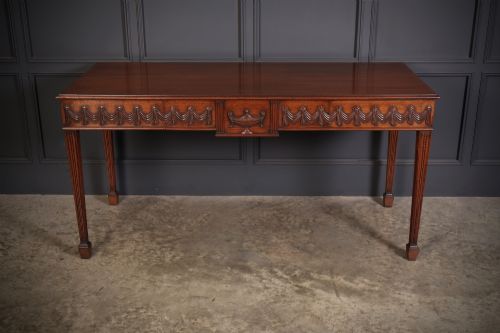
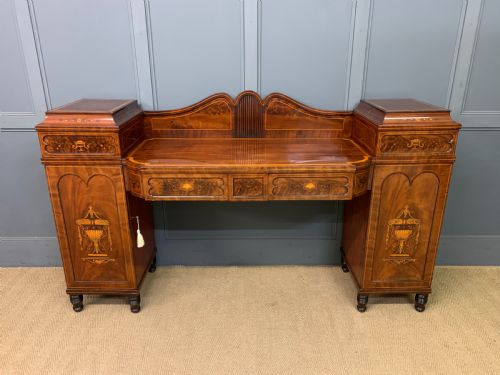


Neoclassical Serving Table
These neoclassical serving table examples bring architectural clarity and refined proportion to a dining room or hall.
Neoclassical Serving Table
A neoclassical serving table combines architectural lines with balanced proportions to anchor a formal dining space or grand hallway. When you search for a neoclassical serving table, you encounter console tables, sideboards, and side tables that draw on classical antiquity through symmetry and restraint.
The pieces on this page span from the eighteenth century through to the early twentieth century, taking in George III, Regency, and Edwardian revivals. Forms range from demilune boards to serpentine console tables and breakfront sideboards.
Makers and workshops of the eighteenth and nineteenth centuries such as Gillows, Marsh and Tatham, and Wilkinson London produced notable variants in this taste. Revival pieces from the Edwardian era and the nineteen-twenties continue this architectural vocabulary.
Judging Quality
Quality rests upon the crispness of the carving and the subtlety of the timber figure rather than ornamental excess. Superior examples display harmonious proportions where every decorative element relates logically to the structural frame.
The integration of marquetry or inlay distinguishes the finer workshop output from simpler commercial production. Timber selection matters immensely, with rich mahogany grain and carefully chosen stringing elevating the presence of the piece.
Neoclassical Serving Table Retail Price Guide 2026
Typical asking prices for neoclassical serving table among the pieces listed under this phrase on Sellingantiques today, from the lower quarter to the upper quarter. They describe what is for sale here now, not the wider market.
Lord Leverhulme once owned one of these serving tables, proving that neoclassical dining furniture belongs both in stately homes and modern halls.
Gillows·Marsh and Tatham·Wilkinson London
The Neoclassical Serving Table Glossary
- Demilune
- Half-moon shaped furniture designed to stand flush against a wall. This format suited smaller dining rooms and entrance halls during the eighteenth century.
- Serpentine
- A curved line featuring a convex centre flanked by concave ends, or vice versa. This shaping added visual movement to heavy timber furniture.
- Breakfront
- A piece of furniture where the central section projects forward from the flanking wings. It created depth and shadow across large sideboards and serving tables.
- Paterae
- Classical decorative motifs resembling circular rosettes or oval medallions. Carvers applied them frequently to the corners of friezes and tabletops.
- Marquetry
- The art of forming decorative patterns using thin veneers of different woods. Craftsmen utilised this technique to create elaborate classical urns and scrolling foliage.
Neoclassical Serving Table: Frequently Asked Questions
What is a neoclassical serving table?
A neoclassical serving table is a formal piece of furniture designed for dining rooms or halls, influenced by the art and architecture of classical antiquity. These tables typically feature straight tapered legs, restrained carved details, and symmetrical layouts.
They emerged strongly during the eighteenth century and saw revivals through the Victorian and Edwardian periods, often taking the form of sideboards, console tables, or side tables.
How were serving tables used historically?
Historically, serving tables stood against dining room walls to hold dishes, silver, and wine coolers during large meals. Servants plated food from these surfaces rather than crowding the main dining table.
Over time, they evolved into display pieces for silver and porcelain, eventually serving as sophisticated sideboards or console tables in entrance halls.
How do I live with a serving table?
A serving table works well in a dining room, hallway, or drawing room as a focal point against a plain wall. Its shallow depth ensures it leaves walkways clear while offering a useful surface for lamps, books, or decorative objects.
Pairing the table with a mirror or a pair of sconces enhances the architectural symmetry inherent in the neoclassical style.
How can I tell the original period?
Determining the period requires examining timber construction, tool marks on secondary woods, and the specific interpretation of neoclassical motifs. Eighteenth-century pieces often display hand-cut joinery and native timber framing beneath the mahogany veneers.
Revival pieces from the Edwardian era or the nineteen-twenties often use machine-cut elements and show a slightly different approach to historical accuracy in their carving styles.