

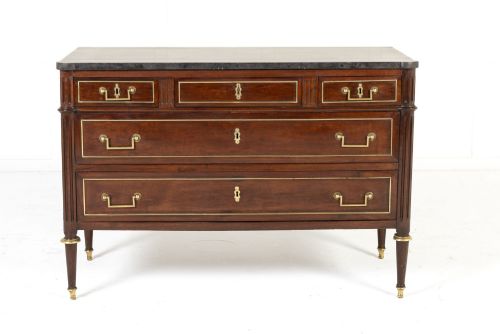
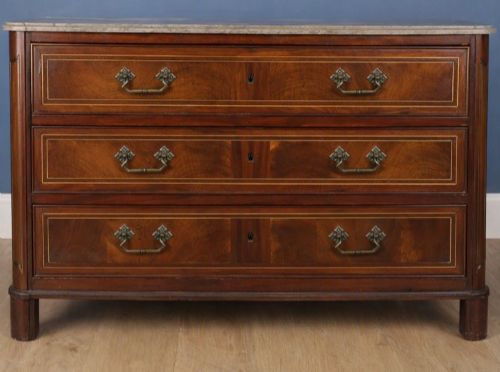
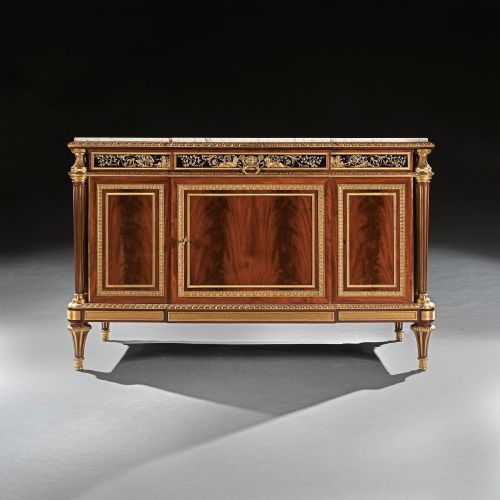
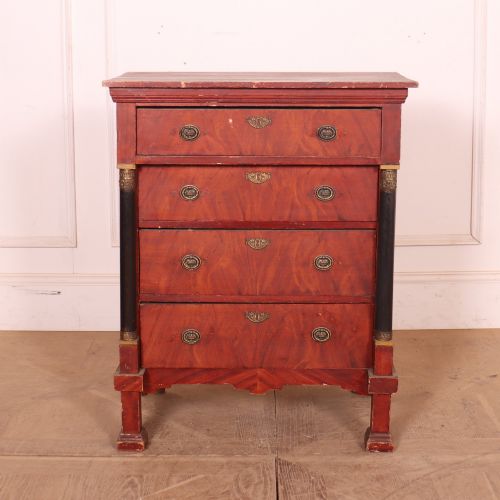
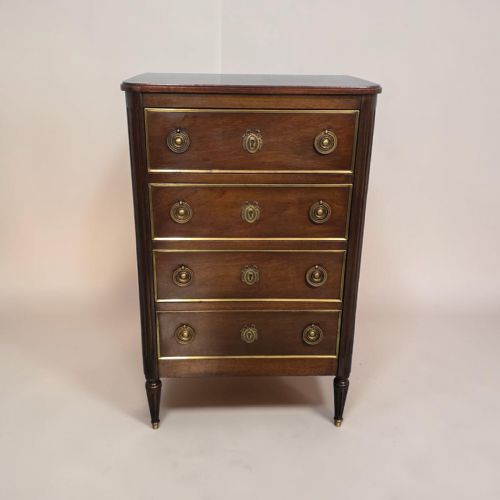


Neoclassical Mahogany Commode
A neoclassical mahogany commode brings architectural restraint and rich timber into a room, offering grand storage through classic proportions.
Neoclassical Mahogany Commode
A neoclassical mahogany commode is a refined storage piece that draws on classical antiquity, frequently taking the form of a chest of drawers, side cabinet, or commode. These pieces emerge across the eighteenth and nineteenth centuries, spanning French Empire, Louis XVI, Sheraton Revival, and Dutch Neoclassical styles.
The versions most commonly met on this page combine figured mahogany timber with contrasting satinwood, boxwood, or marquetry inlay. Many examples feature marble tops and architectural pilasters, reflecting the formal design vocabulary of Georgian, Victorian, and continental workshops.
Judging Quality
The finest examples display meticulous matching of mahogany veneer grains across the drawer fronts and sides, ensuring visual continuity. Superior pieces also feature crisp, finely chased ormolu mounts rather than plain cast metal.
Structural integrity reveals itself in the drawer construction and the thickness of the marble top. Pieces bearing signatures or attributed to established makers like Henry Dasson or Mon Krieger demonstrate higher levels of cabinet-making skill.
Neoclassical Mahogany Commode Retail Price Guide 2026
Typical asking prices for neoclassical mahogany commode among the pieces listed under this phrase on Sellingantiques today, from the lower quarter to the upper quarter. They describe what is for sale here now, not the wider market.
One listed piece served a dual domestic life as a cot drawer, proving that even neoclassical grandeur has occasionally doubled as nursery storage.
Henry Dasson·Mon Krieger·Weisweiler·Riesener
The Neoclassical Mahogany Commode Glossary
- Commode
- A low chest of drawers or cabinet designed for domestic storage, often standing on relatively high legs. The form originated in France before spreading across European cabinet-making.
- Ormolu
- Gilt-bronze decorative mounts applied to furniture. This technique involves coating cast bronze in a gold amalgam and heating it to leave a rich finish.
- Marquetry
- The art of applying small pieces of veneer to a structure to form decorative patterns and pictorial scenes. Makers use contrasting woods like satinwood and boxwood within the mahogany ground.
- Demi-Lune
- Half-moon shaped furniture, typically seen in side cabinets and commodes designed to sit flush against a wall. This profile became popular during the Sheraton Revival period.
- Parquetry
- Geometric wood inlay forming repetitive patterns such as cubes or chequers across the surface of the cabinet. It relies on precise cutting of timber veneers.
Neoclassical Mahogany Commode: Frequently Asked Questions
Where did neoclassical commodes originate?
Neoclassical commodes developed across Britain, France, Holland, and Italy during the eighteenth century as taste shifted away from ornate rococo designs toward the straight lines of classical antiquity.
French and Dutch makers favoured architectural symmetry, ormolu mounts, and rich mahogany veneers, while British cabinet makers interpreted the style through Sheraton and Adam influences.
How do I style a mahogany commode?
These pieces suit both traditional and contemporary interiors, where their dark timber and polished marble tops provide a strong visual anchor against neutral walls.
Use the surface for lamps or decorative objects, allowing the figured wood and brass mounts to draw the eye without cluttering the room.
How do I tell Louis XVI from Empire style?
Louis XVI pieces display restrained symmetry, fluted columns, and lighter proportions, reflecting an earlier eighteenth-century interest in classical archaeology.
Empire style commodes, popular in the nineteenth century, are heavier and more imposing, often featuring bold ormolu military mounts and darker mahogany surfaces.
What is Sheraton Revival furniture?
Sheraton Revival pieces date from the late nineteenth century and draw inspiration from the late eighteenth-century designs of Thomas Sheraton.
They are characterised by satinwood banding, painted details, and delicate tapered legs, offering a lighter alternative to heavier Victorian furniture.