


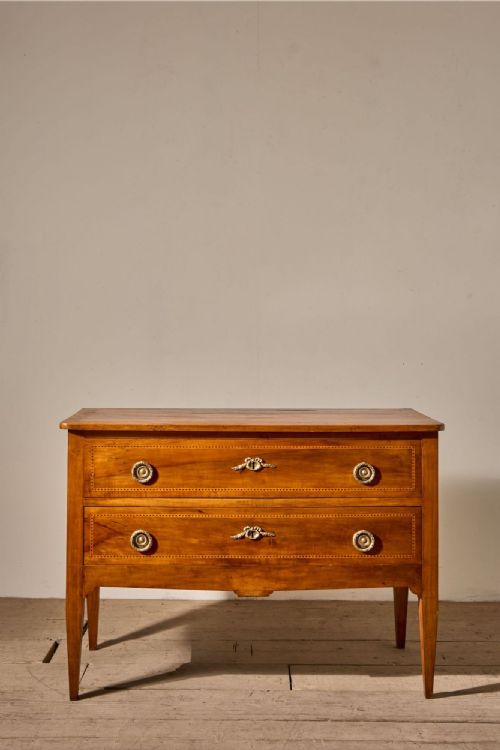


Neoclassical French Chest
A neoclassical french chest brings architectural order and refined proportions to a room, grounding the space with classical restraint.
Neoclassical French Chest
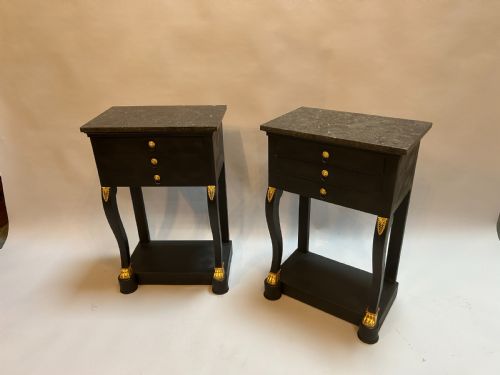
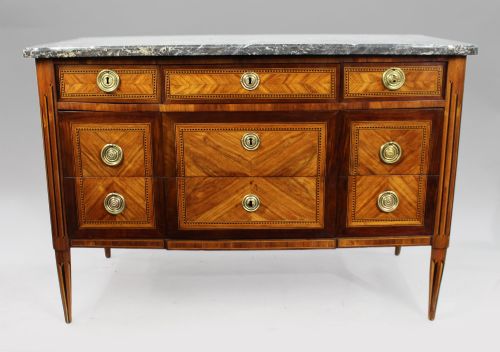
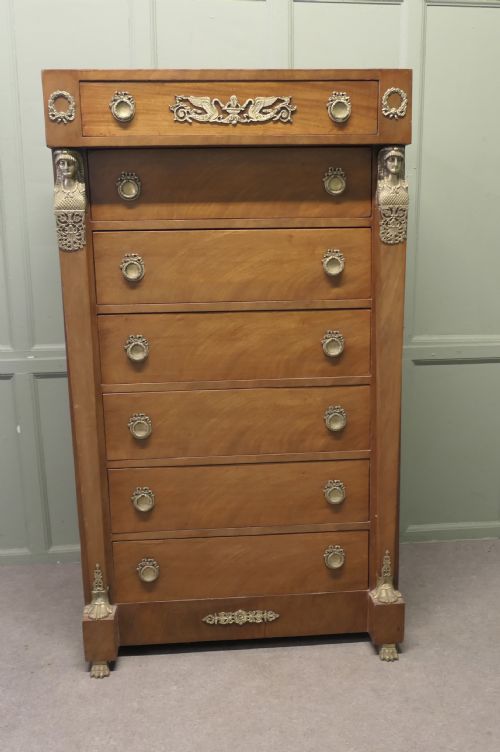
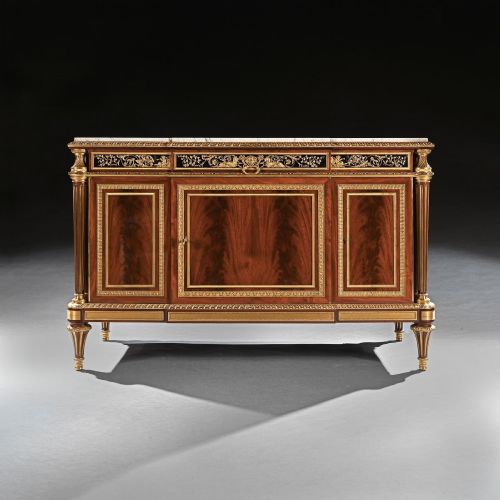
A neoclassical french chest encompasses commodes, bedside chests, and secretaire chests dating from the eighteenth century through the early twentieth century. These pieces display the architectural symmetry and straight lines that defined the shift away from ornate rococo curves towards classical antiquity.
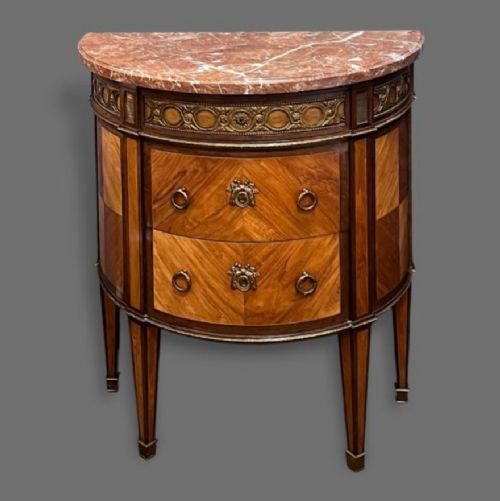
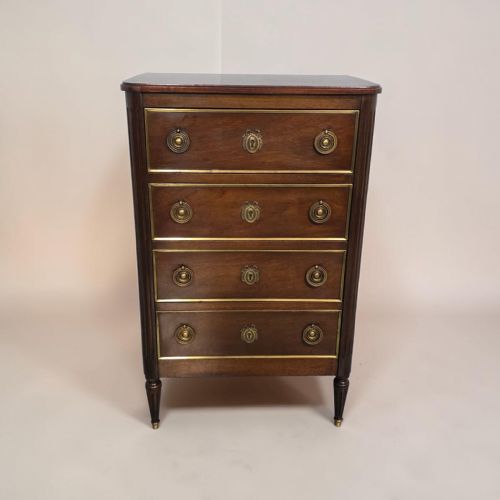
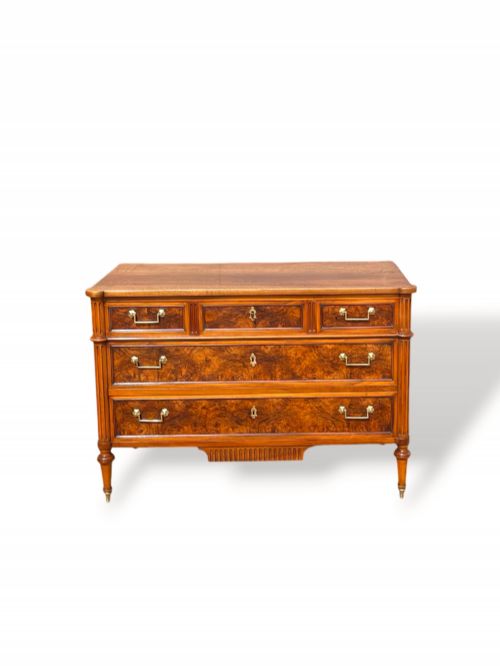
The commode stands as the most frequent form encountered, alongside bedside cabinets and taller chests of drawers. Examples range from provincial walnut and painted surfaces to grander urban pieces veneered in mahogany, satinwood, and harewood.
Originating predominantly from French workshops and provincial regions such as Alsace, these pieces reflect the enduring influence of Louis XVI, French Empire, and transitional neoclassical design principles.
Construction and Materials
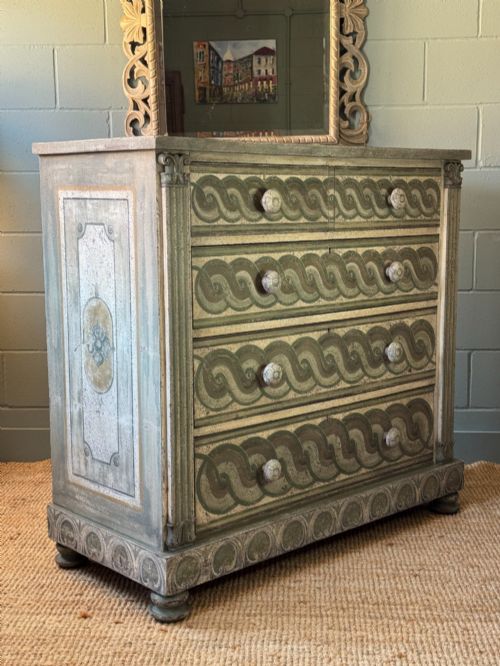
Cabinetmakers constructed carcass frames in native and imported timbers, utilising walnut, mahogany, cherrywood, oak, and satinwood, frequently laid with parquetry and geometric veneer patterns. Painted finishes appear across both provincial furniture and later interpretations.
Marble tops in various colours provide the characteristic heavy, finished surface on commodes and bedside cabinets, often cut with moulded edges to follow the straight or demi-lune contours of the piece.
Cast bronze and brass mounts, fire-gilded as ormolu, accent key corners, drawer pulls, and aprons on formal Empire and Louis XVI pieces, fixed through the wood with threaded pins.
Several chests carry the ghosts of past workshops, where anonymous hands polished satinwood drawers destined for Parisian salons.
Evaluating Quality
Quality rests in the precision of the cabinetmaker's joinery, the crispness of cast ormolu mounts, and the grain selection within the wood veneers or parquetry layouts. Finer pieces demonstrate seamless integration between the marble slab and the wooden frame beneath.
Finer examples show meticulous attention to secondary timbers inside drawer linings and backboards, while lesser pieces rely on simpler construction methods and heavier, less refined surface applications.
Henry Dasson·Weisweiler·Mon Krieger·Riesener
The Neoclassical French Chest Glossary
- Commode
- A low chest of drawers or cabinet developed in France during the seventeenth century. The form remained a staple of formal and provincial neoclassical interior design.
- Ormolu
- Gilded bronze mounts applied to furniture. Makers used mercury gilding to achieve a deep, durable metallic lustre on decorative hardware.
- Parquetry
- Geometric patterns formed by fitting small pieces of veneer together. Cabinetmakers arranged contrasting woods like mahogany and satinwood to create optical depth on drawer fronts.
- Demi-lune
- A half-moon shape used for the footprint and top of specific commodes. This curved front required precise bending of rails and tailored marble slabs.
- Secretaire chest
- A chest of drawers incorporating a fitted writing drawer with a drop-front. It combined the storage capacity of a commode with a functional writing surface.
Neoclassical French Chest: Frequently Asked Questions
What is a neoclassical french chest?
A neoclassical french chest is a storage piece, typically a commode or bedside cabinet, built according to classical architectural rules of symmetry, straight lines, and restrained ornament.
These pieces span the eighteenth, nineteenth, and early twentieth centuries, reflecting changing interpretations of ancient Greek and Roman design.
How were marble tops used?
Marble slabs functioned as durable, elegant working surfaces on top of commodes and bedside cabinets. They were selected to complement the wood veneers or painted finishes of the carcass.
Heavier marble tops rested directly on the wooden frame, sometimes secured with rebates or moulding edges following the contour of the chest.
Where were these chests placed?
Historically, these chests served functional storage roles in bedrooms, salons, and formal hallways. Their finished backs and refined surfaces allowed them to sit prominently against walls or act as side cabinets.
Today, they function similarly in modern interiors as statement storage pieces that anchor a room with classical proportion.
How do I identify the period?
Period identification relies on examining construction techniques, timber choices, and stylistic vocabulary. Eighteenth-century pieces often display hand-cut dovetails and regional timbers alongside sophisticated parquetry.
Nineteenth- and early twentieth-century examples frequently reproduce earlier Louis XVI or Empire styles, utilising machine-assisted elements while maintaining traditional joinery methods.