
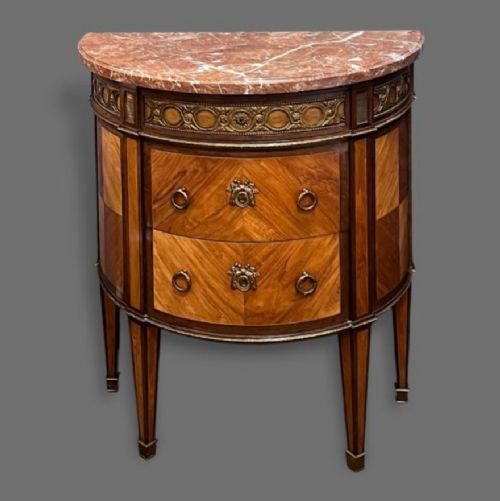


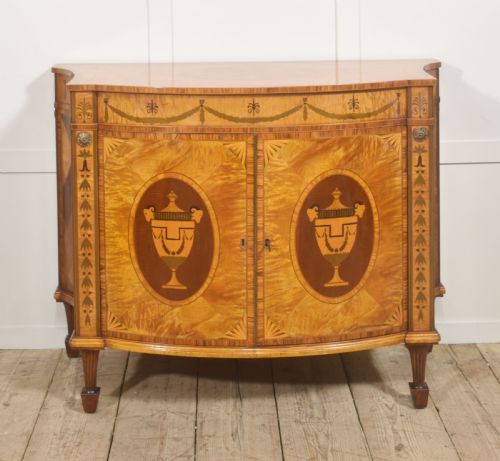


Demi Lune Side Cabinet
A demi lune side cabinet brings half-circle elegance to a room, offering practical storage against a wall without dominating the floor space.
Demi Lune Side Cabinet
When searching for a demi lune side cabinet, buyers encounter half-moon console tables, commodes, and cupboards designed to fit flush against flat walls. These semicircular storage pieces appear frequently in satinwood, mahogany, and walnut from periods spanning the eighteenth, nineteenth, and early twentieth centuries.
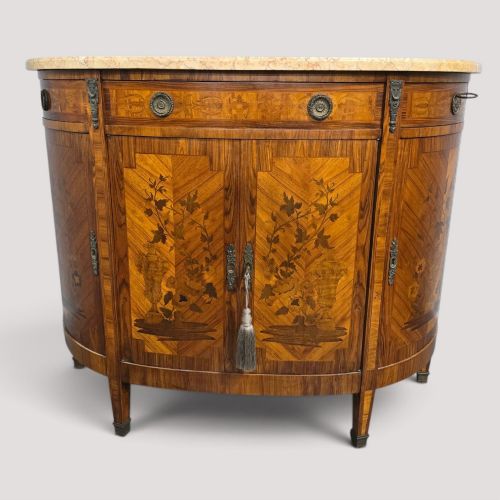
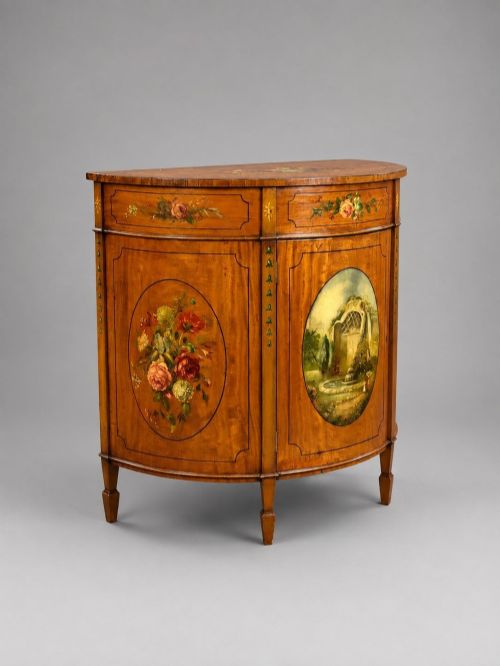
The evidence shows a strong representation of Sheraton Revival and Edwardian pieces alongside eighteenth-century Georgian and Dutch examples. French and Italian versions frequently incorporate marble tops and marquetry, while British makers favoured painted panels and figured timbers.
Object types range from tall bedside cabinets and crystal vitrines to large sideboards and commodes. The half-circle footprint makes these items suitable for hallways, drawing rooms, and dining spaces where depth is limited.
Materials and Construction
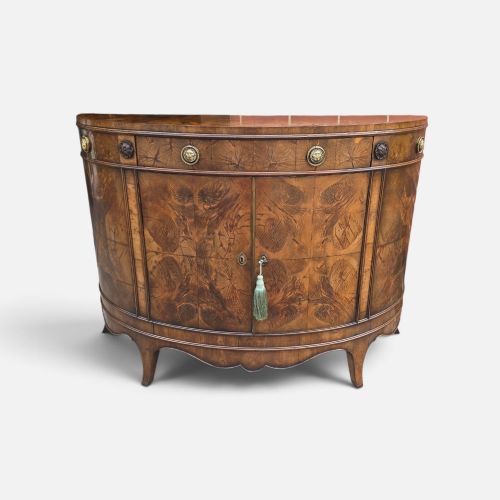
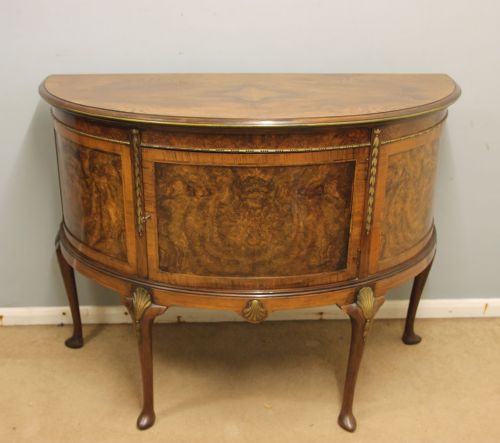
Cabinetmakers utilised dense hardwoods such as mahogany and walnut for structural stability, applying decorative veneers like satinwood, burr yew, and burr elm across the curved drawer fronts and doors. Marquetry inlays of boxwood and other contrasting timbers form elaborate classical urns, floral motifs, and geometric borders.
Many nineteenth and twentieth-century examples incorporate heavy marble tops, often white or veined grey, fitted precisely to the curved stone edge of the carcass. Fine brass mounts, handles, and sabots accent the feet and corners of French Louis XVI style and Neoclassical pieces.
Tambour doors, painted classical panels, and hand-brushed Chinoiserie finishes demonstrate the diverse specialist skills employed in their construction. Carved details in the styles of Chippendale and Queen Anne appear on supporting legs and aprons.
Sheraton Revival, Neoclassical, and French Louis XVI styles dominate the decorative vocabulary across available side cabinets.
Craftsmanship and Proportion
Quality rests upon the precision of the curved joinery and the selection of figured veneers. Superior examples display seamless matching of grain across the semi-circular sweep of the doors and drawers.
The sophistication of the painted or inlaid decoration distinguishes standard production from exhibition pieces. Finer cabinets integrate hand-painted classical panels and intricate marquetry rather than simpler stencilled designs.
Original hardware, sound marble slabs without repairs, and the crisp execution of carvings indicate higher workshop standards. The reputation of makers such as Edwards and Roberts or Maple & Co further elevates a piece.
Edwards and Roberts·Maple and Co·Pietro Ferrario·Waring and Gillow·Wylie and Lochhead·Wright and Mansfield·Shoolbred
The Demi Lune Side Cabinet Glossary
- Demi-lune
- A half-moon shape used to describe tables and cabinets with a flat back and a curved front. This configuration allows the furniture to stand flush against a wall.
- Marquetry
- The art of applying pieces of veneer to a structure to form decorative patterns and pictures. Craftsmen use various tinted woods to create contrasting tonal effects.
- Commode
- A low chest of drawers or cabinet with doors, often used as a side table. In continental pieces, this term frequently describes elaborate decorative storage units.
- Sabot
- A metal sleeve fitted to the foot of a piece of furniture for protection and decoration. These mounts are commonly cast in brass and finished with gilding.
- Tambour
- A surface constructed of narrow vertical strips of wood glued to a canvas backing, allowing doors to slide around curved tracks. This technique appears on eighteenth-century cupboards.
Demi Lune Side Cabinet: Frequently Asked Questions
Where should I place a demi lune side cabinet?
These semicircular pieces suit narrow hallways, landings, and entrance spaces where a rectangular table would project too far into the walkway. They also function effectively against dining room walls for serving or in living rooms beneath mirrors and artwork.
The flat back sits securely against the plaster, while the curved front softens the geometry of a room. Bedside versions provide compact surface space and enclosed storage in smaller bedrooms.
How do I identify the period of a cabinet?
Eighteenth-century examples often feature solid mahogany or burr timbers with understated stringing and hand-cut dovetails. Edwardian and Sheraton Revival pieces from around nineteen hundred frequently showcase painted satinwood, delicate floral swags, and neoclassical panels.
Twentieth-century reproductions and adaptations adopt earlier styles like Chippendale and Louis XVI, but timber preparation, internal construction methods, and secondary woods usually reveal the later manufacturing date.
Are marble tops original to these cabinets?
Marble tops are common on nineteenth and twentieth-century French and Italian commodes, console tables, and side cabinets. They provided a durable, cool surface for serving drinks or displaying decorative objects.
When examining a piece, check that the marble edge follows the exact curve of the wooden carcass beneath. Variations in thickness and veining help confirm whether the stone slab belongs to the original construction.
How do I care for satinwood and marquetry?
Satinwood and delicate marquetry veneers require protection from direct sunlight to prevent fading and discoloration of the tinted timbers. Dusting with a soft, dry cloth maintains the finish without moisture damage.
Avoid placing damp items or unsealed planters directly onto the polished wood or marble surfaces. Application of traditional beeswax helps nourish old veneers and preserves the historical sheen.