


Neoclassical Demilune Table
These neoclassical demilune table pieces bring classical symmetry to a room, offering the half-moon shape that fits neatly against a wall.
Neoclassical Demilune Table
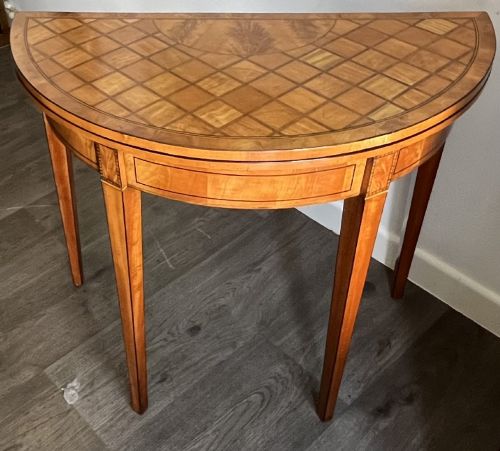
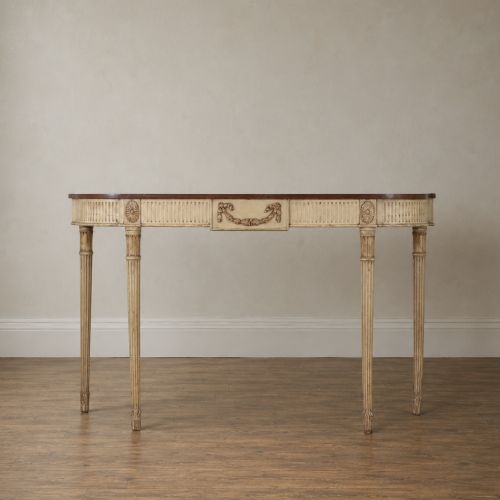
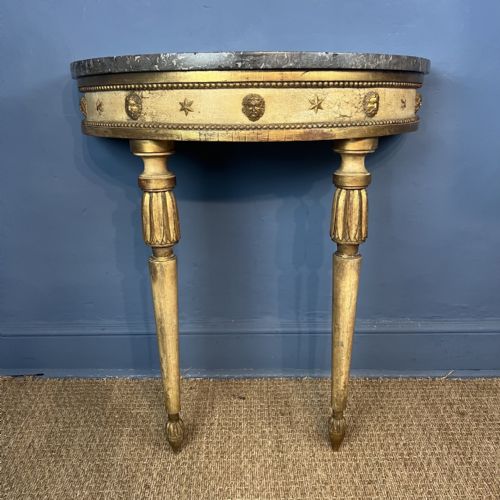
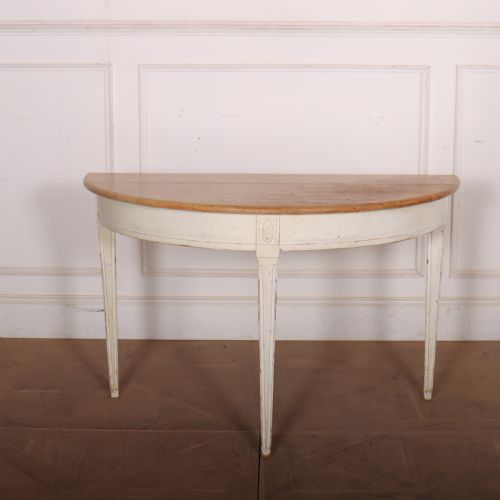
A neoclassical demilune table presents a semi-circular footprint designed to stand flush against a wall in a hallway or drawing room. When exploring this selection, buyers frequently encounter console tables, card tables, and pier tables taking this half-moon form.
The pieces span periods from the eighteenth century through the nineteenth century, including Georgian, Regency, and later revival eras. English, French, Italian, Dutch, and Swedish workshops all contributed to this diverse group of semicircular furniture.
Makers utilised various formats, producing fold-over tops for games, marble tops for display surfaces, and painted finishes for decorative interiors. The configuration ranges from simple side tables to grand console cabinets intended for formal spaces.
Materials and Construction
Cabinet makers built the primary carcass using timbers such as mahogany, satinwood, rosewood, and oak. These woods provided a stable foundation for cross-banding, veneers, and intricate inlay work.
Surfaces often feature painted wood and parcel gilt, alongside applied brass mounts and marble tops. Artisans employed carving and specialised finishing techniques to achieve the restrained classical ornamentation characteristic of the style.
Some card tables hide secret compartments beneath the fold-over top for storing loose coins.
Markers of Quality
Excellence in these tables rests upon the selection of timber and the precision of the joinery. Finer examples display carefully matched veneers, such as satinwood paired with rosewood cross-banding, executed by skilled hands.
The refinement of the carved details and the integrity of the painted or gilt decoration distinguish superior pieces. Original surfaces and well-fitted folding mechanisms on card tables elevate the standing of an individual item.
The Neoclassical Demilune Table Glossary
- Demilune
- Half-moon shape, describing tables constructed with a straight back edge for placement against a wall and a curved front.
- Pier table
- A table designed specifically to stand against the wall between two windows, often paired with a matching mirror above.
- Cross-banding
- A strip of veneer laid perpendicularly to the grain of the main surface, creating a decorative border around the edge of a tabletop.
- Card table
- A folding table designed for playing cards, featuring a top that opens out to reveal a baize-lined or polished playing surface.
- Console table
- A table supported by wall brackets or console legs, functioning primarily as a decorative display surface.
Neoclassical Demilune Table: Frequently Asked Questions
Where do you put a demilune table?
These tables find their natural home in entrance halls, narrow corridors, or against flat walls in living rooms where depth is restricted. Because of the flat back edge, they sit flush without protruding far into the walkway.
In formal rooms, a pair of these tables often flanks a fireplace or sits beneath a large mirror to balance the interior arrangement.
How do you use a fold-over table?
The hinged top unfolds to double the surface area, resting on a swing leg or a gateleg mechanism concealed within the frame. This design allowed households in the eighteenth and nineteenth centuries to utilise a compact piece for dining or card games.
When closed, the table occupies minimal space while displaying the decorative wood grain or inlay on the top.
What is the difference between a console and a side table?
Console tables traditionally relied on wall brackets for physical support or stood against a wall as decorative fixtures. Side tables are free-standing items of furniture designed to stand against any wall without wall fixings.
In practice, eighteenth and nineteenth-century cabinet makers used the terms interchangeably for semicircular and rectangular formats.
How do you date an 18th century table?
Dating relies on examining the secondary timbers used in the internal framing, the construction methods of the drawer linings, and the style of the carving. Eighteenth-century pieces frequently show hand-cut dovetails and native timber usage consistent with Georgian or Sheraton periods.
Later revival pieces from the Victorian era or nineteen-hundreds often employ machine-sawn components and different finishing agents.