




Adam Style Console Table
An adam style console table brings neoclassical symmetry and classical ornamentation to a hall or drawing room.
Adam Style Console Table
When you search for an adam style console table, you are looking at wall-fixing or freestanding pier and side tables designed with classical symmetry, straight tapering legs, and restrained architectural ornament. The pieces gathered here span from eighteenth-century Georgian originals through nineteenth-century revivals up to Edwardian interpretations.
Most examples you will meet on this page date from the nineteenth and early twentieth centuries, drawing heavily on eighteenth-century pattern books and neoclassical motifs. These later revivals capture the refined urns, husks, and fluting popularised during the Georgian period without requiring an original seventeenth-century provenance.
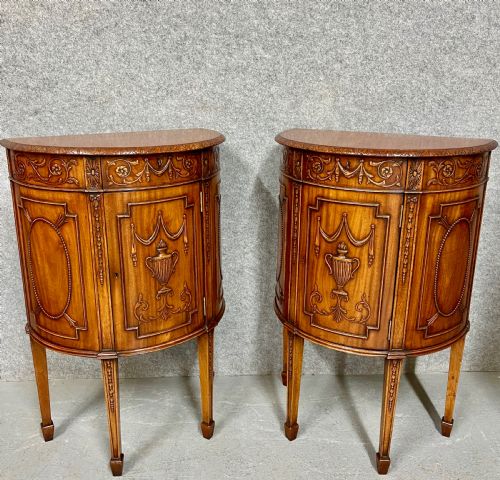
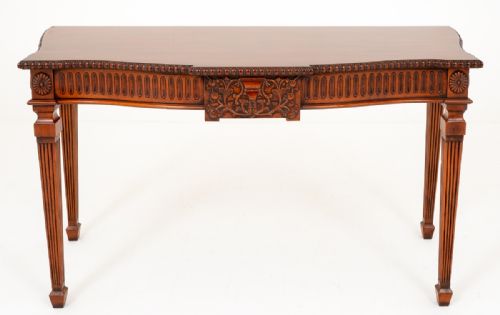
The forms vary from narrow rectangular serving tables and demi-lune hall pieces to serpentine console cabinets and card tables. Walnut, mahogany, pine, and painted woods form the structural foundation of these designs, often finished with marble tops or giltwood detailing.
Assessing quality and execution
The distinction between ordinary and superior pieces rests on the crispness of the carving and the fidelity of the classical proportions. Hand-carved mahogany and sharp gesso mouldings indicate a higher grade of craftsmanship compared to soft or indistinct applied decoration.
Timber selection and structural integrity separate fine examples from routine production, with well-figured mahogany and stable joints commanding greater interest. The integration of materials, such as a correctly fitted marble top or original painted surfaces, governs the overall coherence of the piece.
Adam Style Console Table Retail Price Guide 2026
Typical asking prices for adam style console table among the pieces listed under this phrase on Sellingantiques today, from the lower quarter to the upper quarter. They describe what is for sale here now, not the wider market.
Materials recorded across the inventory include mahogany, brass, marble, giltwood, painted wood, gesso, and paint.
The Adam Style Console Table Glossary
- Demi-lune
- Having a half-moon shape with a flat back edge designed to sit flush against a wall. This profile is common in hall and console tables from the Georgian and revival periods.
- Neoclassical
- A style originating in the mid-eighteenth century inspired by classical Greece and Rome. It relies on straight lines, symmetry, and architectural motifs like urns and swags.
- Pier table
- A table designed to stand against the wall between two windows, frequently paired with a matching mirror above. They share a similar narrow footprint with console tables.
- Gesso
- A plaster-like material applied to wood surfaces and carved or moulded into decorative reliefs. It is often gilded or painted in classical furniture.
- Paterae
- Circular ornamental carvings resembling flat rosettes or libation dishes, frequently used on the legs or frieze of neoclassical furniture.
Adam Style Console Table: Frequently Asked Questions
Where should I place a console table?
These tables fit naturally in narrow hallways, entrance lobbies, or against a drawing room wall where floor space is limited. Their shallow depth allows them to sit flat against the architecture without obstructing movement.
Pairing the table with a mirror or hanging a piece of art above it completes the traditional arrangement seen in period interiors.
How do I date an adam style table?
Dating relies on timber characteristics, tool marks, and construction methods rather than stylistic motifs alone, as revival periods copied eighteenth-century designs closely. Eighteenth-century pieces exhibit hand-sawn timber and specific joinery, while nineteenth and twentieth-century revivals show machine assistance or different secondary woods.
Examining the underside and drawer linings often reveals the true age of the timber and the period of assembly.
Did Robert Adam make these tables?
Robert Adam was an architect and designer who dictated the neoclassical style rather than a cabinetmaker who built furniture by hand. Workshops and makers working in his manner produced these pieces based on his architectural drawings and interior schemes.
Tables described in this style follow his design vocabulary rather than originating from his personal workshop.
Are marble top console tables heavy?
Marble tops add substantial weight to the overall piece, though the wooden bases are engineered to support them securely. The heavy stone top keeps the console stable against the wall without requiring permanent fixings in many cases.
Lifting or moving these tables requires two people to separate the marble slab from the wooden base safely.