
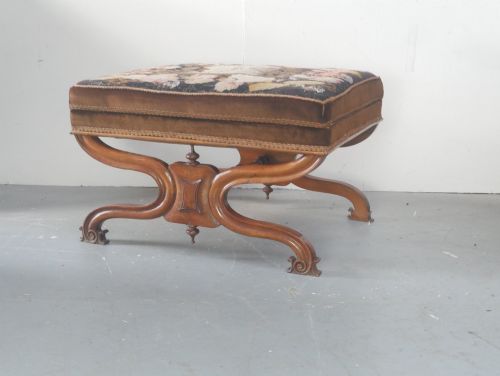
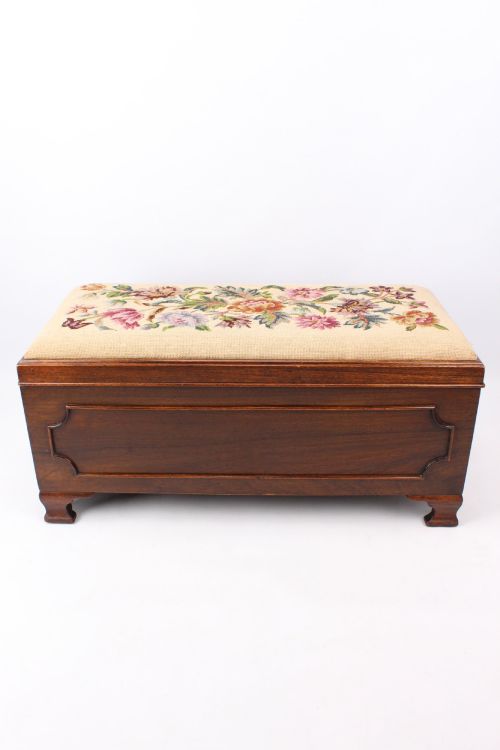


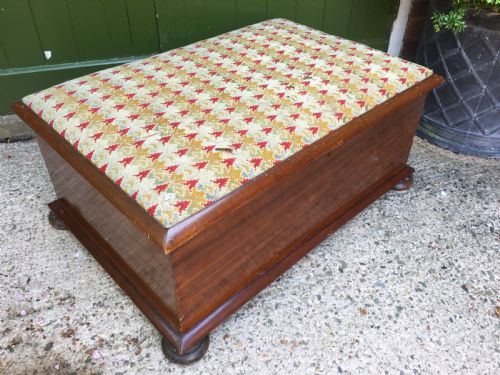
Needlepoint Top Footstool
A needlepoint top footstool brings a tactile splash of historic stitchwork to a room, offering both practical comfort and decorative charm.
Needlepoint Top Footstool
A needlepoint top footstool combines a sturdy wooden frame with a decorative textile seat designed for resting the feet or sitting at a dressing table. The selections here span the nineteenth century and the early twentieth century, taking forms such as dressing table stools, larger ottomans, and low footstools.
The styles range from restrained Regency designs to robust Victorian interpretations and revival pieces like Scottish Baronial, Chippendale style, and Queen Anne style. Victorian examples appear frequently, often featuring substantial walnut or mahogany structures beneath elaborate floral or geometric tapestry covers.
These items serve as versatile additions to traditional interiors, functioning equally well beside an armchair or tucked beneath a vanity. Their enduring appeal lies in the combination of warm timber frames and colourful wool work executed by hand.
How they were made
Makers built the structural frames of these stools using dense hardwoods such as mahogany, walnut, and rosewood, alongside occasional ebonised or painted finishes. Joinery relied on traditional techniques to ensure stability under daily use.
The upholstery centres on textile elements like wool, tapestry, fabric, and velvet, frequently utilising gros-point or needlepoint stitching for the top surface. Artisans secured these covers tightly over padded foundations supported by the wooden bases.
Many a Victorian needlework stool owes its survival to generations of family pets claiming it as their preferred sleeping spot.
What varies in quality
The distinction between standard examples and the finest pieces often rests upon the intricacy and tightness of the needlework itself. Dense, finely stitched wool panels display superior detail and durability compared to looser, simpler work.
Timber selection and carving quality also divide the range, with select pieces exhibiting rich grain patterns, polished finishes, or refined stylistic details such as carved rosewood or Scottish Baronial motifs rather than plain turned legs.
The Needlepoint Top Footstool Glossary
- Gros-point
- A type of needlepoint stitch worked on a coarse canvas, creating a durable and textured surface often found on nineteenth-century footstools. This technique allows for bold geometric or floral patterns.
- Mahogany
- A durable tropical hardwood prized for its reddish-brown colour and stable grain, frequently utilised by makers for nineteenth-century frames. It takes a high polish and resists warping.
- Ottoman
- A low, upholstered seat without a back or arms, sometimes large enough to serve as a footrest or secondary seating. These pieces often feature hinged lids revealing storage compartments.
- Tapestry
- A heavy woven or stitched textile featuring decorative designs, used extensively for the upper surfaces of period stools. The materials typically combine wool and silk threads over a stout backing.
- Scottish Baronial
- An architectural and decorative revival style drawing on medieval Scottish castles, characterised by robust proportions and distinctive detailing. Stools in this style often present heavier frames.
Needlepoint Top Footstool: Frequently Asked Questions
What is a needlepoint top footstool used for?
These items serve primarily as footrests beside armchairs or low seats for dressing tables in period interiors. Their sturdy timber frames and padded textile tops provide practical daily comfort.
Beyond utility, they introduce historic textile patterns and warm wood tones into living spaces as decorative accents.
How do I date a Victorian footstool?
Dating relies on examining the timber species, framing style, and the construction methods used for the upholstery foundation beneath the needlepoint cover. Victorian pieces frequently employ walnut or mahogany combined with robust internal webbing and stuffing.
Comparing the decorative motifs against known revival styles such as Chippendale or Scottish Baronial helps narrow down the decade of manufacture.
Are these stools suitable for daily use?
Most surviving examples remain structurally sound and capable of handling regular use as footrests or occasional seats. The dense hardwoods employed by period makers provide lasting stability.
Care should be taken with antique needlework tops to avoid excessive abrasion or direct sunlight that might fade the wool threads.
What is the difference between gros-point and needlepoint?
Gros-point specifically refers to a bolder, larger-scale stitch worked on a coarse canvas mesh, yielding a thick and durable textured surface. Needlepoint is a broader term encompassing various canvas work techniques including finer petit-point.
Stools described with gros-point tops display sturdier, more pronounced stitch patterns well suited to foot traffic.