


Navy Blue Kurdish Carpet
These heavy, durable weavings bring rich village character to floors, uniting deep indigo dyes with traditional tribal geometry in a navy blue kurdish carpet.
Navy Blue Kurdish Carpet
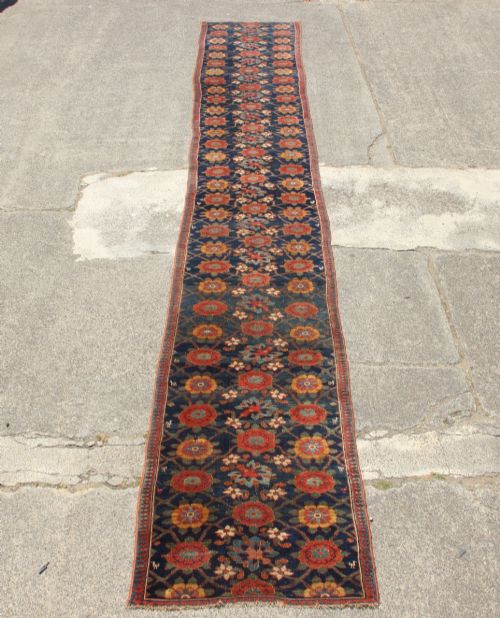
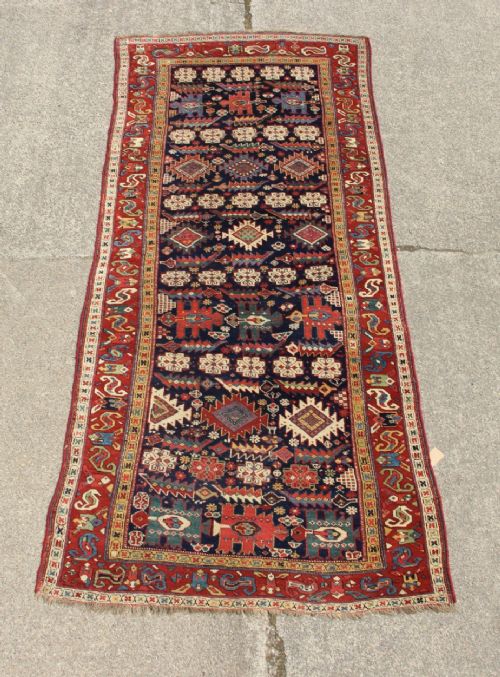
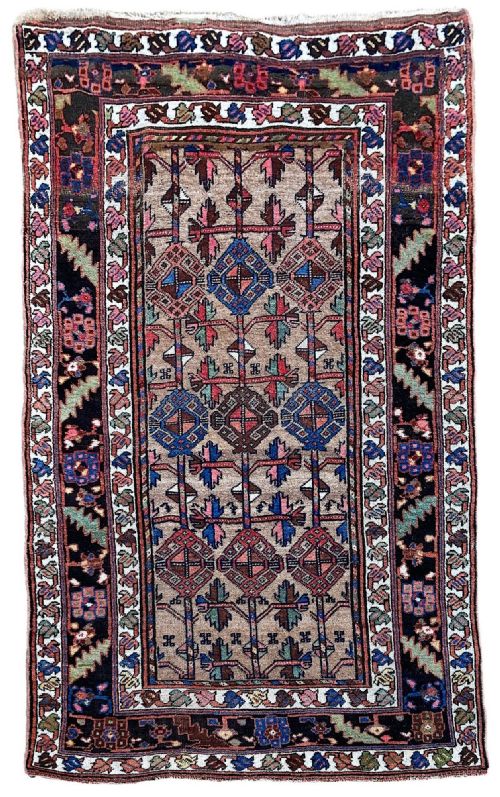
A navy blue kurdish carpet represents the traditional weaving output of tribal and village makers across Kurdistan and north-west Persia, spanning the late nineteenth and early twentieth centuries. These floor coverings appear in various formats, ranging from small scatter rugs and long narrow runners to room-sizedelleh carpets.
Most examples found on this page display strong geometric medallions, repeating shrub motifs, or traditional Mina Khani patterns set against dark indigo or navy fields. The regional output encompasses works attributed to specific groups such as the Jaf, Seneh, Bijar, and Quchan Kurds, reflecting diverse local village aesthetics.
Buyers looking at these pieces encounter authentic room-sized formats and corridor runners designed to withstand heavy domestic traffic. The overarching aesthetic merges robust tribal utility with intricate village craftsmanship from nineteenth and early twentieth-century Anatolian and Persian borderlands.
Materials and construction
The construction relies fundamentally on sturdy wool and hand-spun wool pile knotted tightly onto sturdy cotton or wool foundation warps and wefts. This combination yields a dense, resilient structure capable of enduring decades of heavy floor use without losing its structural integrity.
Weavers utilised natural dyestuffs to achieve deep navy and indigo ground colours, which contrast sharply with softer madder reds, ivories, and golds in the secondary motifs. The traditional hand-spinning of the wool creates subtle variations in texture and colour absorption across the surface of each carpet.
Footprints of generations of Kurdish weavers remain quietly locked within the dense, hand-knotted indigo wool.
Evaluating quality and execution
Quality in a navy blue kurdish carpet rests on the crispness of the tribal drawing and the density of the knotting across the foundation. Finer examples exhibit precise execution of complex geometric guls, Memlinc motifs, or dragon borders, whereas simpler village pieces show a looser, more rustic interpretation.
The choice and saturation of the indigo dye heavily influence the visual depth of the field, with richer, more uniform dark blue grounds commanding greater appreciation. Additionally, the condition of the original outer borders and selvedges dictates the overall integrity and desirability of the textile.
The Navy Blue Kurdish Carpet Glossary
- Kelleh
- A large, elongated room-sized carpet format, typically longer than a standard rug but wider than a corridor runner. These grand pieces were traditionally woven for specific village and tribal reception rooms.
- Mina Khani
- A traditional all-over repeating pattern composed of stylized flowers linked by delicate lattice vines. This classical Persian design frequently appears reinterpreted in Kurdish village weaving.
- Gul
- A repeating medallion or octagonal motif often found in tribal rugs and carpets. These geometric emblems carry deep cultural and decorative significance within the weaving traditions.
- Bijar
- A Persian town and district renowned for extremely heavy, densely packed village carpets featuring robust wool foundations. They earned the moniker of the iron rugs of Persia due to their unmatched durability.
- Boteh
- A stylised floral motif resembling a pear or curved almond shape, heavily utilised in oriental and tribal carpets. The symbol has ancient roots representing life and eternity.
Navy Blue Kurdish Carpet: Frequently Asked Questions
Where were these carpets originally made?
These textiles originate from the mountainous regions of Kurdistan, extending across north-west Persia and adjacent borderlands. Local village weavers and nomadic groups produced them for domestic use and local trade.
Production centres included Bijar, Seneh, and Hamadan, each imparting distinct structural traits and design preferences to their respective carpets.
How do I care for an old wool carpet?
Routine maintenance requires gentle vacuuming without a rotating power brush to protect the vintage wool pile. Keeping the rug out of direct, harsh sunlight preserves the deep navy and indigo dyes.
Professional cleaning by specialists familiar with antique oriental textiles ensures the natural lanolin remains intact within the hand-spun wool.
Are these carpets suitable for hallways?
Many examples on this page are specifically formatted as narrow runners and long corridor carpets, making them ideal for high-traffic hallways. Their durable wool construction and sturdy cotton foundations handle heavy footfall exceptionally well.
Placing a quality underlay beneath the runner prevents slipping and cushions the weave against hard stone or wooden floors.
How can I tell the age of a Kurdish carpet?
Dating relies on assessing the natural colour palettes, the type of wool spinning, and structural characteristics like knot density and edge finish. Pieces originating from the nineteenth century often display more organic dye variations and softer, worn patination.
Stylistic shifts and structural markers place the inventory spanning from the late Victorian era into the early decades of the twentieth century.