


Navy Blue Hallway Rug
A navy blue hallway rug brings depth and structure to a long corridor using traditional Persian and Caucasian weaving methods.
Navy Blue Hallway Rug
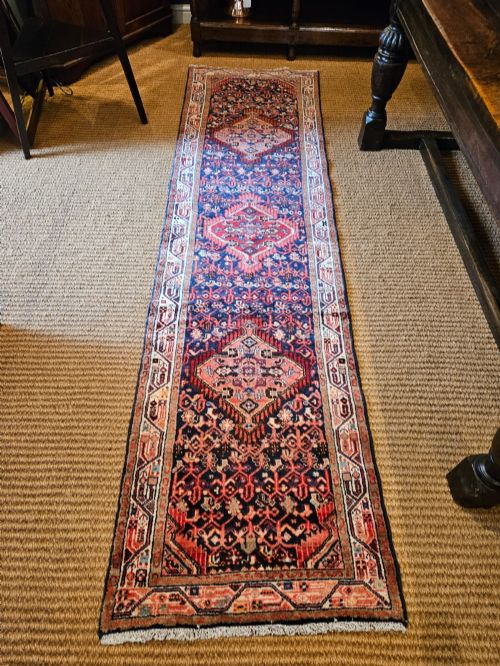
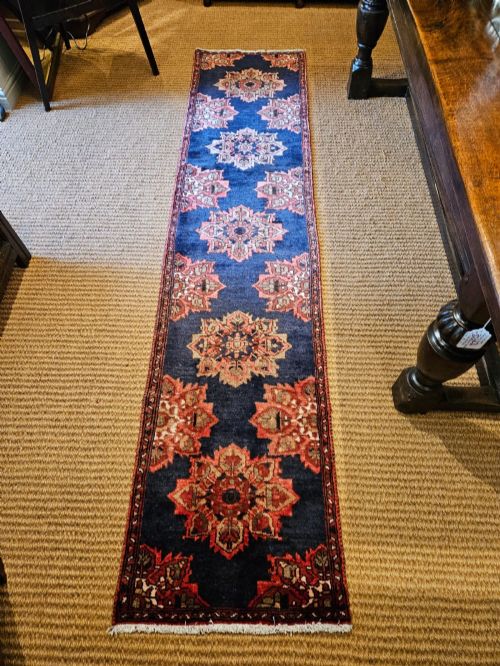
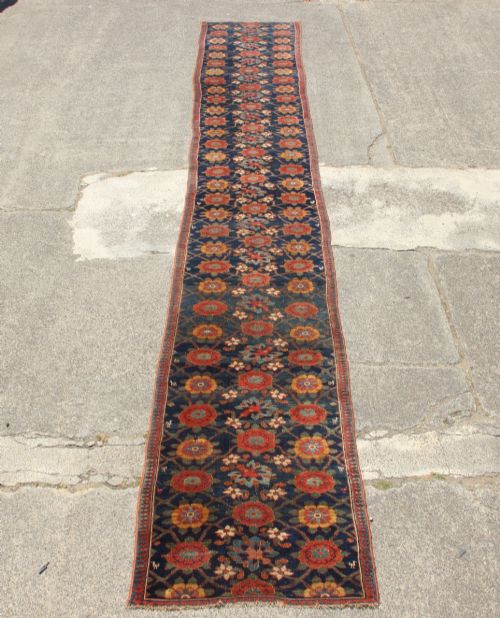
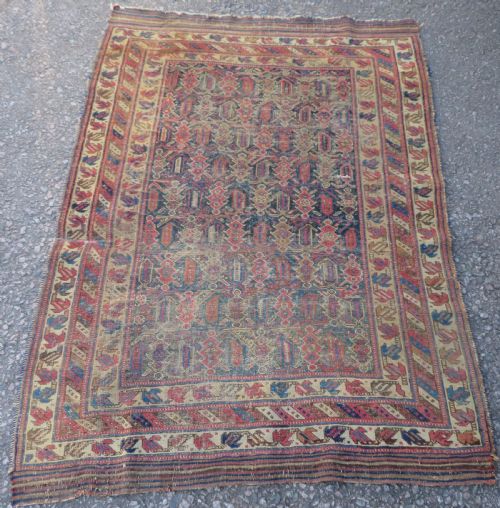
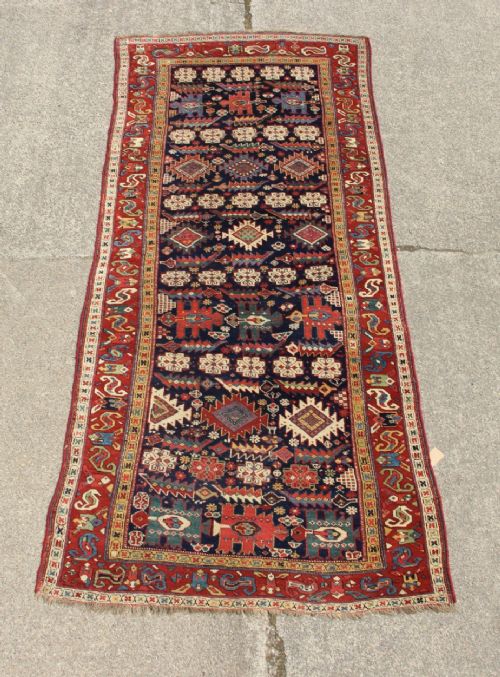
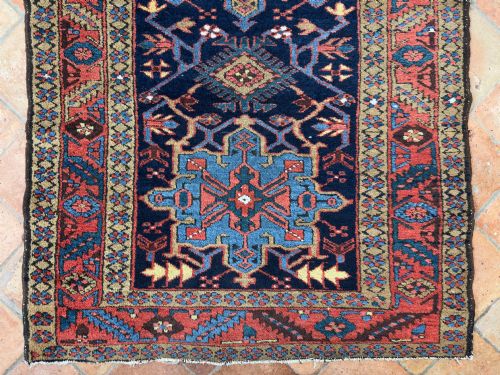
A navy blue hallway rug takes the form of long, narrow runners and carpets produced across Persia, the Caucasus, and Turkey during the nineteenth and early twentieth centuries. These elongated floor coverings were woven to fit transitional spaces, relying on repetitive geometric medallions and intricate field patterns to draw the eye along corridors. Buyers searching for a navy blue hallway rug meet traditional village and tribal formats that range from compact lengths to gallery-sized runners spanning several metres.
The selection reflects diverse regional weaving traditions, including Kurdish, Bakhtiari, Heriz, Kazak, and Afshar workshops and tribal groups. Pieces span the period from the eighteen-eighties through the nineteen-thirties, showing characteristic wear patterns and regional wool variations. Narrow formats dominate the inventory, designed specifically for domestic hallways and passageways where durability and narrow dimensions are required.
Materials and construction
The pieces rely on wool, hand-spun wool, and cotton foundations to build durable pile surfaces that withstand heavy corridor traffic. Weavers knotted individual tufts of wool onto warps of cotton or wool, securing the structure with overcast side cords and woven end finishes.
Natural dyes provide the characteristic palette seen across the collection, yielding deep indigo shades for the field backgrounds alongside contrasting tones. Hand-spun wool absorbs these natural colorants unevenly, creating subtle abrash variations within the pile that give depth to the surface.
Many nineteenth-century weavers embedded stray animal hairs straight into the wool pile, leaving permanent signatures of the farmyard on the corridor floor.
Qualities of distinction
Quality rests upon the fineness of the knotting and the crispness of the drawing within the central medallions and border guards. Tightly packed knots and resilient wool pile indicate superior structural integrity, while looser weaves yield softer, more yielding handles.
The complexity and execution of regional motifs, such as boteh designs or star medallions, set finer examples apart from simpler village productions. An intact original selvedge and preserved end finishes contribute significantly to the overall integrity of an antique runner.
The Navy Blue Hallway Rug Glossary
- Abrash
- Natural variations in dye colour within the wool pile, caused by shifts in dye batches or hand-spun yarn lots. This tonal variation creates a banded effect across the rug surface.
- Boteh
- A traditional almond-shaped or paisley motif representing a floral or cypress shoot, frequently repeated in rows across Caucasian and Persian runner fields.
- Kazak
- A style of rug woven in the Caucasus region known for bold geometric medallions, primary colour palettes, and heavy wool piles.
- Heriz
- A style of geometric carpet and runner originating from north-west Persia, characterised by large central medallions and sturdy structures.
- Kelim
- A flat-woven rug or runner produced without a pile, utilising warp-faced weaving techniques to create geometric patterns.
- Selvedge
- The bound edge along the lengthwise sides of a rug that protects the structure from unravelling.
Navy Blue Hallway Rug: Frequently Asked Questions
How do I measure for a hallway runner?
Measure the clear floor space of your corridor, leaving an equal margin of exposed wood or tile around the perimeter of the rug. Ensure that doors swinging into the hallway clear the thickness of the wool pile without obstruction.
Account for the total length required to anchor the space visually, stopping short of thresholds and staircases to maintain a balanced appearance.
Are these runners durable enough for daily use?
Antique runners woven with dense wool pile and sturdy foundations are built to endure generations of foot traffic in high-use areas. The natural lanolin present in traditional hand-spun wool resists staining and repels everyday dirt.
Pairing the rug with a suitable underlay prevents sliding and cushions the foundation fibres against hard subfloors.
How do I identify a tribal design?
Tribal designs typically feature geometric motifs, stylised animals, and memory-woven patterns rather than precise curvilinear court designs. These rugs display asymmetrical elements and spontaneous colour changes reflecting the weaver's individual choices.
Village and nomadic pieces often incorporate hooked polygons, stars, and bold central medallions characteristic of specific regional weaving groups.
What causes abrash in antique rugs?
Abrash occurs naturally when dyers mix small batches of natural colourants by hand, resulting in subtle tonal shifts along the length of the yarn. As the weaver progresses through the work, these slight colour variations manifest as horizontal bands of shading.
This characteristic confirms the use of traditional dyeing methods rather than synthetic uniform dyes.