
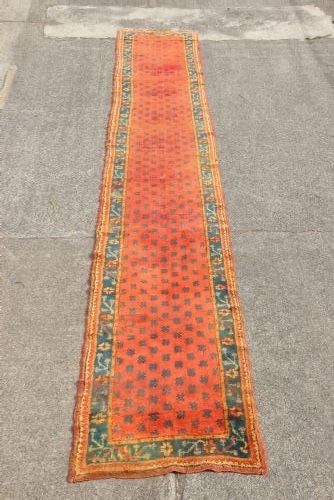
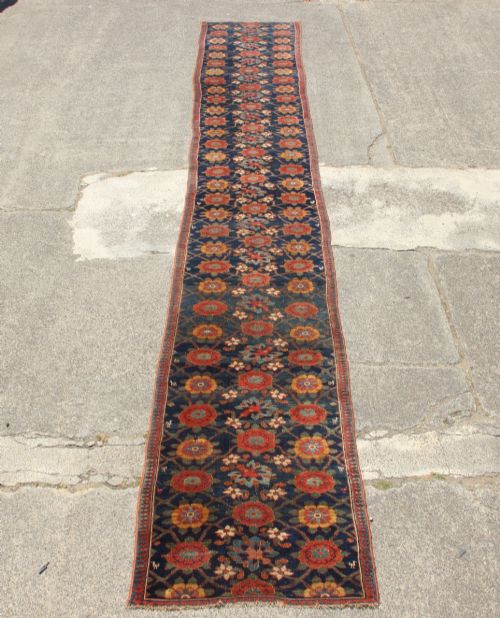
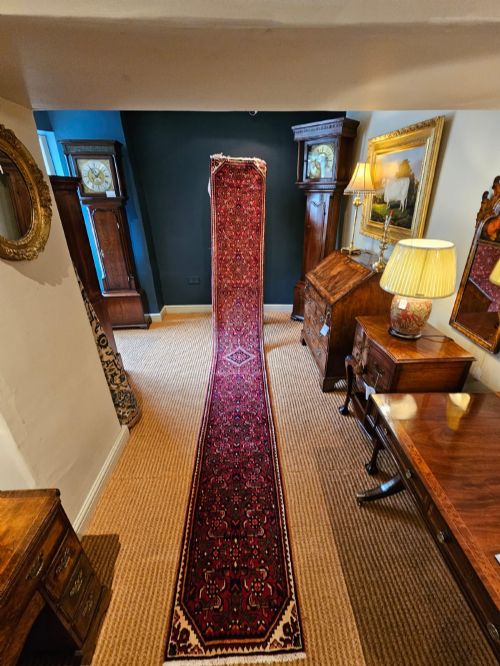
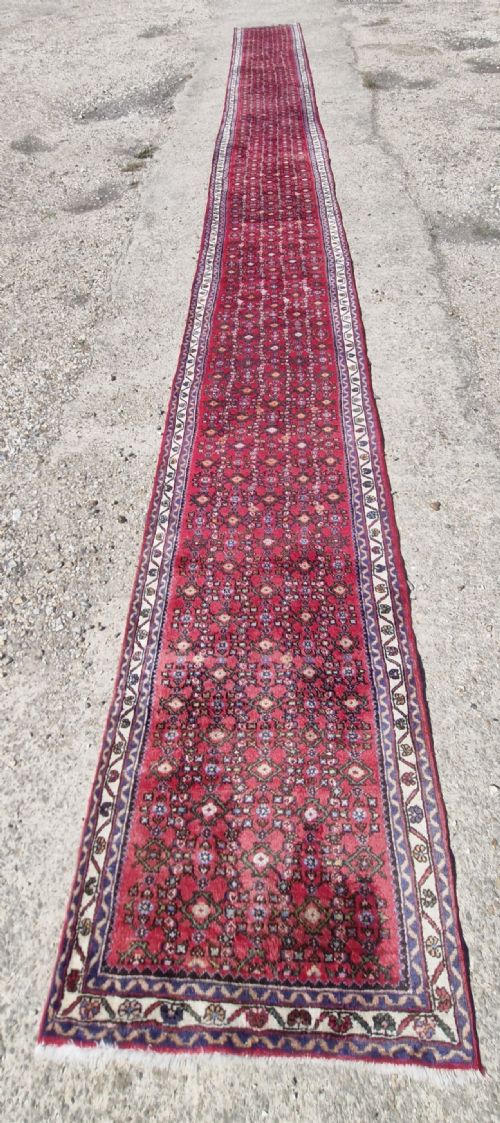


Extra Long Runner Rug
An extra long runner rug provides a narrow, continuous path of warmth and pattern for extended hallways, landings, and staircases.
Extra Long Runner Rug
An extra long runner rug is specifically designed to span extended architectural spaces like long hallways, corridors, and staircases. These pieces often feature narrow, elongated proportions that bridge grand distances while maintaining a balanced visual weight on the floor.
The selection here draws primarily from traditional styles including Persian, Kurdish Tribal, and Moroccan Berber origins. Pieces span various decades from the nineteenth century through to the mid-twentieth century, showcasing diverse regional patterns.
Buyers frequently encounter substantial dimensions, with lengths often exceeding four or five metres, alongside occasional monumental lengths reaching over twelve metres. These formats suit long architectural passages perfectly.
Materials and construction
The pieces listed rely consistently on wool and cotton as foundational materials for both pile and foundation. Wool provides a resilient, durable surface for high-traffic corridors, while cotton often forms stable warps and wefts.
Weavers utilised traditional hand-knotting and flatweaving techniques across tribal and village workshops. These methods ensured the dense structures necessary to withstand decades of footfall along narrow paths.
Judging quality in long runners
Quality rests in the precision of the weave and the structural integrity of the long format. Maintaining straight, parallel edges over several metres requires exceptional skill from the weaver.
The choice of wool and the depth of the pile dictate how well the piece ages under continuous use. Finer knotting allows intricate tribal and floral motifs to remain sharp along the length of the path.
The Extra Long Runner Rug Glossary
- Runner
- A long, narrow carpet format designed for hallways, corridors, and stairs. Its proportions emphasise length over width.
- Kilim
- A flatwoven carpet or runner produced without a pile. These pieces rely on interlocking weft threads to create geometric patterns.
- Kelleh
- A large, elongated format often categorised between a standard rug and a full carpet. It offers substantial length and width for spacious rooms.
- Mina Khani
- A repeating floral lattice pattern frequently found in traditional Persian weaving. It arranges geometric blossoms connected by delicate vines.
Extra Long Runner Rug: Frequently Asked Questions
Where should I place an extra long runner rug?
These pieces suit extended hallways, grand landings, and sweeping staircases where standard lengths fall short. Their narrow proportions guide the eye and direct movement through expansive architectural spaces.
They also work effectively in long galleries or wide corridors, anchoring the room while protecting high-traffic wooden or stone flooring.
How do I measure for a runner this long?
Measure the clear floor space of your corridor, leaving an equal margin of exposed flooring around the perimeter of the rug. Ensure doors can swing freely over the thickness of the pile.
Account for any landings or turns where the runner might need to stop short or transition to a different surface.
Are these rugs durable enough for hallways?
Traditional construction using wool pile on sturdy foundations makes these pieces naturally resilient for busy passageways. Wool fibres resist crushing and naturally repel dirt.
Regular rotation and appropriate underlays help distribute foot traffic evenly, preserving the condition of the weave over decades of daily use.
How do I identify the regional style?
Regional styles reveal themselves through distinct motifs, colour palettes, and weaving structures. Persian designs often display floral lattices and Heriz geometries, while Kurdish and Shassavan pieces favour bold tribal patterns.
Moroccan Berber examples typically present minimalist geometric symbols on pale or natural wool grounds.