


Nautical Bulkhead Wall Clock
These heavy marine timepieces bring purposeful utility and the character of the sea into a domestic interior.
Nautical Bulkhead Wall Clock
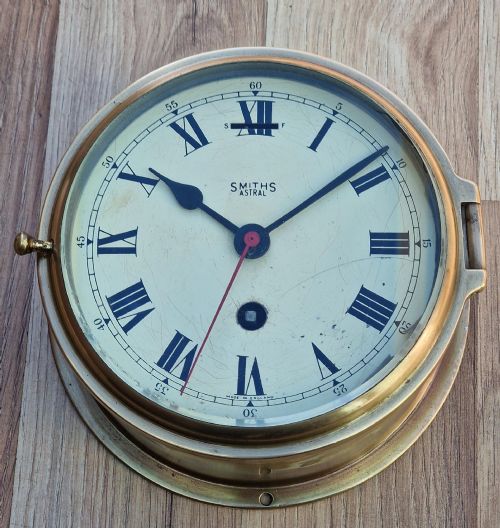
A nautical bulkhead wall clock is designed for mounting on the wall of a ship's cabin or wheelhouse, constructed to endure a marine environment. When you search for a nautical bulkhead wall clock, you encounter heavy, robust timepieces originating from the nineteenth and twentieth centuries.
The selections available here span from Victorian fusee models to mid-century industrial examples. Styles range from plain maritime utilitarian pieces to refined Edwardian instruments bearing makers' names.
Forms include standard round marine clocks, engine room variants, and specialised radio room dials with coloured segments. You also find companion sets pairing the clock with a matching barometer.
Materials and construction
Cases are predominantly cast in solid brass, sometimes nickel-plated or finished in chrome for corrosion resistance, protecting the delicate mechanisms within. Some examples feature wooden surrounds or industrial steel construction.
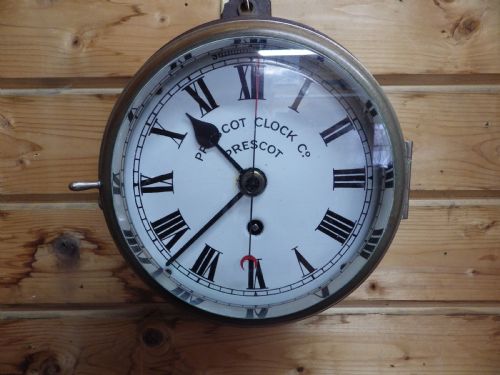
Dials are protected by thick bevelled glass lenses held in heavy hinged bezels, secured tightly to prevent moisture ingress. Enamel dials provide clear legibility, often marked with bold numerals and subsidiary indicators.
Listings feature brass, glass, enamel, steel, and chrome materials across Victorian, Edwardian, and mid-century maritime styles.
Standards of quality and workmanship
Quality in these timepieces rests upon the sophistication of the internal movement and the heft of the housing. Fusee movements with chain drive represent a higher standard of clockmaking precision compared to standard spring-driven alternatives.
The casting quality of the brass case and the clarity of the enamel dial distinguish superior examples from standard production pieces. Maker attribution, such as signed dials from recognised firms, further elevates the status of a piece.
Prescot Clock Co·Kelvin White and Hutton London·Schatz of Germany·Smiths Empire
The Nautical Bulkhead Wall Clock Glossary
- Bulkhead
- A vertical partition dividing the compartments of a ship. These clocks are designed specifically to be screwed directly onto such surfaces.
- Fusee
- A conical pulley used with a chain or cord to equalise the torque of the mainspring as it winds down. This mechanism improves the timekeeping accuracy of the clock.
- Radio room clock
- A specialised marine clock featuring red and green sector markings on the dial. These markings indicate mandatory silence periods for monitoring distress frequencies.
- Bezel
- The metal ring that holds the glass cover over the clock face. In marine clocks, this is often hinged and secured with a threaded thumb screw.
Nautical Bulkhead Wall Clock: Frequently Asked Questions
How do I mount a heavy marine clock?
These pieces require sturdy fixings due to their solid brass construction and substantial weight. Secure them directly into wall studs or use appropriate heavy-duty wall anchors.
Ensure the mounting height allows easy access to the bezel for regular winding and time adjustment.
What is a fusee movement?
A fusee movement uses a conical drum and a chain to regulate the power delivered by the mainspring. This ensures steady force is applied to the gear train as the spring unwinds.
Clocks with this mechanism are generally older and represent finer horological craftsmanship.
Why do some dials have coloured segments?
Radio room clocks feature red and green sectors on the dial face to mark specific intervals for international maritime distress listening. Operators maintained absolute silence during these minutes to hear weak SOS signals.
These coloured markings add a distinctive visual feature to mid-century maritime timepieces.
How do I wind an antique marine clock?
Most models require a matching winding key inserted into a small aperture on the dial face. Turn the key gently until you feel firm resistance, avoiding overwinding.
Fusee models typically require winding every week to maintain accurate timekeeping.