
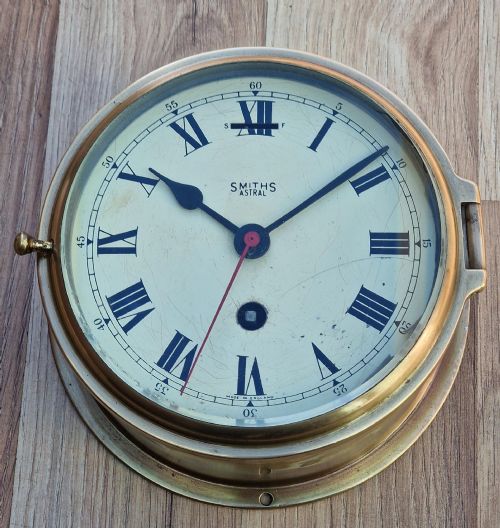
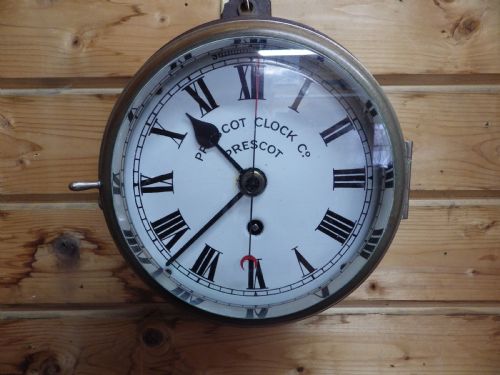


Brass Ship Wall Clock
A brass ship wall clock brings genuine maritime history into a room with heavy metal cases and clear enamel dials.
Brass Ship Wall Clock
A brass ship wall clock is a timepiece designed for maritime use, featuring sturdy metal construction meant to withstand marine environments. These pieces appear in forms such as bulkhead clocks, engine room clocks, and radio room clocks.
The versions most commonly met on this page date from the Victorian period through to the mid-twentieth century. Makers and manufacturers produced these clocks in styles including industrial maritime and traditional nautical designs.
Many examples originate from notable makers and specific sectors, including Air Ministry instruments and London workshops. Collectors encounter various dial types, from standard Roman numerals to specialised coloured segments for radio rooms.
Materials and construction
Makers constructed the primary housing from heavy brass, sometimes nickel-plated, paired with thick glass viewing covers to protect the dial. Internal mechanisms frequently utilise chain fusee movements or standard mechanical gear trains housed securely within the metal shell.
Object forms on this page include wall clocks, bulkhead clocks, and specialised radio room timepieces with mechanical movements.
Factors of quality
Quality in these timepieces rests upon the sophistication of the internal movement, with chain fusee mechanisms representing a higher standard of clockmaking. The weight and thickness of the brass casing and the clarity of the enamel dial further distinguish finer examples.
Provenance and original military or institutional service also influence the character of a piece, as seen in items bearing Air Ministry markings. The crispness of the casting and the preservation of original components separate standard production clocks from superior instruments.
Prescot Clock Co·Kelvin White and Hutton London·Schatz of Germany·Smiths Empire
The Brass Ship Wall Clock Glossary
- Bulkhead clock
- A timepiece designed to be mounted directly onto the wall or bulkhead of a ship's cabin or bridge. These clocks feature heavy cases to resist moisture and vibration.
- Fusee movement
- A mechanism utilising a conical pulley and chain to ensure even power delivery as the mainspring unwinds. This system improves timekeeping accuracy across the power reserve.
- Enamel dial
- A metal dial face covered with a fused glass powder layer, providing a durable and bright white background for painted numbers. These dials resist yellowing over decades of exposure.
- Radio room clock
- A specialised timepiece featuring coloured segments on the dial face to indicate designated silent periods for radio operators. These markings were vital for distress signal monitoring.
- Engine room clock
- A robust clock designed specifically for the loud, high-vibration environment of a vessel's engine room. They often display utilitarian styling and extra-heavy brass housings.
Brass Ship Wall Clock: Frequently Asked Questions
How do I mount a bulkhead clock safely?
Bulkhead clocks require secure fixing into wall studs or solid masonry due to their heavy brass construction. Use appropriate wall anchors that match the weight of the metal casing and backplate.
Ensure the mounting screws match the original fixing holes if present to preserve the integrity of the wooden or metal surround. Professional installation is advisable for delicate chain fusee movements.
What is a fusee movement?
A fusee movement is a mechanical system that uses a conical pulley and a chain to regulate the pull of the mainspring. As the spring loses tension, the chain moves to a wider part of the cone to maintain consistent torque.
This clever engineering results in much more accurate timekeeping throughout the running period of the clock. It is a hallmark of higher quality antique clockmaking.
Why do some dials have coloured segments?
Coloured segments on maritime clock dials indicate specific radio silence periods used for listening to distress frequencies. Operators needed to monitor these exact minutes without interruption.
Red and green markings are typical on mid-century radio room clocks. They reflect the strict communication protocols enforced aboard commercial and naval vessels.
How do I clean a brass clock case?
Clean the brass case gently using a soft cloth to remove dust and surface grime without stripping the aged patina. Avoid harsh chemical polishes that can damage engraved markings or remove historic wear.
Glass covers can be cleaned with standard glass cleaner applied to a cloth rather than sprayed directly onto the frame. This prevents moisture from seeping into the movement.