
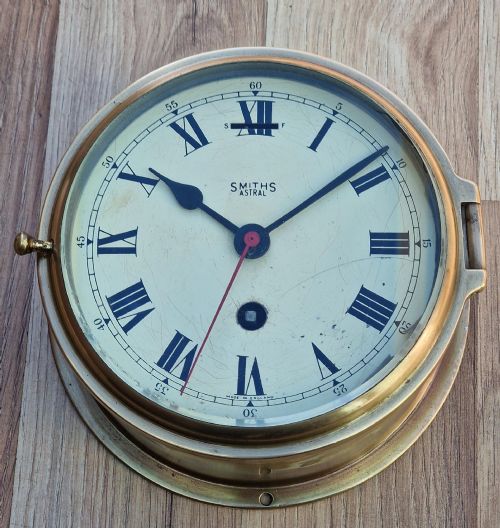
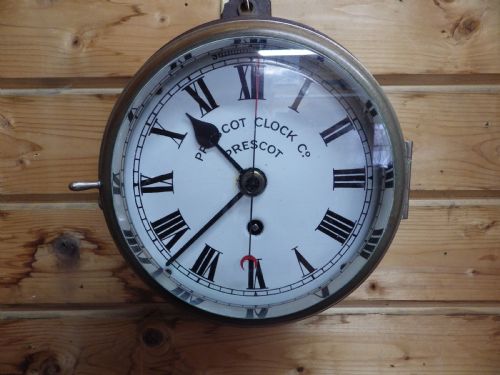


Brass Marine Bulkhead Clock
A brass marine bulkhead clock brings a sturdy nautical presence to a room, valued for its robust engineering and maritime history.
Brass Marine Bulkhead Clock
A brass marine bulkhead clock is a wall-mounted timepiece designed to withstand harsh maritime environments on ships and vessels. Buyers searching this phrase look for authentic timepieces originating from various periods including Victorian, Edwardian, and mid-century eras.
The versions most commonly met on this page span styles such as standard maritime, industrial, and specialised radio room configurations. These pieces function as wall clocks housed primarily in heavy circular metal casings.
Origins represented in the evidence range across British manufacturing traditions, with notable makers and military service pieces also appearing. Each object reflects the practical necessity of reliable timekeeping at sea through robust construction.
Materials and construction
The construction relies heavily on brass for the exterior case, providing durability against corrosion in damp marine conditions. Nickel-plated brass variants also appear alongside metal and wooden elements.
Glass protects the dial face while enamel frequently provides a clear, legible surface for the numerals. Internal mechanisms often incorporate sophisticated chain fusee movements designed to maintain consistent tension and accuracy.
Materials documented across these listings include brass, glass, enamel, steel, wood, and nickel-plated brass.
Assessing quality and craftsmanship
Quality separates through the sophistication of the internal movement, notably the presence of chain fusee mechanisms versus standard spring-driven calibres. Heavier castings and refined finishing on the brass case also elevate a piece above standard utility models.
The legibility and material quality of the dial face, such as vitreous enamel versus painted metal, indicate the original grade of the instrument. Association with specific military departments or esteemed makers adds historical weight to the manufacture.
Prescot Clock Co·Kelvin White and Hutton London·Schatz of Germany·Smiths Empire·Smiths Astral
The Brass Marine Bulkhead Clock Glossary
- Bulkhead
- A vertical partition dividing compartments within a ship, onto which these clocks were originally mounted. This placement required secure, vibration-resistant mounting systems.
- Fusee
- A conical pulley used with a chain or cord to maintain even power as the mainspring unwinds. This mechanism is prized by horological collectors for improving timekeeping precision.
- Enamel
- A glassy substance fused to a metal dial substrate at high temperature to create a durable, glossy surface. Enamel dials resist fading and yellowing over decades of service.
- Sestrel
- A renowned brand name associated with navigational instruments and maritime clocks. Pieces bearing this name reflect established British trade standards.
- Admiralty pattern
- A standardised design specification commissioned for use by the naval forces. These items adhered to strict government criteria for endurance and reliability.
Brass Marine Bulkhead Clock: Frequently Asked Questions
How do I mount a bulkhead clock safely?
These clocks typically secure directly to a wall through pre-drilled holes in the heavy brass flange or rim. Ensure the fixings match the weight of the metal casing and solid wall construction.
Because original marine pieces are substantial in weight, proper anchor screws prevent any strain on the surrounding plaster or wood paneling.
Why do some models feature coloured dial segments?
Specialised variants like radio room clocks display red and green sectors on the face for monitoring international silent periods. These markings assisted radio operators in tuning into distress frequencies.
Such functional details reflect the precise operational duties required of the vessel's crew during navigation and communication.
What is the difference between a fusee and standard movement?
A fusee movement uses a conical drum and chain to regulate the force delivered by the mainspring. This complex gearing ensures consistent torque as the spring loses tension.
Standard movements rely on direct spring drive, which is simpler in design but less mathematically uniform in its power delivery over the running period.
How do I date an antique marine clock?
Dating relies on stylistic clues, maker marks, and structural traits recorded across Victorian, Edwardian, and mid-century periods. Government broad arrows or military department stamps also help establish a specific era of service.
Examining the type of escapement and the materials used in the casing offers further chronological context for the piece.