


Vintage Brass Ship Clock
A vintage brass ship clock brings heavy marine engineering and crisp naval dials straight into a study or drawing room.
Vintage Brass Ship Clock
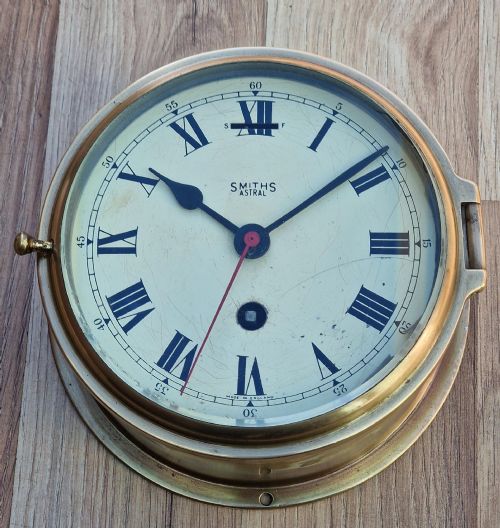
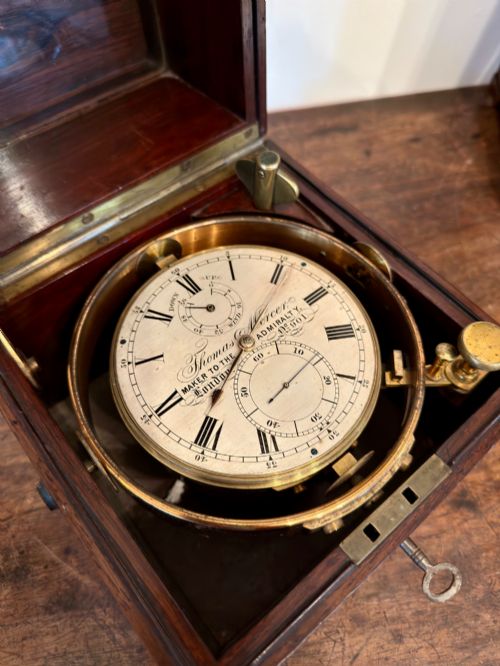
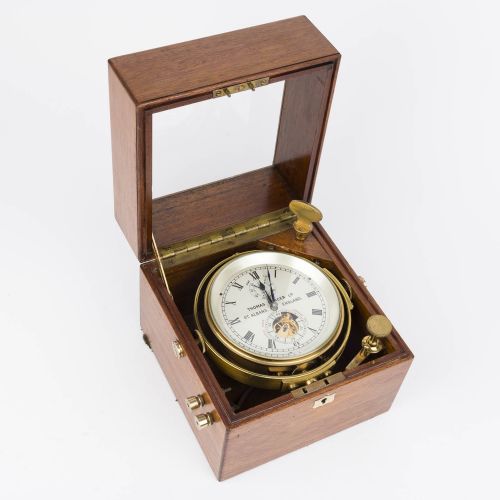
A vintage brass ship clock is a robust timepiece built originally for service on the water, taking forms such as bulkhead wall clocks, mantel clocks, and marine chronometers. These instruments span periods from the nineteenth century through the mid-twentieth century, showing influences from Victorian, Regency, and industrial maritime styles.
Buyers will encounter heavy brass cases paired with white enamel dials, silvered metal chapters, and occasional mahogany mountings. The selection ranges from strict military bulkhead pieces stamped by the Air Ministry to decorative French four-glass clocks set within brass ships wheels.
How they were made
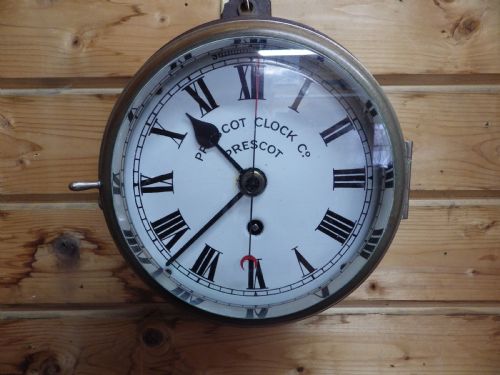
Makers housed heavy brass movements within thick cast brass cases designed to withstand salt air and motion at sea. Dials typically feature clear black enamel numerals protected by heavy bevelled glass doors.
Higher-grade examples incorporate chain fusee movements or twin fusee mechanisms to maintain even tension on the gear train as the mainspring unwinds, ensuring accurate timekeeping.
Some engine room clocks survived decades of diesel smoke and salt spray to end up ticking quietly in modern suburban hallways.
What varies in quality
Quality rests in the precision of the movement and the integrity of the housing. Chronometers and fusee clocks by named makers represent the high end of marine timekeeping.
Simpler bulkhead clocks and desk pieces offer sturdy brass construction without the intricate escapements found in precision navigation instruments.
Thomas Mercer·Litherland Davies Of Liverpool·James McCabe·Kelvin White And Hutton·Gay Vicarino
The Vintage Brass Ship Clock Glossary
- Bulkhead clock
- A sturdy clock designed to be bolted directly to the wall of a ship cabin or engine room. These heavy brass instruments kept time through heavy seas.
- Fusee
- A conical pulley used in better clocks to equalise the torque of the mainspring as it runs down. This mechanical addition ensures more consistent timekeeping.
- Marine chronometer
- A highly accurate portable clock used at sea to determine longitude by celestial navigation. They are often suspended in gimbals inside wooden boxes.
- Silvered metal
- A brass dial plate treated with a silver solution to create a matte white finish for the engraved numerals. It provides high contrast against dark hands.
- Four-glass clock
- A mantel clock featuring glass panels on all four sides to expose the brass movement and escapement. Some maritime examples incorporate a ship's wheel frame.
Vintage Brass Ship Clock: Frequently Asked Questions
How do I wind a fusee ship clock?
Use the appropriate key on the winding arbor through the dial face, turning gently until resistance stops the movement. Do not overwind.
Ensure the chain or cord on fusee models is properly seated on the cone before applying full pressure.
Where were bulkhead clocks mounted?
Bulkhead clocks were screwed directly to the wooden or steel bulkheads of ships, typically in the captain cabin, chart room, or engine room.
This mounting kept the heavy brass instrument secure against the rolling motion of the vessel.
How do I tell an 19th-century clock from a later one?
Nineteenth-century pieces often rely on fusee movements and heavy hand-cast brass cases with distinctive patination. Maker signatures are frequently engraved directly onto the backplate.
Mid-century bulkhead clocks from the nineteen-forties and fifties tend toward standardised mass production, sometimes featuring Air Ministry broad arrow marks.