


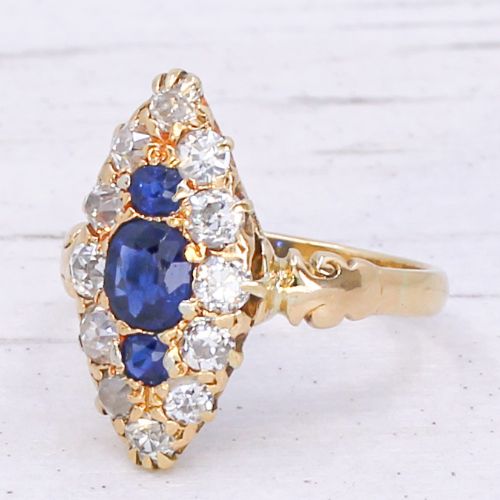


Natural Blue Sapphire Ring
A natural blue sapphire ring brings deep, velvety colour and historical weight to the hand through gems shaped by the earth.

Natural Blue Sapphire Ring
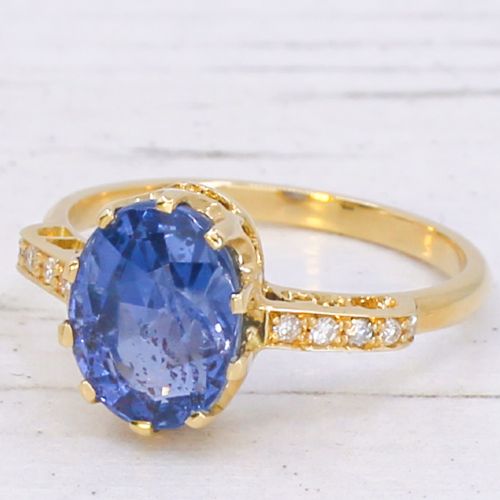
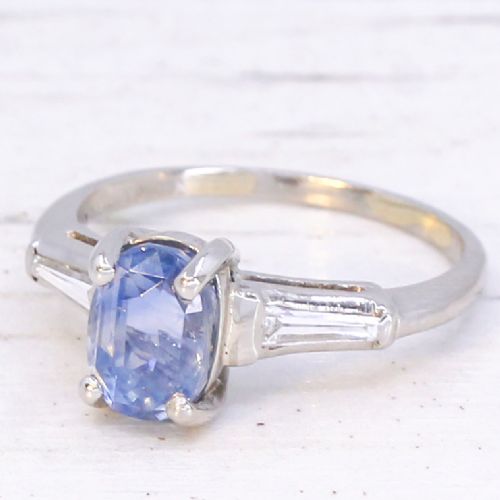
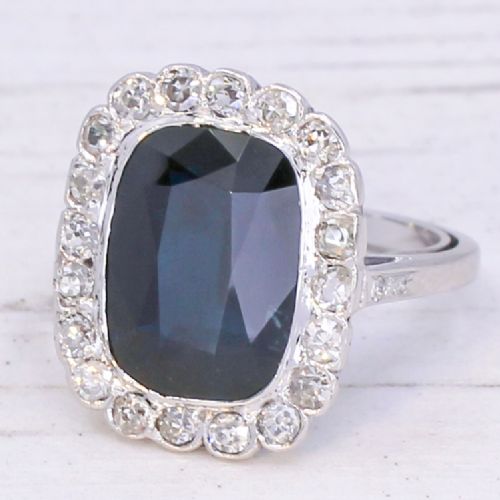
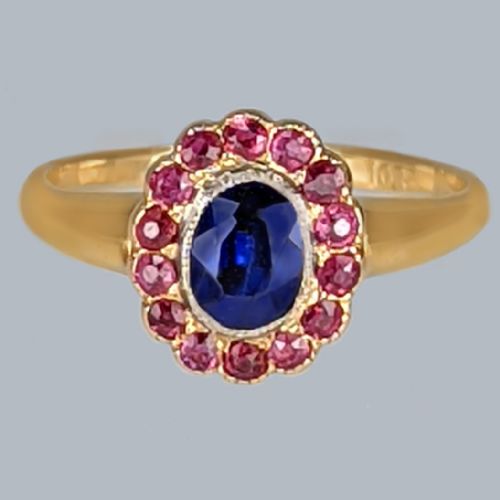
When you search for a natural blue sapphire ring, you are looking at precious finger ornaments spanning the Victorian, Edwardian, Art Deco, Retro and Mid-Century periods. These pieces range from delicate single-stone solitaires and multi-stone trilogy settings to substantial cocktail clusters.
The version you are most likely to meet on this page is a Mid-Century or Art Deco creation, often featuring a significant Ceylon or Burmese stone paired with diamonds. The mountings shift from yellow gold in the earlier eras to platinum and white gold as twentieth-century tastes evolved.
Origin plays a central role in defining these jewels, with specific regions such as Kashmir, Burma and Ceylon noted for distinct crystalline properties. The mounting styles mirror the design movements of their decades, moving from ornate floral clusters to geometric architectural lines.
How they were made
The construction of a natural blue sapphire ring relies upon durable precious metals such as platinum, 18ct white gold and 18ct yellow gold. Goldsmiths secured the central corundum stones alongside diamonds using claw, bezel or flush settings designed to maximise light passage.
Gemstone cutting encompasses both traditional faceted styles, which enhance brilliance, and smooth cabochon domes that highlight optical phenomena like star patterns. Diamond accents are frequently shaped as old cuts, rose cuts or transitional cuts typical of their respective decades.
The listings span eight distinct eras, moving from Victorian and Edwardian craftsmanship through Art Deco geometry into Mid-Century modernism.
What varies in quality
Quality in a natural blue sapphire ring rests upon the saturation, tone and purity of the central stone's colour, alongside the absence of artificial heat enhancement. Stones originating from historic localities with deep, unheated saturation command particular attention from collectors.
The standard of metalwork and the matching quality of accompanying diamonds also shape the piece. Precision in the geometric symmetry of an Art Deco mount or the delicate millgrain detailing of an Edwardian setting reflects the mastery of the original jeweller.
The Natural Blue Sapphire Ring Glossary
- Unheated
- A sapphire that has not undergone thermal treatment to improve its natural colour or clarity. This attribute is confirmed by gemological reports.
- Ceylon
- A geographical descriptor for sapphires mined in Sri Lanka, historically celebrated for a bright, vivid blue hue. These stones often exhibit high transparency.
- Cabochon
- A gemstone style shaped and polished with a smooth, rounded dome rather than flat facets. This cut is frequently chosen to display asterism or highlight the depth of the material.
- Trilogy ring
- A finger ring set with three stones, traditionally symbolising the past, present and future. In these pieces, a central sapphire is typically flanked by diamonds.
- Old cut
- A diamond cutting style prevalent in the Victorian and Edwardian eras, characterised by a smaller table, higher crown and open culet. These cuts were shaped by hand to catch candlelight.
Natural Blue Sapphire Ring: Frequently Asked Questions
How do I identify an Art Deco sapphire ring?
Art Deco sapphire rings display geometric motifs, symmetry and strong architectural lines typical of the 1920s and 1930s. They frequently utilise platinum or white gold to frame the stones.
These pieces often combine calibré-cut sapphires with brilliant diamonds to create sharp contrast and linear patterns. The overall aesthetic rejects Victorian ornamentation in favour of sleek modernity.
What does unheated sapphire mean?
An unheated sapphire is a gemstone that retains its natural colour and clarity exactly as it emerged from the earth, without human intervention via high-temperature ovens. Such stones are prized for their untouched geological history.
Thermal treatments are common in the gemstone trade to improve visual appeal, making certified unheated examples notably scarce. Gemological laboratories examine microscopic inclusions to verify this natural state.
Can I wear an antique sapphire ring daily?
Corundum, the mineral family of sapphire, ranks nine on the Mohs scale of hardness, making it exceptionally durable for everyday wear. However, the surrounding precious metal mount and older settings require mindful care.
Prongs and claws can thin over decades, so regular inspection by a jeweller helps secure the central gem. Removing the ring during heavy manual tasks prevents unnecessary stress on antique gold or platinum.
What is the difference between Ceylon and Burmese sapphires?
Ceylon sapphires originate from Sri Lanka and are widely recognised for a vibrant, luminous blue tone with high clarity. Burmese sapphires come from Myanmar and often display a deep, velvety royal blue.
Both origins are historically significant and heavily sought after by collectors. Certified paperwork accompanying a ring usually specifies the geographic source based on internal mineral inclusions.