


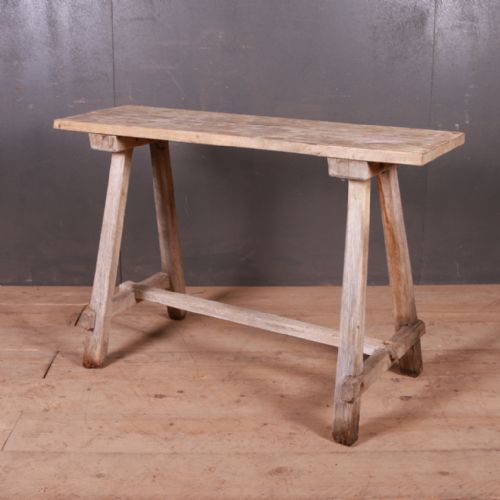

Narrow Wood Dining Table
A narrow wood dining table offers a practical surface for compact rooms, bringing honest materials and enduring period character to daily meals.
Narrow Wood Dining Table
A narrow wood dining table brings scaled-down proportions to compact spaces without sacrificing surface utility. These tables serve daily meals and gatherings where standard widths overwhelm the floor plan.
The selection here draws heavily from French country traditions and 19th century workshops. French trestle tables and Swedish preparation tables dominate the available forms.
Makers designed these pieces in mahogany, oak, pine, and poplar to suit both formal townhouses and rustic provincial kitchens. The narrow profile accommodates intimate seating arrangements while maintaining functional length.
Materials and construction
Craftsmen built these tables using solid hardwoods and softwoods selected for local availability and daily resilience. Mahogany appears in formal Regency designs, while oak, pine, and poplar form the backbone of French and Scandinavian provincial pieces.
Trestle bases and extending mechanisms rely on traditional joinery designed to support heavy daily use. Scrubbed and bleached surfaces reflect historical preparation methods where cooks scoured tabletops clean after food and workshop tasks.
The listings feature 19th century timber tables spanning French provincial, Scandinavian country, and formal Regency styles.
Assessing quality and character
Quality rests in the integrity of the timber and the honesty of the surface patina. Scrubbed poplar and oak display deep grain patterns shaped by decades of washing and wear, distinguishing working antiques from later reproductions.
Structural refinement separates simpler provincial pieces from formal Regency dining tables. Mechanics in extending tables operate smoothly when original brass fittings and runners remain intact and properly aligned.
Gillows
The Narrow Wood Dining Table Glossary
- Trestle table
- A table consisting of two or more supports connected by a longitudinal beam that carries a flat top. This form allows maximum legroom along the length of the surface.
- Scrubbed surface
- Wood that has been repeatedly washed with water and stiff brushes to remove dirt and reveal the pale grain beneath. This finish is typical of French and Scandinavian preparation tables.
- Preparation table
- A utilitarian work table used historically in domestic kitchens or dairies for food tasks. These pieces feature sturdy wooden tops and simple, robust frames.
- Sutherland table
- A narrow drop-leaf table with exceptionally small hinged flaps supported by swing legs. The design folds down to a slim footprint when not in use.
Narrow Wood Dining Table: Frequently Asked Questions
How do I fit chairs around a narrow dining table?
Choose dining chairs with slim profiles or armless designs to maximise the seating capacity along the long sides of the table. Benches also tuck neatly underneath when the table is not in use.
Measure the clearance between the floor and the underside of the tabletop to ensure chair arms clear the aprons or trestle supports comfortably.
Can I use a preparation table for everyday dining?
Preparation tables provide sturdy wooden surfaces well-suited for daily meals, baking, and casual gatherings. Their original utilitarian construction ensures they handle frequent domestic use.
Protect scrubbed or bare timber surfaces from spills by using placemats and coasters to preserve the natural patina without applying heavy varnishes.
How do I clean a scrubbed wood table?
Wipe the surface with a damp cloth and mild soap, following the direction of the wood grain. Avoid harsh chemical cleaners that strip the historic character from the timber.
Dry the wood thoroughly after cleaning to prevent warping or water staining on antique pine, oak, and poplar tops.
What defines a Regency dining table?
Regency dining tables date from the early 19th century and typically feature formal woods like mahogany. They often incorporate brass details, pedestal bases, or extending mechanisms.
These pieces reflect classical design influences with clean lines and balanced proportions, distinguishing them from rustic provincial trestle tables.