
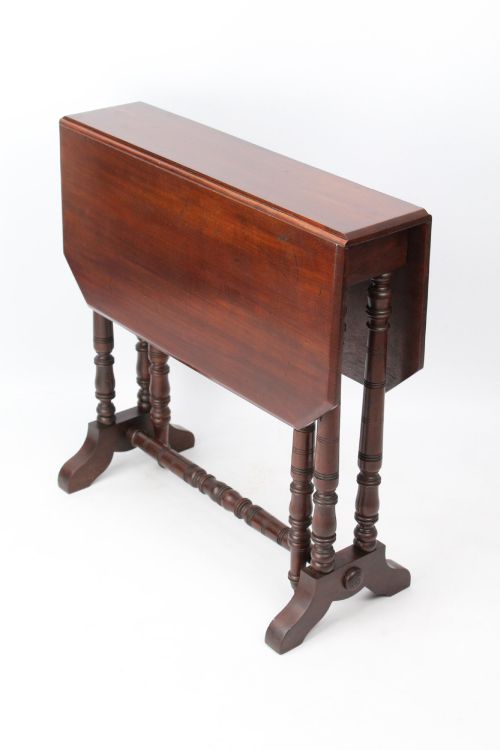


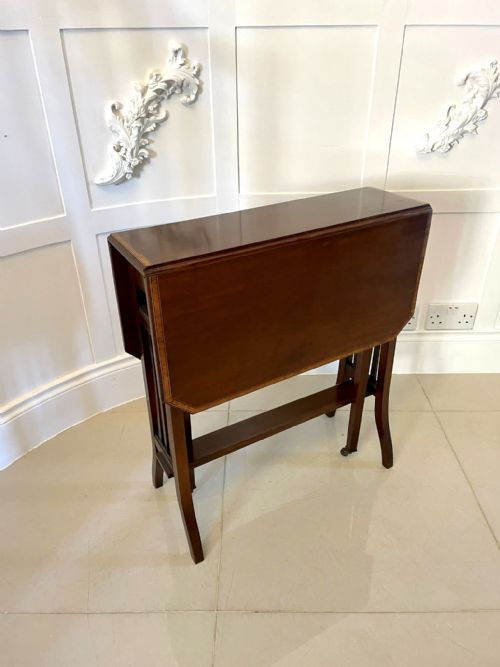


Narrow Mahogany Occasional Table
These narrow mahogany occasional table examples bring compact folding versatility to a room, offering drop leaves and slender frames designed for period interiors.

Narrow Mahogany Occasional Table
A narrow mahogany occasional table primarily takes the form of a Sutherland table, featuring a drop leaf action supported by swinging gate legs. These pieces emerge predominantly across Victorian and Edwardian periods, alongside a single William IV example.
Makers designed these compact tables to stand neatly against a wall when folded down and expand quickly for tea or reading. The selection includes oval tops, ebonised finishes, and delicate spider-leg Pembroke constructions.
How they were made
Cabinet makers utilised solid and veneered mahogany, frequently incorporating satinwood inlay to add contrast along the top and border. Structural elements rely on tight joinery for the folding gate legs and hinges that support the drop leaves.
Secondary details involve brass fittings and occasional ceramic or glass components, while ebonised mahogany variations demonstrate a dark chemical or painted surface treatment applied to the timber.
The listings span from the nineteenth century through the Edwardian era, featuring mahogany, satinwood inlay, and ebonised finishes.
What varies in quality
Quality rests upon the crispness of the satinwood inlay and the selection of figured mahogany timber for the top. Pieces that retain a tight, stable action in their gate legs without wobble display superior initial construction.
Proportion and scale dictate the desirability of the piece, with smaller tables maintaining more delicate turned or spider-leg supports that require precise carpentry to remain sturdy.
The Narrow Mahogany Occasional Table Glossary
- Sutherland table
- A narrow drop-leaf table with hinged flaps that fold down almost vertically, supported by swinging legs. It was patented in the nineteenth century and remains a space-saving staple.
- Gate leg
- A hinged leg that swings outward from the frame to support an open drop leaf. This mechanism provides sturdy weight distribution beneath an otherwise slender top.
- Pembroke table
- A small rectangular or oval table with two hinged flaps on opposite sides. Edwardian variations often feature slender spider-leg supports.
- Satinwood
- A pale, hard timber used extensively for decorative inlay and banding on darker mahogany surfaces. It creates sharp visual contrast in Victorian and Edwardian pieces.
- Ebonised
- Timber treated to imitate ebony, giving the mahogany a deep black finish. This technique appeared on select Victorian and Edwardian occasional tables.
Narrow Mahogany Occasional Table: Frequently Asked Questions
What is a Sutherland table?
A Sutherland table is a specific form of drop-leaf table characterised by a very narrow central top and exceptionally wide leaves. When folded, it takes up minimal floor space.
The hinged flaps drop down nearly to the floor, supported by pivoting gate legs that swing out from the narrow underframe.
How were these tables used?
Victorians and Edwardians utilised these compact tables as flexible furniture for parlours and drawing rooms. They served easily for tea, writing, or holding small lamps.
Because the leaves folded down completely, servants or residents could push the furniture against a wall to clear the centre of the room.
How do I date a table?
Dating relies on examining the timber grain, leg turning, and presence of decorative details like satinwood inlay. Victorian examples tend to feature heavier turned legs, while Edwardian pieces often appear lighter.
Construction marks, such as hand-cut screws or hinge types, also help narrow down the decade of manufacture between the mid-nineteenth and early twentieth centuries.
Are these tables sturdy?
Despite their slender frames, well-built pieces offer surprising stability when the gate legs swing fully into position. The clever geometry distributes weight evenly across the hinged supports.
Buyers should check that the pivot points on the gate legs move smoothly without excessive looseness in the joints.