




Muted Green Pastoral Artwork
Muted green pastoral artwork brings quiet country rivers, grazing cattle and rustic farmsteads into a room through calm earth tones and gentle brushwork.
Muted Green Pastoral Artwork
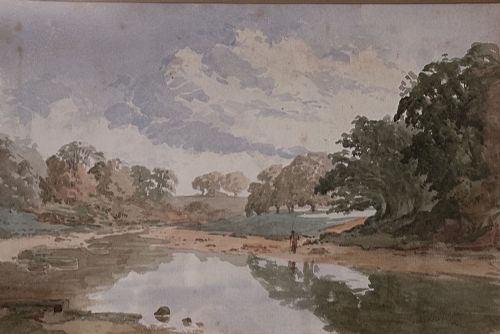
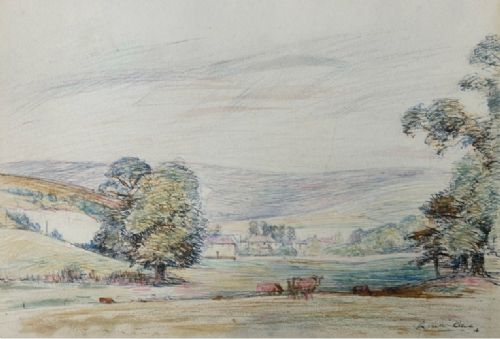
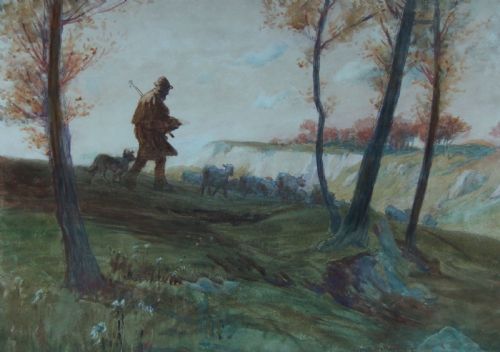
Muted green pastoral artwork encompasses traditional paintings and watercolours that capture countryside scenes through soft, natural palettes dominated by olive, sage and deep woodland tones. These pieces focus on rural life, featuring riverscapes, farm ponds, hayfields and figures engaged in quiet rural tasks.
The selections available here span from the nineteenth century through the Edwardian era and early twentieth century, with British Impressionism and Victorian naturalism strongly represented. Works range from intimate watercolour studies on paper to larger oil paintings on canvas.
Most examples depict specific English localities, from Yorkshire and the Thameside to fenland villages and Devon almshouses. Buyers encounter works by named artists alongside accomplished pieces from the wider Victorian and Edwardian periods.
Materials and Techniques
Artists working in this genre relied primarily on watercolour pigment applied to paper or oil paint laid upon canvas. Watercolour paintings often utilise fine washes to create atmospheric light over rivers and meadows, while oil paintings build richer textures across fields and farm buildings.
Support materials include traditional stretched canvas, heavy watercolour paper and occasional glass framing to protect works on paper. Pastels also appear alongside watercolours to capture the soft light of winter landscapes.
Framing frequently involves period giltwood or simple timber surrounds that complement the natural greens and browns of the composition.
Countless Victorian children apparently spent their entire youth lingering by rivers with fishing rods or chasing geese.
Assessing Quality
Quality in these pastoral scenes rests upon the artist's handling of atmospheric light and the subtlety of the green and earthy palette. Superior works command attention through confident brushwork that defines water, foliage and distant hills without stiffness.
Compositional balance distinguishes the finest examples, where figures, livestock and cottages integrate naturally into the wider landscape rather than appearing as isolated additions. The preservation of the paper or canvas surface also influences the enduring strength of the piece.
Ernest Higgins Rigg·Thomas Mackay·Henry Charles Fox·Thomas Hunn·John Pedder
The Muted Green Pastoral Artwork Glossary
- Watercolour pigment
- Finely ground colour suspended in a water-soluble binder, used on paper to create translucent washes of tone.
- Oil on canvas
- Pigment mixed with drying oil applied to a woven fabric stretched across a wooden frame, allowing rich colour depth and visible brush texture.
- British Impressionism
- A late nineteenth and early twentieth-century painting movement focused on capturing light and everyday rural subjects outdoors.
- Pastoral realism
- An artistic approach that depicts rural life and agricultural scenes with careful attention to natural detail and authentic working environments.
Muted Green Pastoral Artwork: Frequently Asked Questions
What subjects appear in these pastoral artworks?
These pieces focus on traditional countryside scenes, including rivers, farm ponds, hayfields and cattle grazing near rural cottages. Many works incorporate human figures such as children fishing, girls walking across bridges or farm workers in the fields.
Most compositions draw directly from recognisable English landscapes and regional villages.
How do I date a pastoral watercolour or oil painting?
Dating relies on stylistic clues, artist signatures, framing methods and materials characteristic of specific decades from the nineteenth century through the mid twentieth century. Victorian works often show detailed naturalism, while early twentieth-century pieces lean towards British Impressionism.
Signatures, dates inscribed by the artist and exhibition labels on the reverse provide definitive chronological markers.
How should I display and care for vintage paintings?
Keep works out of direct sunlight to prevent watercolour pigments and oil paints from fading over time. Maintain stable room humidity to protect paper supports, canvases and original wooden frames.
Glazed watercolours benefit from conservation-grade glass to filter ultraviolet light.
What is the difference between watercolour and oil paintings here?
Watercolour paintings use transparent water-soluble pigments on paper, creating lighter, more delicate atmospheric effects. Oil paintings utilise pigment suspended in drying oil on canvas, offering heavier texture and richer colour saturation.
Both mediums were widely used by pastoral artists to capture rural light and atmosphere.