



Muted Brown Landscape Painting
A muted brown landscape painting captures quiet earth tones and restrained palettes across British Impressionism and Victorian works.
Muted Brown Landscape Painting
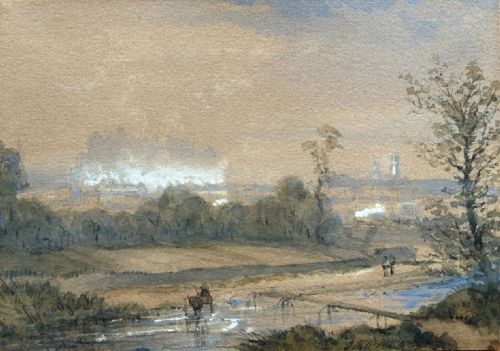
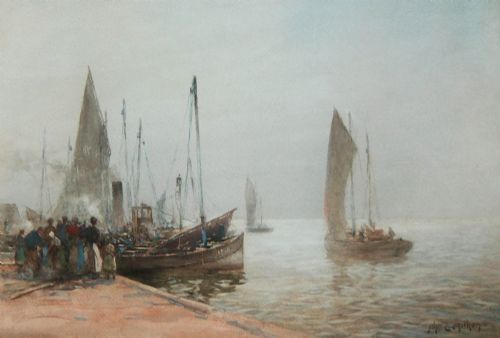
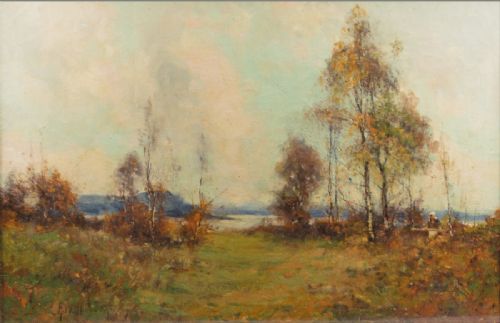
A muted brown landscape painting represents rural and coastal views rendered in subdued earthy tones, spanning periods from the nineteenth century through the mid twentieth century. These works frequently record historic British and European scenes, encompassing maritime harbours, agricultural valleys, and winter settings.
The pieces appearing here are predominantly watercolours on paper or oil paintings on canvas and board. Artists working within British Impressionism, the 20th Century British School, and Post-Impressionism utilise these tonal ranges to emphasise atmosphere and light over bright primary colour.
How they were made
Watercolour pigment applied to paper creates translucent washes that build subtle tonal depth, often enhanced with pencil underdrawing. This medium allows artists to capture atmospheric effects quickly, particularly in plein air studies of coastal docks and rural villages.
Oil paint laid onto canvas or prepared board provides heavier impasto and richer layering, enabling varied surface textures. Painters build these compositions through directional brushwork that defines landforms, water, and architecture using restricted earthy palettes.
Current listings feature watercolours on paper and oil paintings on canvas spanning the nineteenth and twentieth centuries.
What varies in quality
Compositional balance and spatial clarity separate skilled handling from rigid execution, as seen in how an artist arranges horizon lines and structures like harbours or cottages. Confident brushwork and purposeful pigment application convey depth and light without relying on heavy detailing.
The integration of tone and atmospheric perspective dictates the success of a subdued palette, ensuring earth tones remain luminous rather than flat. Works that demonstrate a clear structural grasp of the landscape maintain visual interest despite the absence of bright colour.
Kenneth Cozens·John R Prentice·James E Aitken·Alexander Wellwood Rattray·Alfred George Morgan·Gyrth Russell·Fred Lawson·Sir Thomas Newenham Dean·Ernest Pile Bucknall·Tom Clough·James Orrock·Louie Stanley Maurice Prince·Arthur Winter Shaw·Henry Charles Fox·Edmund Morris Wimperis·John D Walker·Harold Swanwick·William James Muller·Owen Bowen·Fred Mayor·Edward Killingworth Johnson·Ernest Higgins Rigg·George Graham·Robert Lesley Howey·William Greaves
The Muted Brown Landscape Painting Glossary
- Watercolour
- A painting method where fine pigment is suspended in a water-soluble binder and applied to paper. It produces translucent effects that rely on the white of the paper for luminosity.
- Impasto
- Paint applied thickly to a canvas or board so that it stands out from the surface. This technique allows brush marks to retain a physical texture and catch the light.
- Board
- A rigid flat support used instead of canvas for oil paintings. Artists frequently utilised wooden panels or millboard during the nineteenth and twentieth centuries.
- Plein air
- The practice of painting outdoors to capture direct observations of natural light and weather. This approach became central to impressionist landscape traditions.
- Post-Impressionism
- An art movement extending roughly from the late nineteenth century that rejected naturalistic depictions of light and colour in favour of expressive forms.
Muted Brown Landscape Painting: Frequently Asked Questions
What periods do these paintings date from?
The works span from the nineteenth century through the mid twentieth century, encompassing Victorian and Edwardian eras alongside later modernist movements.
Most examples reflect regional British and European schools operating between eighteen-eighty and nineteen-sixty.
Which materials were commonly used by the artists?
Artists worked primarily with watercolour pigment on paper or oil paint applied to canvas and rigid board.
These traditional supports and mediums allowed creators to balance detailed draughtsmanship with expressive tonal layering.
How should these artworks be framed and displayed?
Watercolours require conservation framing behind glass to protect the paper surface from environmental moisture and light damage. Oil paintings on canvas or board are typically housed in traditional wood frames that accommodate surface texture.
Placing them away from direct sunlight preserves the stability of both pigments and supports.
What subjects typically appear in these landscapes?
Common subjects include rural valleys, coastal fishing docks, marine harbours, and winter village scenes across Britain and Europe.
Artists frequently documented specific regional locations, recording historical topography through restrained palettes.