




Moulded Earthenware Jug
These moulded earthenware jugs offer practical service and rich historic character, bringing tangible texture and colour to any interior scheme.
Moulded Earthenware Jug
A moulded earthenware jug represents a functional ceramic vessel shaped by pressing clay into a patterned mould rather than throwing it entirely on a potter's wheel. Collectors seeking a moulded earthenware jug will find examples spanning from the Georgian period through the Victorian era and into the Edwardian years.
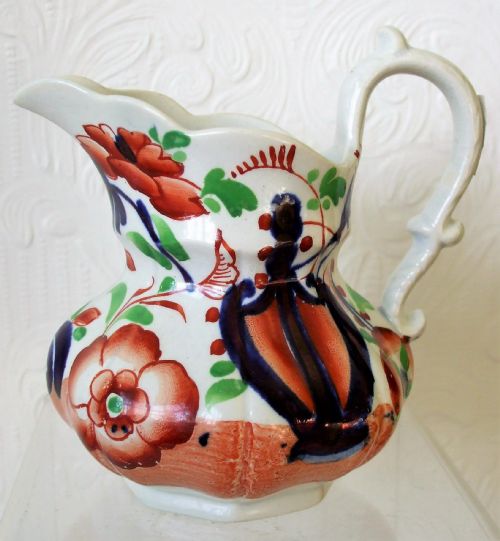
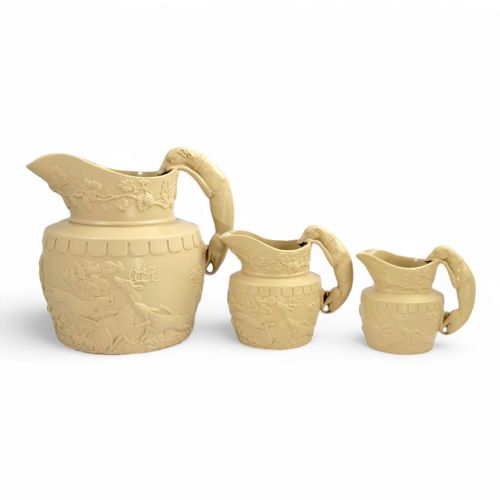
The assortment on this page draws heavily from nineteenth-century production, incorporating utilitarian milk jugs alongside larger pitchers and graduated sets. These pieces often feature distinctive relief decoration such as cabbage leaf moulding, hunting scenes, or botanical motifs.
Originating predominantly from Staffordshire potteries and related British workshops, these jugs display a range of historical styles including Regency, Gothic revival, and Victorian exuberance. Buyers encountering these listings will see bodies finished in varying techniques, from salt glaze and pearlware to rich copper lustre and majolica.
How they were made
Potters produced these vessels by pressing prepared earthenware or stoneware clay into plaster or metal moulds that carried the intended relief design on their inner surfaces. The resulting halves were joined together carefully before the handle and spout were attached by hand.
Surface decoration relied on specialised finishes applied prior to firing, including slip clay, coloured glazes, and salt glazing where salt was introduced into the kiln to produce a characteristic pitted texture. Cream-coloured sprigged ornaments were frequently moulded separately and applied to the main body before the final glaze firing.
Listings span the nineteenth century, incorporating Georgian pearlware, Victorian stoneware, and Edwardian majolica forms.
What varies in quality
Quality in these vessels is defined by the crispness of the moulded relief and the precision with which the decorative motifs emerge from the background surface. Finer examples retain sharp botanical details and clean junction lines where the mould halves met.
The application of glaze and colour also dictates distinction, separating standard utility ware from exhibition pieces finished with rich majolica enamels or detailed copper lustre. The balance of the handle and the symmetry of the pouring lip reveal the skill of the original workshop.
Ridgway & Sons·Phillips & Bagster·George Jones
The Moulded Earthenware Jug Glossary
- Pearlware
- A refined earthenware developed in the eighteenth century featuring a subtle bluish glaze that pooled in recesses to create a whiter appearance than creamware. This material formed the body of many early relief-moulded jugs.
- Salt Glaze
- A vitreous coating formed by throwing common salt into the kiln during high-temperature firing, producing an orange-peel texture across the stoneware body. This finish created durable, impervious surfaces suitable for everyday utility.
- Majolica
- A colourful lead-glazed earthenware style popular during the Victorian period, known for vivid botanical and animal reliefs such as bullrushes and lilies. The glazes fused during firing to yield deep greens, browns, and ochres.
- Copper Lustre
- A metallic glaze technique imparting a reflective, copper-hued sheen over an earthenware or ceramic body. This finish appeared frequently on nineteenth-century milk jugs and pitchers to create a brilliant reflective surface.
- Sprigging
- A decorative technique where small moulded clay motifs are applied directly to the unfired surface of a vessel using liquid clay as an adhesive. These raised ornaments added contrast and texture to plain stoneware or earthenware bodies.
Moulded Earthenware Jug: Frequently Asked Questions
What is a moulded earthenware jug?
A moulded earthenware jug is a ceramic vessel shaped using a patterned mould rather than being thrown solely on a potter's wheel. This technique allowed potteries to produce consistent relief patterns such as leaves, hunting scenes, and architectural motifs.
These pieces served functional roles in homes as milk jugs, water pitchers, or decorative table set pieces. Their production spanned multiple centuries, reflecting changing tastes from Georgian refinement to Victorian ornamentation.
How do I date a jug?
Dating relies on examining the ceramic body, the glaze type, and the stylistic cues of the moulding. Earlier pieces often utilise pearlware or salt-glazed stoneware bodies, while later Victorian examples frequently employ majolica glazes or copper lustre.
Maker marks, where present on the base, provide direct evidence of origin and production period. Stylistic elements such as Gothic revival influences or Regency handle designs also help narrow down the decade of manufacture.
Were these jugs used daily?
Many of these vessels were manufactured for practical domestic service, handling liquids such as milk, water, or beer on dining tables and in kitchens. Their durable earthenware and stoneware bodies made them suitable for regular household tasks.
Exhibition pieces and elaborate majolica or lustre jugs were sometimes reserved for display or formal hospitality. However, the heavy wear evident on many surviving examples points to active use in period households.
How should I display them?
These jugs display well on wooden dressers, open shelving, or inside glazed cabinets where their relief work and glazed surfaces catch the light. Grouping graduated sets together highlights the variation in scale and form achieved by nineteenth-century potteries.
Placing them away from direct heat sources and high-traffic edges ensures their historic glazes and applied handles remain secure. Simple placement on stable horizontal surfaces allows the detailed moulding to be appreciated from multiple angles.