


Mother of Pearl Sewing Casket
A mother of pearl sewing casket is a fitted repository for needlework tools, prized for its lustrous iridescence and cabinet-maker joinery.
Mother of Pearl Sewing Casket
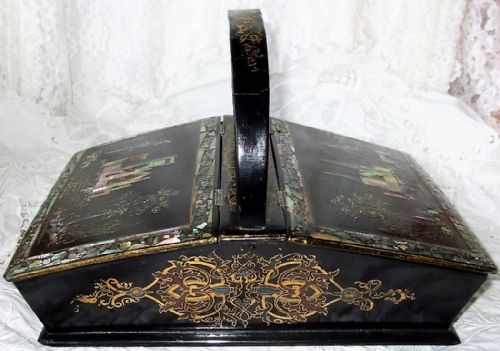
A mother of pearl sewing casket brings together small-scale cabinet making and decorative shell work designed to hold needles, threads and implements securely. When you browse for a mother of pearl sewing casket, you encounter nineteenth-century pieces shaped as rectangular boxes or sarcophagus forms.
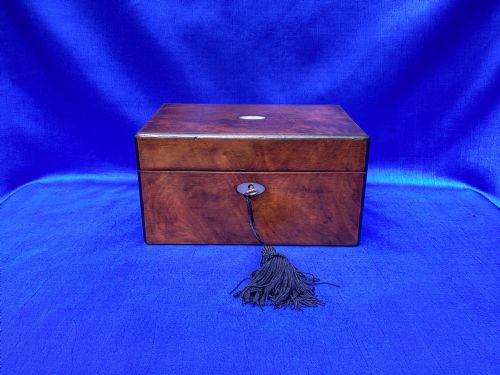
The selection here draws primarily from the Victorian and Regency periods, alongside nineteenth-century examples fashioned from rosewood or papier-mâché. These containers often retain fitted interiors designed to organise delicate sewing paraphernalia.
Materials and construction
Workshops built these caskets using solid timbers such as rosewood and coromandel, or moulded papier-mâché, applying thin plaques of iridescent mother-of-pearl to the exterior surfaces. Artisans frequently added brass stringing or inlay to frame the shimmering shell panels.
Interiors required precise woodworking to create removable trays and compartments, lined with materials like velvet and silk. Many examples incorporated original gold-fitted implements within these tailored compartments.
The listings span the Regency and Victorian eras, predominantly featuring rosewood and papier-mâché bodies inlaid with mother-of-pearl.
Assessing quality and execution
Quality rests upon the precision of the shell inlay and the stability of the timber carcase. Tighter joints and more intricate geometric patterns or floral motifs set the finer examples apart.
The survival of internal fittings, such as original silk linings and gold-plated tools, elevates a piece considerably. Finer caskets also display superior grain selection in woods like rosewood or coromandel.
The Mother of Pearl Sewing Casket Glossary
- Mother-of-pearl
- The hard, iridescent internal layer of certain mollusc shells, utilised by makers as thin decorative veneers on boxes and caskets.
- Sarcophagus
- A box form featuring a sloping lid and a stepped or domed profile, popular for nineteenth-century workboxes and caskets.
- Papier-mâché
- A composite material made of paper pulp mixed with glue and resin, pressed into moulds and lacquered to create smooth surfaces.
- Necessaire
- A small fitted case containing essential personal or sewing implements, often including gold or silver fittings.
- Stringing
- Inlay of contrasting wood or metal cut into thin strips to outline panels or edges on fine cabinet work.
Mother of Pearl Sewing Casket: Frequently Asked Questions
What goes inside a sewing casket?
These caskets contained compartments for spools, thimbles, bodkins, and needles. Many held specialised gold or silver tools.
Lined trays lifted out to reveal deeper storage space below for larger scraps of fabric and patterns.
How do I date a sewing box?
Dating relies on timber choices, construction methods, and hardware styles. Regency pieces often show lighter woods and classical proportions.
Victorian examples frequently introduce denser rosewood bodies or papier-mâché shells with elaborate mother-of-pearl geometric patterns.
Are these boxes waterproof?
No, these are delicate decorative objects made with wood, glue, paper pulp, and silk. Moisture damages the interior linings and warps the timber carcase.
Keep them away from direct sunlight and damp environments to preserve the shell veneer and adhesives.
What is the difference between a workbox and a sewing casket?
The terms are often used interchangeably by makers and dealers to describe decorative containers for needlework. Casket can imply a more architectural form, such as a sarcophagus shape.
Both types served the same domestic purpose for Victorian and Regency needlewomen.