


Moorish Inlaid Chair
These moorish inlaid chair examples bring intricate geometric parquetry and traditional Mashrabiya panels straight into modern rooms.
Moorish Inlaid Chair
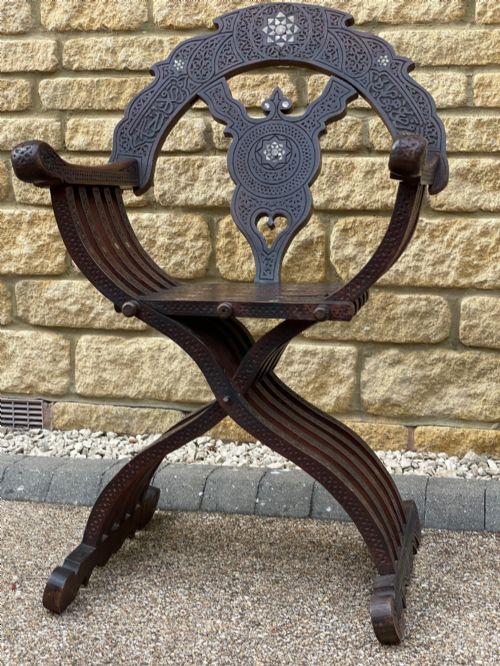
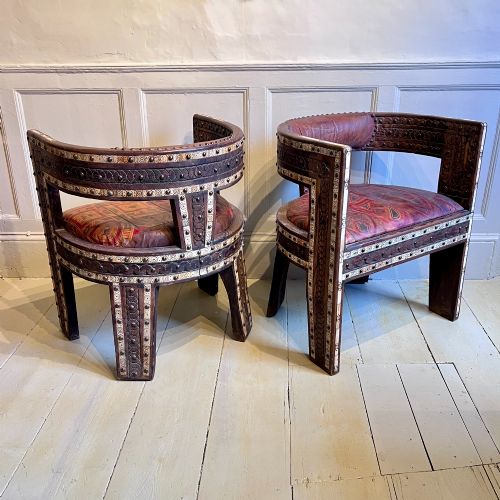
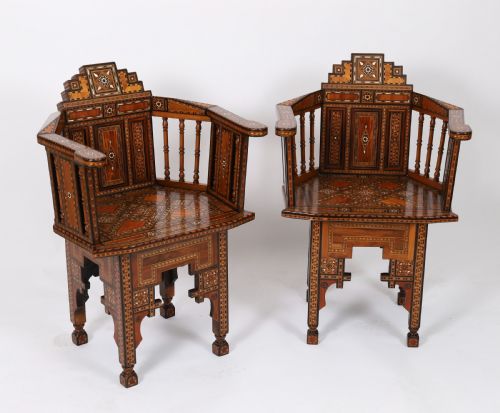
The physical forms on offer range widely, including structural armchairs, corner chairs with intricate latticework, folding chairs of X-frame design, and matching seating suites or conversation sets. Walnut, fruitwood, and various hardwoods provide the structural foundation for these seating pieces, often paired with leather elements or distinctive folding mechanisms.
Origins span from Damascus and wider Syria to North Africa, Andalucia, and Spain, reflecting diverse regional aesthetics within the broad Moorish Revival category. Pieces frequently display deep carving alongside complex geometric arrangements that draw directly upon Levantine and Hispano-Moresque design vocabularies.
What varies in quality
The precision and density of the parquetry work separates standard examples from exceptional ones, particularly regarding how tightly bone and mother-of-pearl tesserae fit within their wooden channels. Finer pieces maintain complete, undisturbed geometric patterns across curved surfaces and structural joints without noticeable gaps in the inlay.
Carving depth and crispness further distinguish individual examples, as deeply undercut foliage and sharp geometric relief require advanced carpentry skill. The complexity of integrated elements, such as multi-panel Mashrabiya latticework or complex X-frame folding constructions, reflects the ambition of the original workshop.
Certain folding chairs fold completely flat, proving that nineteenth-century nomads and Victorian parlor owners shared a deep appreciation for pack-flat convenience.
Liberty and Co
The Moorish Inlaid Chair Glossary
- Mashrabiya
- An architectural element adapted into furniture, consisting of turned wooden elements fitted together in complex repeating geometric lattices. These panels provide decorative transparency and structural stability to chair backs and sides.
- Parquetry
- A geometric mosaic of wood pieces used to cover surfaces in repeating patterns. In these chairs, parquetry frequently incorporates contrasting light and dark timbers alongside bone and nacre.
- Nacre-shell
- Also known as mother-of-pearl, this iridescent inner layer of mollusc shells is cut into thin plates and embedded into wooden frames. It catches ambient light to create shimmering contrast against dark walnut or fruitwood.
- X-frame form
- A folding chair construction where two intersecting legs form an X-shape from the side profile, allowing the seat base to collapse. This portable design echoes ancient folding stool traditions adapted through Islamic and Spanish woodworking.
- Hispano-Moresque
- A style reflecting the cultural synthesis of Islamic and Christian traditions in the Iberian Peninsula. It informs the design of specific folding chairs and structural armchairs originating from Spain and Andalucia.
Moorish Inlaid Chair: Frequently Asked Questions
How do I identify a Syrian chair?
Syrian examples often feature dense mother-of-pearl and bone parquetry covering extensive wooden surfaces, frequently utilising walnut or fruitwood foundations.
Look for intricate geometric star motifs and traditional Syrian joinery techniques embedded directly into the armrests and high back panels.
Are folding chairs structurally stable?
X-frame and folding chairs rely on pivoting crossed members that distribute weight evenly across the central axis when fully opened.
While designed for portability historically, surviving nineteenth-century examples maintain structural integrity when placed on level flooring.
What is a corner chair?
Corner chairs feature a diagonal seating orientation with a curved backrest supported by multiple upright spindles or solid corner posts.
Many examples incorporate Mashrabiya panels beneath the armrests, creating an enclosed and decorative seating profile.
How do I clean mother of pearl?
Mother-of-pearl inlay requires gentle dusting with a dry, soft cloth to prevent particulate buildup within the micro-crevices of the parquetry.
Avoid liquid cleaners or harsh chemical polishes, as moisture can weaken the historic adhesive holding the delicate shell pieces in place.