


Carved Curule Chair
A carved curule chair brings classical X-frame authority to a room, offering sculptural presence and portable seating through centuries of revivalist design.
Carved Curule Chair
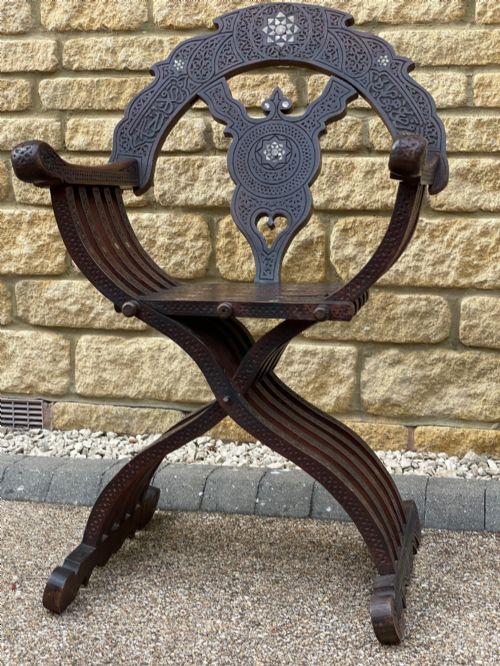
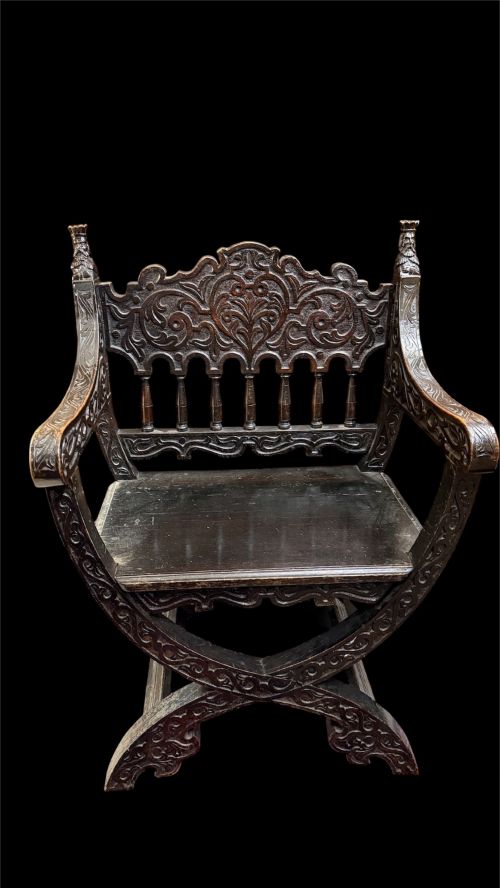
When you search for a carved curule chair, you encounter a distinct lineage of cross-frame seating rooted in ancient Roman forms and revived across multiple centuries. These pieces appear most frequently as 19th century armchairs, stools, and side chairs drawing on Renaissance, Gothic, and Middle Eastern decorative traditions.
The physical form relies on intersecting curved supports that create an X-shaped profile when viewed from the side. You will find these chairs executed in robust timbers like oak and walnut, often accompanied by folding mechanisms, elaborate carved details, or inlaid mother-of-pearl.
Variations on this page span from Victorian Gothic revival examples and Welsh Glastonbury seats to Syrian nacre-shell inlaid folding chairs and Venetian gondola forms. Each iteration adapts the fundamental X-frame architecture to domestic settings ranging from libraries to grand halls.
How they were made
Cabinetmakers constructed these frames primarily from dense hardwoods such as walnut and oak, selecting timber capable of bearing structural weight at intersecting diagonal joints. Selected pieces incorporate secondary materials including brass hardware, leather upholstery, and woven textiles.
Decorative embellishment relied on manual carving to articulate foliage, linenfold panels, or zoomorphic motifs directly into the wooden framework. Artisans working in Middle Eastern and Venetian traditions integrated intricate nacre-shell inlay and geometric parquetry into the wooden surfaces.
Materials documented across the inventory include walnut, oak, brass, leather, fabric, textile, mahogany, and painted wood.
What varies in quality
Quality resides in the precision of the joinery where the intersecting members cross and pivot or lock into place. Tighter tolerances and seamless alignment distinguish workshop execution from simpler regional production.
The depth and crispness of the carved ornamentation separate standard production from superior pieces. Skilled hand-carving retains sharp undercut details in walnut or oak, whereas lesser examples show softer, shallower relief work.
White, Allom & Co.
The Carved Curule Chair Glossary
- Curule chair
- An ancient Roman magistrate seat characterised by opposing curved legs forming an X-shape. This architectural silhouette serves as the foundational archetype for subsequent folding and cross-frame seating.
- X-frame
- A structural furniture design utilising two diagonal members crossing to form an X. This configuration provides inherent stability and often allows the chair to fold flat.
- Savonarola chair
- A specific type of Renaissance X-frame armchair featuring multiple curved wooden slats forming the backrest and sides. It is named after the 15th-century Florentine friar who famously used one.
- Glastonbury chair
- An ecclesiastical-style armchair constructed from solid oak with plank arms and a slanted panel back. Originating in England, it adapts cross-frame principles for stability.
- Nacre-shell inlay
- The decorative insertion of iridescent mother-of-pearl fragments into carved wooden channels. This technique defines Middle Eastern and Syrian furniture styles.
Carved Curule Chair: Frequently Asked Questions
Are carved curule chairs comfortable to sit in?
These chairs provide an upright, supportive seating posture owing to their rigid wooden construction and fixed armrests. Many historical examples were designed for formal or administrative spaces rather than extended lounging.
Adding a loose squab cushion or upholstered seat pad can soften the firm wooden base. The supportive geometry of the intersecting frame maintains correct posture during use.
How do I identify a Victorian Gothic revival curule chair?
Victorian Gothic revival examples typically feature dense oak frames decorated with architectural motifs such as pointed arches, quatrefoils, and heavy moulding. The woodwork often exhibits a dark, patinated finish characteristic of 19th-century revival interiors.
Look for structural joinery methods and hardware consistent with mid-to-late 19th-century manufacturing standards. These pieces frequently incorporate religious or heraldic symbolism into the carved back panels.
Did all curule chairs fold flat?
While the ancient Roman prototype was designed to fold easily for transport by military commanders, many later revival iterations are structurally fixed. Renaissance and 19th-century interpretations often glued or bolted the intersecting members together for permanent domestic stability.
You must examine the pivot points beneath the seat to determine if a specific piece retains its folding mechanism. Fixed frames offer greater rigidity, while functional folding chairs maintain their original portable nature.
How do I care for inlaid wooden chairs?
Protect inlaid surfaces by maintaining stable relative humidity in the room to prevent the wood from expanding and loosening the shell fragments. Dust the carvings regularly with a soft, dry brush to prevent particulate buildup in the recesses.
Avoid applying liquid polishes directly onto mother-of-pearl or exposed wooden joints. Professional conservation wax can be applied sparingly to nourish the timber without harming the delicate nacre.