



Mirrored Victorian Whatnot
These mirrored victorian whatnot pieces bring tiered display and reflected light to a room, offering both practical shelving and striking period presence.
Mirrored Victorian Whatnot
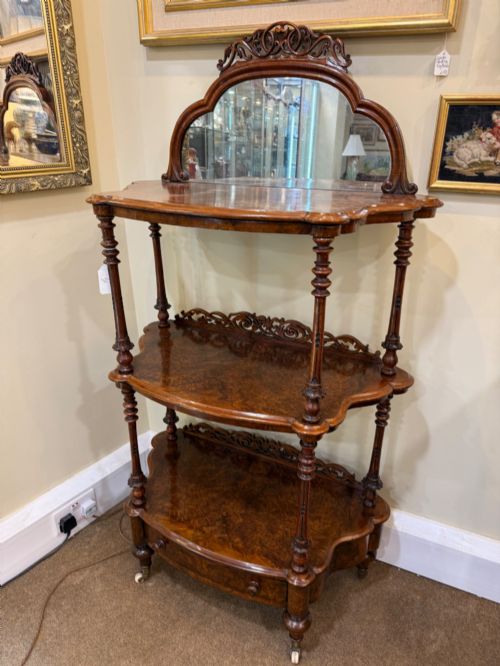
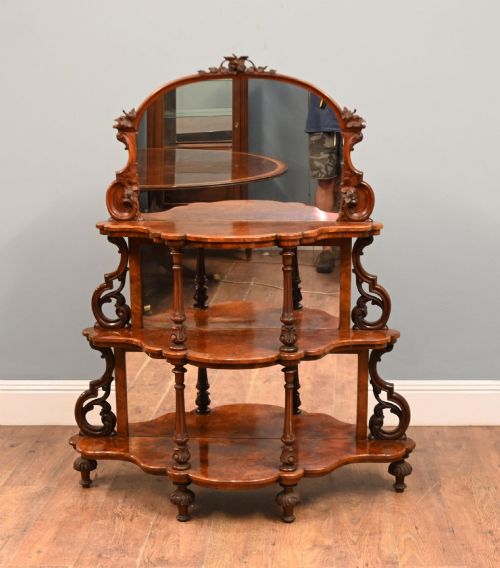
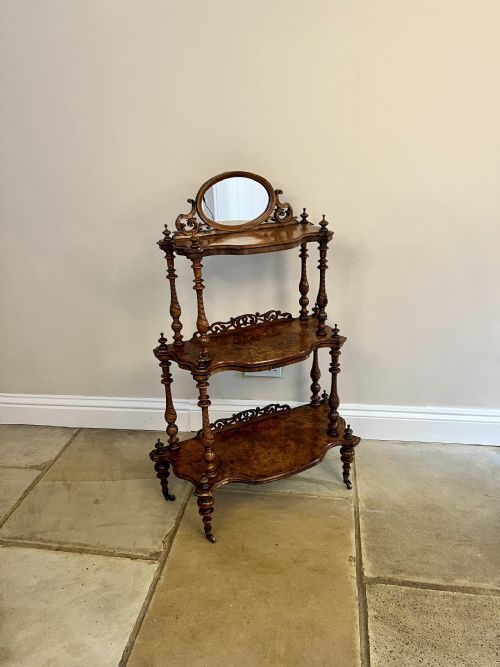
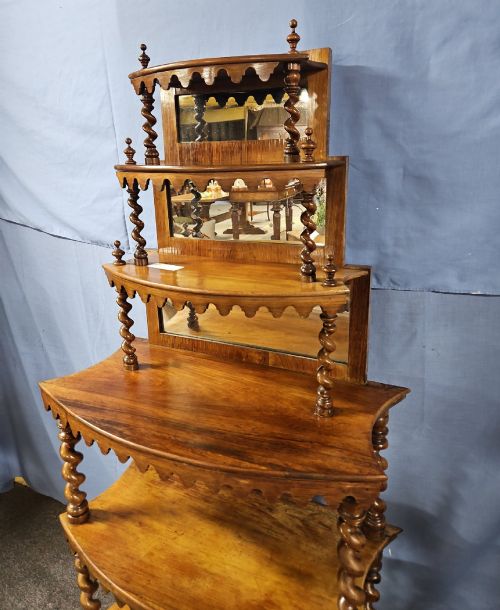
A mirrored victorian whatnot stands as a tiered display piece designed to hold books, ornaments, and small treasures while incorporating a glass mirror into its upper framework. Most examples met here date from the Victorian era and the nineteenth century, utilising upright tiers supported by turned columns or barley twist uprights.
Makers constructed these units in forms ranging from simple three-tier open shelving to complex combinations incorporating chiffoniers, sideboards, drawers, and lower cupboards. The integration of the mirror reflects light back into the room and illuminates the objects displayed on the shelves.
The dominant material choice across these pieces is walnut, frequently finished in burr walnut veneers, alongside rosewood and mahogany. Buyers encounter configurations that serve as etageres, freestanding shelving units, or combined display cabinets intended for principal reception rooms.
Materials and construction methods
Cabinet makers relied heavily on burr walnut, rosewood, and mahogany as the primary timber foundations, applying rich veneers to visible surfaces and incorporating fine marquetry inlay. The timber frames support glass mirrors, brass hardware, and occasionally porcelain details.
Structural uprights often feature turned wooden supports, hollow barley twists, and tiered platforms fixed together with traditional joinery. Lower sections frequently integrate fitted drawers or small side cabinets with glazed or panelled doors.
Mirrored Victorian Whatnot Retail Price Guide 2026
Typical asking prices for mirrored victorian whatnot among the pieces listed under this phrase on Sellingantiques today, from the lower quarter to the upper quarter. They describe what is for sale here now, not the wider market.
Twisted wooden supports bring a touch of Victorian whimsy to otherwise practical book and ornament shelves.
Distinctions in quality
Quality reveals itself in the selection of timber veneers, particularly the dramatic grain patterns of burr walnut and the depth of colour in rosewood and mahogany. Higher grade pieces incorporate precise marquetry inlay, delicate carving, and substantial brass fittings rather than plain or utilitarian construction.
The integration of the mirror and the stability of the tiered shelving structure dictate the standard of execution. Pieces that balance multiple tiers, integrated drawers, and complex turned or twisted supports with rigid assembly sit at the upper end of the range.
The Mirrored Victorian Whatnot Glossary
- Whatnot
- A freestanding piece of furniture consisting of multiple open shelves for displaying ornaments, books, or china. These units first gained popularity in the nineteenth century.
- Etagere
- A French term for a piece of furniture with a set of open shelves for displaying small objects. It functions similarly to a whatnot.
- Burr walnut
- A highly prized timber veneer showing swirling, knotted grain patterns caused by growths on the walnut tree. Cabinet makers utilised it on principal surfaces of fine Victorian furniture.
- Marquetry
- The art and craft of applying pieces of veneer to a structure to form decorative patterns and pictures. It appears on the surfaces of select nineteenth-century display furniture.
- Barley twist
- A decorative turning technique resembling a spiralling rope or barley sugar stick. It forms the vertical supports on certain Victorian display pieces.
Mirrored Victorian Whatnot: Frequently Asked Questions
What is a mirrored victorian whatnot used for?
These pieces function primarily as open display shelving for decorative objects, books, and small personal collections within a principal room.
The integrated mirror serves to reflect natural light and enhance the visual depth of the items placed upon the tiers.
Where should I place a whatnot in my home?
These units suit living rooms, studies, or hallways where their multi-tiered shelving and reflected light can be fully appreciated against a wall.
Because they combine display space with cupboards or drawers in certain configurations, they also function well alongside sideboards or chiffoniers.
What is the difference between a whatnot and an etagere?
The terms are often used interchangeably to describe multi-tiered open shelving furniture designed for display.
Etageres historically lean towards French decorative traditions, while whatnots commonly represent British nineteenth-century utilitarian display design.