




Mirrored Etagere Shelves
These mirrored etagere shelves bring open display and reflected light into a room, combining tiered timber structures with mirrored backs from the Victorian period.
Mirrored Etagere Shelves
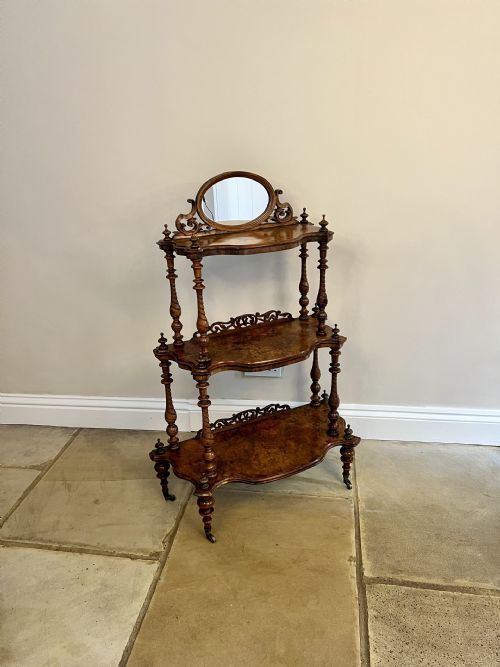
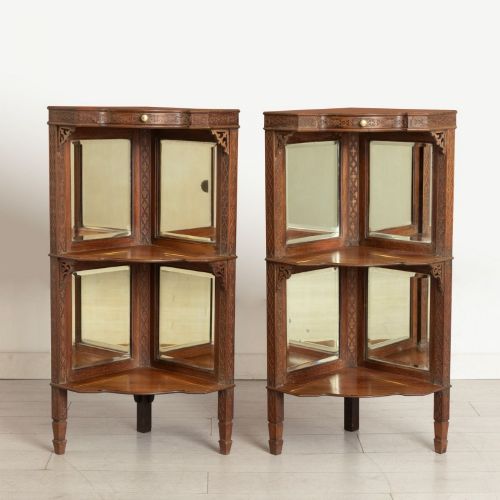
When buyers search for mirrored etagere shelves, they encounter tiered display furniture designed to hold small decorative objects against a reflective glass background. The examples listed on this page span the Victorian era, the nineteenth century, and the Georgian period, taking forms such as wall shelves, corner display cabinets, and floor-standing whatnots.
The most common version met here is the Victorian whatnot or wall shelf constructed from timber and fitted with an integrated mirror. These pieces combine multiple tiers for shelving with upright supports, utilising the reflective glass to brighten corners and amplify the display of ornaments.
How they were made
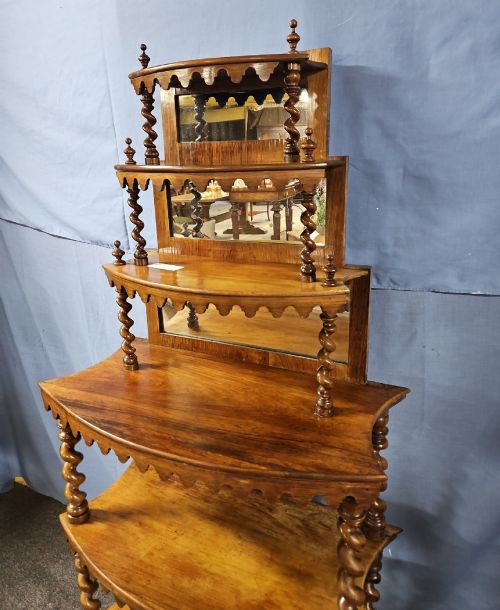
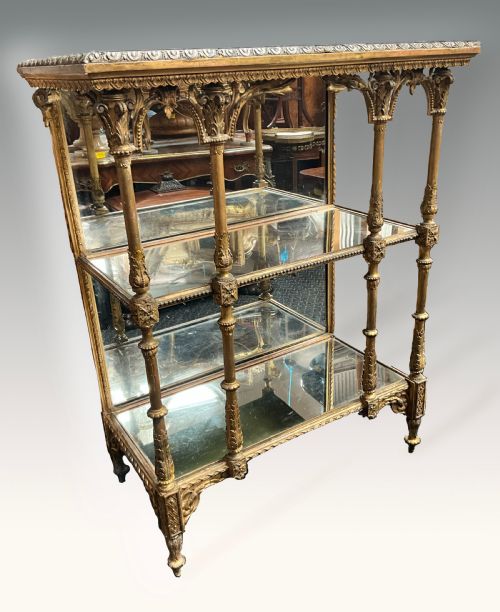
Cabinetmakers built these pieces using timbers such as mahogany, rosewood, walnut, and burr walnut, often enhancing the surfaces with marquetry inlay or brass details. Giltwood and gesso were also utilised for more ornate frames and mirrored wall brackets.
Mirrors were set into the backboards to catch the light, while structural elements included turned columns, barley twists, or carved brackets to support the individual tiers.
Periods represented span from Georgian and George IV through the Victorian era, Aesthetic Movement, and into the early twentieth century.
What varies in quality
The distinction between standard and superior pieces rests on the choice of timber figure, such as richly grained burr walnut or figured mahogany, alongside the crispness of carved gesso or inlay. Finer examples show careful attention to jointing and the integration of the mirror plate within the frame.
Design complexity also separates the range, moving from plain timber wall shelves to elaborately turned barley twist columns, multi-tiered étagères, and pieces bearing maker labels.
Edwards & Roberts·Strahan of Dublin
The Mirrored Etagere Shelves Glossary
- Étagère
- A piece of furniture consisting of a set of open shelves for displaying small objects. They are typically freestanding or designed to be mounted on a wall.
- Whatnot
- A multi-tiered open storage unit used for books or ornaments in nineteenth-century interiors. These often incorporated drawers or lower cabinets beneath the display shelves.
- Burr walnut
- A veneer taken from the burl growth of a walnut tree, prized for its swirling grain patterns. Cabinetmakers used it on high-end Victorian furniture.
- Giltwood
- Timber that has been coated with a thin layer of gold leaf. This finish appears frequently on nineteenth-century wall mirrors and display brackets.
- Marquetry
- Decorative woodwork where pieces of contrasting veneer are fitted into a ground material to form geometric or floral patterns. It adorns finer Victorian tabletops and cabinet doors.
Mirrored Etagere Shelves: Frequently Asked Questions
Where should I place a wall shelf?
Wall-mounted versions suit smaller rooms or spaces above a sideboard where floor space is limited. They provide a compact platform for small ceramics or framed photographs.
Ensure the fixings match the weight of the timber and the mirror plate securely.
How do I clean the mirror plate?
Use a soft cloth and a gentle glass cleaner applied to the cloth rather than directly onto the glass. This prevents moisture from seeping behind the old silvering.
Take care around the wooden rebate and any gilt gesso borders.
Can floor-standing whatnots hold books?
These tiers were primarily designed for ornaments, decorative ceramics, and curios rather than heavy library volumes. The lighter timber structures are best utilised for display rather than load-bearing storage.
Distribute lighter items across the upper shelves for visual balance.
What is a Canterbury whatnot?
A Canterbury is a specific type of low stand originally intended for holding sheet music or folios, often combined with tiers for general display. The inclusion of vertical dividers distinguishes them from standard shelving.
Victorian makers adapted this form to serve multiple display functions in the parlour.