


Mid Victorian Sofa
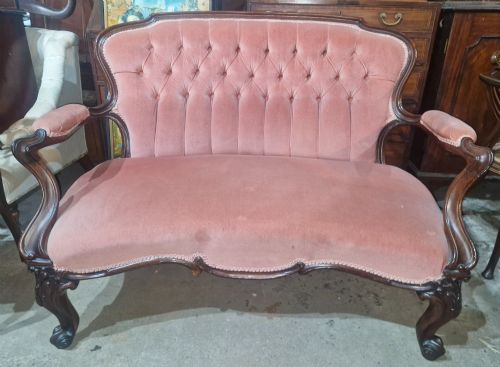
A mid victorian sofa brings nineteenth-century comfort and substantial timber framing into a room.
Mid Victorian Sofa
A mid victorian sofa combines nineteenth-century seating forms with robust timber frames in walnut, mahogany, and rosewood. These pieces emerge from the mid-nineteenth century, spanning decades from eighteen-fifty to eighteen-eighty.
Buyers encounter varied seating designs within this group, including classic chesterfield sofas, drawing room settees, and open conversation pieces. Frames show distinct revival influences, notably Victorian rococo and Louis the fifteenth styles.
The proportions suit formal reception rooms or substantial living spaces, offering deep buttoned upholstery and generous cushioned surfaces. Surviving examples often display carved wooden details along the crest rails and arm supports.
Materials and Construction Methods
Cabinetmakers utilised dense hardwoods such as mahogany, walnut, burr walnut, and rosewood to construct the primary structural frames. These timbers provide the foundational strength required for heavy nineteenth-century seating.
Surface treatments incorporate decorative veneers, intricate marquetry inlay, and carved wooden motifs. Brass castors frequently support the legs, while traditional fabric and leather finishes complete the upholstery work.
Recorded styles span Victorian rococo revival, Louis the fifteenth revival, and rustic country interpretations.
Distinctions in Build and Preservation
Quality rests in the crispness of the timber carving and the selection of figured wood veneers, such as burr walnut. Superior pieces maintain structural rigidity in the frame joints without excessive modern reinforcement.
The integrity of the original show wood, alongside well-executed marquetry inlay, separates standard production from finer cabinet work. Retained maker signatures or attribution further elevate the standing of a piece.
Holland & Sons·Howard & Sons·James Winter & Sons
The Mid Victorian Sofa Glossary
- Chesterfield sofa
- A fully upholstered deep-buttoned seating form with rolled arms of equal height to the back. This iconic design provides firm support and traditional nineteenth-century presence.
- Burr walnut
- A highly figured timber grain sourced from tree growths, utilised for decorative veneer surfaces. Cabinetmakers prize this material for its intricate swirling patterns.
- Marquetry
- The art of applying pieces of veneer to a structure to form decorative patterns. Craftsmen use contrasting woods to create detailed geometric or floral designs on tabletops and frames.
- Rococo Revival
- A nineteenth-century design movement mimicking eighteenth-century French curved ornamentation and asymmetrical motifs. This style appears frequently in carved wooden frames.
- Show wood
- The exposed polished timber portions of an upholstered seat frame. High-quality pieces display careful carving and polishing in these visible areas.
Mid Victorian Sofa: Frequently Asked Questions
How do I identify a mid victorian sofa?
Examine the timber species, such as walnut or rosewood, and look for stylistic cues like rococo revival carving. These details anchor the piece firmly in the middle decades of the nineteenth century.
Check for traditional joinery methods and the presence of exposed show wood frames. Comparing the proportions with documented examples helps confirm the period origin.
Were these sofas used for formal rooms?
These seating pieces served primarily in formal drawing rooms, libraries, and country house reception spaces. Their substantial frames and upholstered finishes were designed to display status and taste.
Today, they function well as statement seating in spacious modern living areas. Their classic proportions allow them to anchor traditional or eclectic room schemes.
What woods were used for the frames?
Cabinetmakers relied on dense native and imported hardwoods for structural integrity and decorative appeal. Walnut, burr walnut, mahogany, and rosewood dominate the surviving examples.
Secondary woods provide internal framing strength, while primary show woods receive careful polishing. This combination ensures lasting durability alongside refined visual texture.
Can I use a leather chesterfield daily?
Leather upholstered chesterfield sofas offer a durable surface well suited to regular everyday seating. The sturdy hardwood frames beneath provide robust structural support for daily use.
Routine conditioning keeps the leather supple and preserves the nineteenth-century finish. Proper care ensures the piece withstands modern living requirements.