


Mid Victorian Games Table
A mid victorian games table combines social play and fine cabinet-making, offering folding tops and hidden compartments designed for nineteenth-century parlour life.
Mid Victorian Games Table
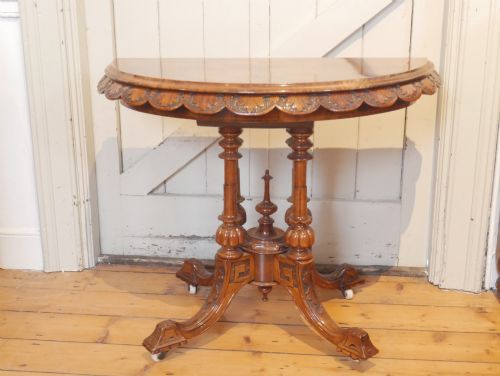
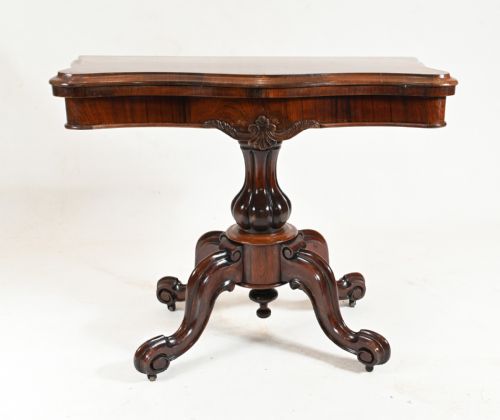
A mid victorian games table is a multifunctional piece of nineteenth-century furniture designed to house cards, chess, and backgammon whilst serving as a handsome centre table when closed. The examples on this page primarily take the form of card tables, occasional tables, and tea and card tables dating from the mid-nineteenth century.
How they were made
Cabinet-makers relied heavily on rich veneers of burr walnut and rosewood applied over solid pine or mahogany carcases, creating striking figured surfaces on the folding tops. Intricate satinwood inlay and brass mounts often punctuated the woodwork, particularly on pieces produced during the height of the Victorian period.
Structural ingenuity defined these pieces, employing pivot hinges, swivel tops, and underframes that concealed sewing bags, backgammon wells, or storage spaces. Carved pedestals and supports rested upon robust platforms with ceramic castors, allowing heavy timber tables to move easily across carpets.
Recorded forms span card tables, tea tables, chess top lamp tables, and combined work and games tables.
What varies in quality
The choice of timber grain sets the visual hierarchy, with heavily figured burr walnut and carefully matched book-matched veneers sitting at the top of the range. Plain mahogany or simpler secondary woods represent more utilitarian workshop output from the period.
Construction fidelity is visible in the precision of the turning, the crispness of the carved foliate details, and the seamless alignment of folding leaves. Superior examples maintain tight joints in their pivoting mechanisms and retain original baize linings and brass hardware.
The Mid Victorian Games Table Glossary
- Burr walnut
- A prized timber harvested from walnut tree growths, producing swirling, knotty grain patterns used extensively for table tops.
- Demi-lune
- A half-moon shape characteristic of tables with semicircular folding tops designed to sit flat against a wall.
- Baize
- A coarse woollen fabric, traditionally green, utilised to line the playing surfaces of card and chess tables.
- Book-matched
- A veneer technique where adjacent slices of timber are mirrored to create a symmetrical pattern across the surface.
Mid Victorian Games Table: Frequently Asked Questions
How do I use a mid victorian games table today?
These tables function well as console or sofa tables when the top is folded shut against the wall.
Opening the leaf reveals a baize-lined surface suitable for card games, board games, or daily desk work.
What woods were used for these tables?
Makers predominantly worked with walnut and burr walnut, complemented by rosewood, mahogany, satinwood, and kingwood.
Inlaid details often incorporated lighter decorative timbers to contrast against the dark polished body.
How do I identify a mid victorian period piece?
Dating relies on stylistic markers such as Victorian rococo revival carving, heavy burr walnut veneers, and brass and ceramic castors.
Mid-century pieces typically date from the eighteen-fifties through to the eighteen-eighties, bridging early and late Victorian aesthetics.
Are combination tables common?
Combination pieces frequently merge card playing with sewing storage or multi-board games like chess and backgammon.
Fitted interiors beneath the top often include compartments for counters, dice, and threads.