
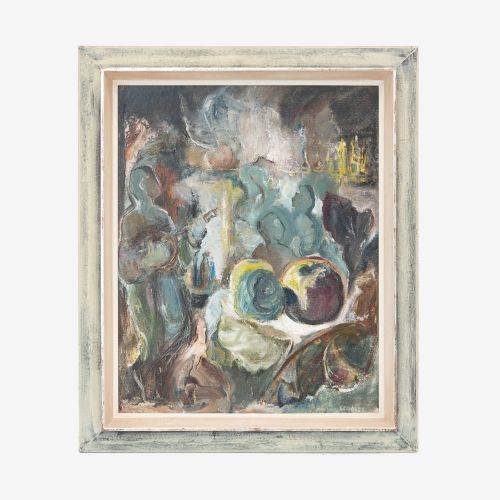


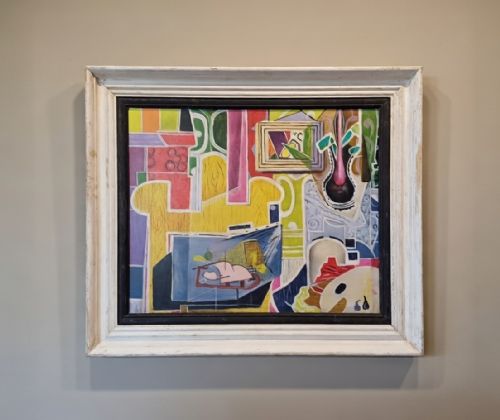


Mid Century Interior Painting
A mid century interior painting brings domestic life and studio spaces onto canvas, capturing the mood of a room with oil and board.
Mid Century Interior Painting
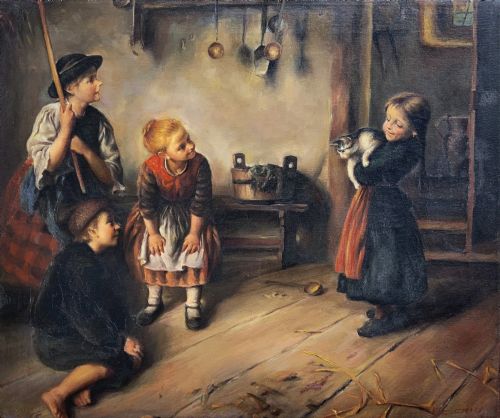
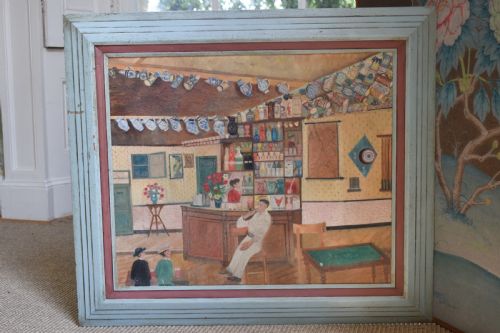
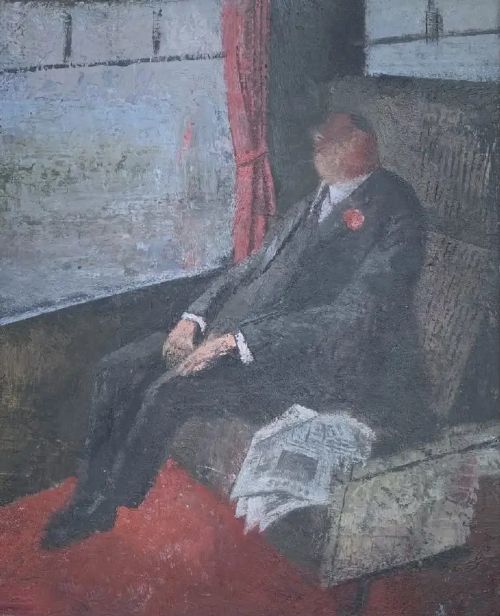
A mid century interior painting captures domestic rooms, bar scenes, studios, and industrial settings through the lens of twentieth-century movements. Buyers will find works ranging from Dutch genre subjects and quiet window views to constructivist factory scenes and bold abstract compositions.
The pieces on this page span several decades, with a strong concentration of works from the nineteen-fifties alongside examples from the nineteen-thirties, nineteen-forties, and nineteen-sixties. Artists work across diverse styles including Post-Impressionism, Modern British, Naive Art, and Mid-Century Expressionism.
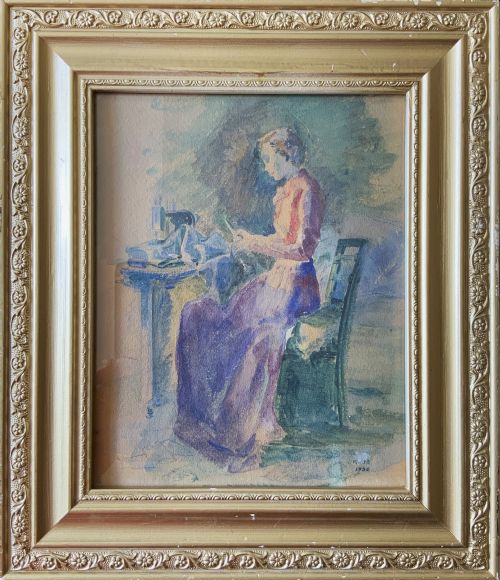
Most compositions are executed in oil paint, appearing on stretched canvas or wooden board, while selected examples utilise watercolour. Gilt wood frames frequently accompany these works, enhancing their presence as wall art.
How they were made
Artists built these compositions primarily using oil paint applied to canvas or rigid board, valuing the medium for its rich colour depth and workable drying time. Selected works also employ watercolour on paper, capturing lighter and more transparent tones.
Substantial wood frames, often finished with gold leaf, frequently house these paintings to complement the composition and protect the edges of the canvas or board.
The selection includes works from the nineteen-thirties to the nineteen-sixties, created on canvas, board, and paper using oil and watercolour.
What varies in quality
The strength of a mid century interior painting relies on the artist's command of light, shadow, and spatial arrangement within the room. Stronger examples demonstrate a confident handling of pigment and a deliberate balance of colour across the canvas or board.
Quality also rests in the vitality of the brushwork and the clarity of the interior narrative, whether depicting a quiet domestic moment or a bustling industrial scene. The integration of the frame with the painting further influences the overall coherence of the piece.
Lilian Colbourn·Roland Batchelor·Maud Frances Eyston Sumner·Charles Cameron Baillie·Zsuzsanna Suger
The Mid Century Interior Painting Glossary
- Oil on board
- A painting executed with oil-based pigment on a rigid wooden or composite board rather than woven fabric. This surface provides a firm support that prevents the flexing associated with stretched canvas.
- Constructivism
- An artistic style originating in the early twentieth century that emphasises geometric forms, industrial motifs, and structural clarity. In interior scenes, it often translates rooms into planes of line and planar shapes.
- Genre painting
- Artwork that depicts scenes from everyday life, such as domestic chores, social gatherings, or public interiors. These works record ordinary human activity rather than grand historical or mythological events.
- Gilt wood frame
- A wooden moulding coated with gold leaf or metallic paint to adorn and protect the perimeter of a painting. Such frames frequently reflect the decorative tastes prevalent during the period of the artwork's creation.
Mid Century Interior Painting: Frequently Asked Questions
What subjects do these interior paintings show?
These works depict a variety of indoor environments, including domestic rooms, artist studios, quiet windows, industrial factories, and bar scenes. Artists focus on the human presence within these enclosed spaces, often capturing intimate daily moments.
Subjects range from realistic portrayals of seamstress rooms and puppet makers to abstracted cubist compositions and constructivist factory floors.
How do I hang a painting on board?
Paintings on board require secure wall fixings suited to the combined weight of the heavy wooden support and its accompanying frame. Ensure the hanging wire or brackets on the reverse are firmly attached to the wooden structure.
Position the artwork away from direct sunlight and strong heat sources to protect both the oil paint and the underlying board from warping or fading.
How do I identify a nineteen-fifties interior painting?
Look for stylistic cues such as abstracted forms, flattened perspectives, and a mid-century colour palette applied to canvas or board. The handling of paint often balances figurative representation with the expressive brushwork characteristic of the post-war period.
Signatures, dates inscribed on the reverse, and framing materials often provide additional clues to confirm the production decade.