

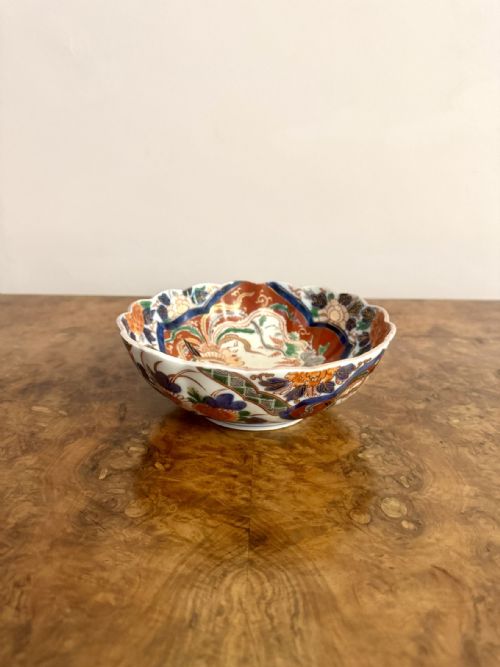
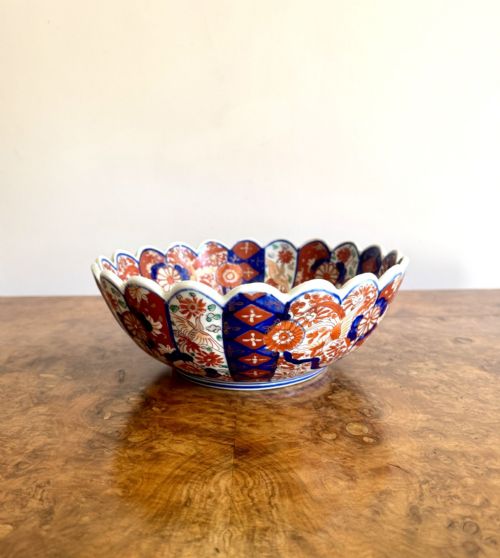


Meiji Imari Fruit Bowl
These meiji imari fruit bowl pieces bring rich palettes and traditional forms to the table, offering a striking centrepiece for any room.
Meiji Imari Fruit Bowl
A meiji imari fruit bowl is a decorative vessel originating from Japan, commonly encountered in porcelain with distinct periods spanning the nineteenth century and around nineteen hundred. Buyers searching for this phrase seek substantive decorative bowls that display traditional patterns across wide forms.
The pieces on this page lean heavily towards the Japanese Imari and Meiji period styles, often exhibiting scalloped or fluted edges. These bowls function as substantial centrepieces and decorative vessels rather than utilitarian tableware.
Most examples hail from the late nineteenth century, specifically between eighteen eighty and nineteen hundred. Their robust porcelain bodies and generous proportions make them enduring focal points for interior display.
How they were made
Makers shaped these bowls from hard porcelain, applying cobalt underglaze blue and enamel colours directly onto the clay body. Artisans frequently enhanced the surface detailing with gold leaf, gilt, and gilding to catch the light.
The finishing process relied on specialised glaze applications that sealed the painted decorations beneath a glossy protective layer. Firing techniques of the period produced the distinct tonal depths found across these porcelain surfaces.
Listings here feature porcelain bowls spanning the nineteenth century, eighteen eighty, eighteen ninety, and nineteen hundred.
What varies in quality
The distinction between standard examples and superior pieces rests largely on the precision of the hand-painted enamel work and the richness of the cobalt underglaze. Finer bowls exhibit crisp lines and a harmonious balance between the iron red, cobalt blue, and applied gilding.
Form also dictates standing, with scalloped edges, fluted profiles, and larger dimensions demanding greater skill from the potter and decorator. Weight, symmetry, and the careful placement of gold leaf separate the everyday decorative bowl from the exceptional centrepiece.
The Meiji Imari Fruit Bowl Glossary
- Imari
- A traditional style of Japanese porcelain decorated in underglaze blue, iron red, and gold. It originated in Arita and was exported extensively through the port of Imari.
- Meiji Period
- The era in Japanese history spanning from eighteen sixty-eight to nineteen twelve, characterised by opening trade with the West. Pieces from this time often show refined export craftsmanship.
- Cobalt Underglaze
- A blue pigment applied to pottery before glazing and firing, capable of withstanding high temperatures. This technique produces deep, permanent blue tones beneath a clear glass layer.
- Gilding
- The application of gold leaf or gold dust to the surface of porcelain. It adds rich highlights to the painted motifs.
- Scallop Edge
- A decorative border formed of curved segments resembling a scallop shell. This shaping requires careful manipulation of the soft clay before firing.
Meiji Imari Fruit Bowl: Frequently Asked Questions
How do I date a meiji imari fruit bowl?
Dating relies on stylistic markers, pottery techniques, and period attributions typical of Japanese export wares from the late nineteenth century. Many pieces align with the Meiji period and the transition into nineteen hundred.
Examination of the glaze, cobalt tones, and gold leaf application helps contextualize the era of manufacture. Reference to nineteenth century production standards provides further clarity on age.
Were these bowls used for actual fruit?
While named for fruit, large decorative bowls of this type often served as prominent centrepieces in formal rooms. Their robust porcelain construction made them capable of holding fruit, though many were preserved primarily for display.
Owners typically placed them on dining tables or sideboards to showcase the intricate enamel and gilt patterns. Their deep forms accommodated various household uses over generations.
How should I clean my porcelain bowl?
Gentle dusting with a soft, dry cloth is usually sufficient to maintain the surface glaze and gold leaf highlights. Avoid harsh chemical cleaners or abrasive scouring pads that might damage the enamel.
If washing is necessary, use lukewarm water and mild soap, drying the piece immediately with a soft towel. Take care around scalloped edges and gilded sections to preserve the finish.
What defines the imari colour palette?
The traditional palette relies heavily on rich cobalt underglaze blue contrasted with vibrant iron red enamel. Artisans then layered gold leaf and gilding across the design to create depth and warmth.
This distinct combination of colours remains the hallmark of Imari porcelain, making these pieces instantly recognizable on display. The interplay of blue, red, and gold defines the visual weight of each bowl.