

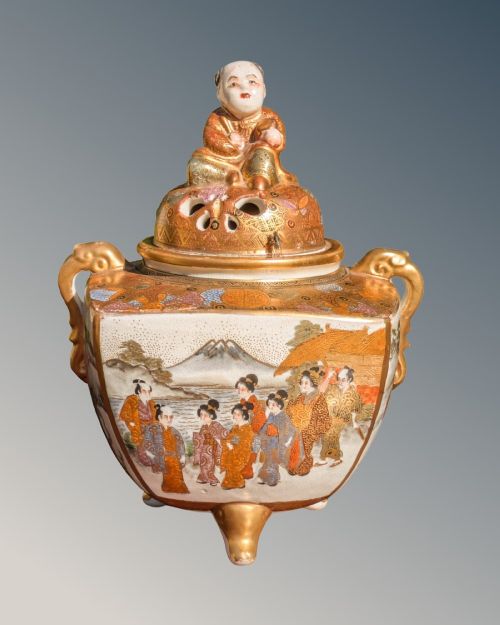


Meiji Ceramic Incense Burner
A meiji ceramic incense burner brings traditional Japanese craft into the room through sculpted figures, detailed overglaze enamel, and fine porcelain.
Meiji Ceramic Incense Burner
A meiji ceramic incense burner represents a distinct class of Japanese decorative art created during the 19th century and the early 20th century. These vessels, often termed koro, were produced in various forms including tripod vessels, miniature pieces, and elaborate lidded containers.
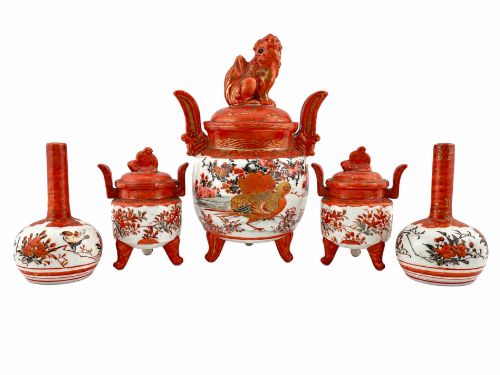
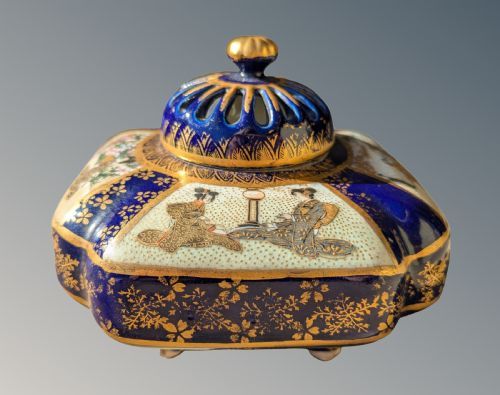
The pieces appearing on this page span several recognisable regional styles and bodies, most notably Satsuma earthenware, Kutani porcelain, Hirado porcelain, and Imari wares. They frequently incorporate traditional motifs such as Shishi lions, dragons, birds, and treasure ships.
Makers and studios of the Meiji period utilised specialised forms, ranging from single lidded koro to multi-piece porcelain garnitures accompanied by vases. Each type reflects the complex ceramic traditions of late nineteenth-century Japan intended for both domestic use and export.
Materials and methods of construction
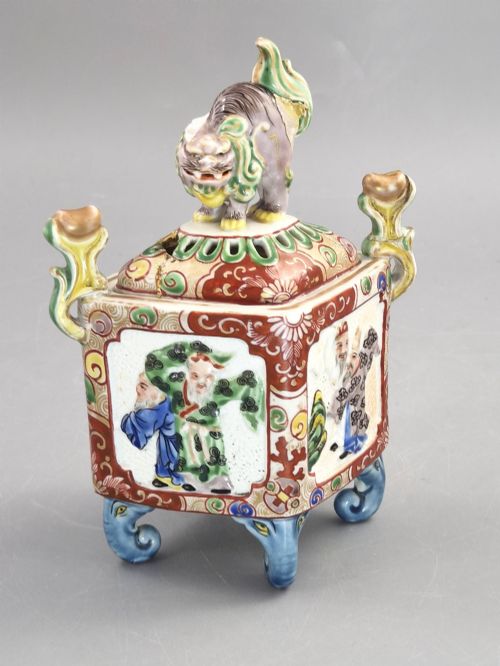
Potters formed these vessels using fine porcelain or earthenware bodies, often shaping them with sculpted additions such as elephant head feet, animal finials, and pierced reticulated walls. Artisans then applied intricate overglaze enamels, detailed gilding, and gold leaf to accent the pictorial panels and relief work.
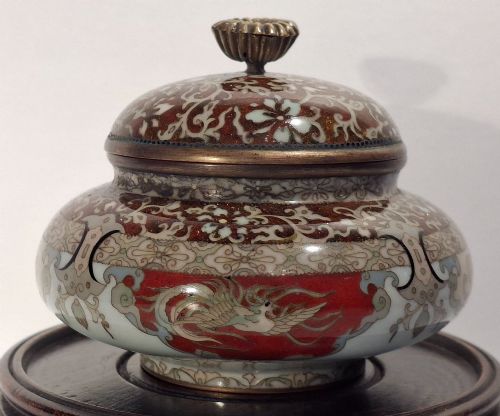
Many Satsuma and Kutani examples received careful hand-painted decoration featuring dense patterns and figural scenes, occasionally paired with bronze components or specialised enamel work. Workshops utilised high-temperature kilns to set the porcelain glazes and lower-temperature muffle kilns for the delicate enamel layers.
Meiji Ceramic Incense Burner Retail Price Guide 2026
Typical asking prices for meiji ceramic incense burner among the pieces listed under this phrase on Sellingantiques today, from the lower quarter to the upper quarter. They describe what is for sale here now, not the wider market.
Elephants rarely visited Japan, yet sculptors happily gave these incense burners sturdy elephant head feet.
Distinctions in execution and finish
The standard of a meiji ceramic incense burner depends on the crispness of the modelling in elements like the dragon or Shishi lion finial. Superior examples display precise control in the overglaze enamels and fine, even application of gold leaf without crowding the primary design.
Tsukamoto Hikokichi·Kinkozan·Kizan·Kotobuki-do·Shizan
The Meiji Ceramic Incense Burner Glossary
- Koro
- A Japanese incense burner, traditionally featuring a body, a pierced cover for releasing smoke, and often resting upon small feet. These vessels form the primary object type found in this category.
- Satsuma
- A style of Japanese earthenware characterised by a pale, ivory-coloured crackle glaze that provides a stable ground for detailed overglaze enamel and gilt decoration.
- Kutani
- A tradition of Japanese porcelain and ceramic production known for vibrant colour palettes, particularly iron red and green, alongside extensive gold embellishment.
- Imari
- A style of Japanese export porcelain featuring deep underglaze blue combined with iron red, green, and gilt accents arranged in complex geometric and floral patterns.
- Shishi
- A mythical guardian lion, frequently sculpted as a finial perched upon the lid of a koro to ward off malevolent spirits.
Meiji Ceramic Incense Burner: Frequently Asked Questions
What is a koro?
A koro is the traditional Japanese term for an incense burner, consisting of a lidded vessel designed to hold burning incense.
These pieces typically feature three feet and a perforated lid to allow scented smoke to drift freely into a room.
How do Satsuma and Kutani differ?
Satsuma wares utilise an earthenware body covered in a characteristic ivory crackle glaze, decorated with fine enamel and gold.
Kutani works are generally executed in porcelain with bolder, highly colourful palettes dominated by reds, greens, and intricate pictorial scenes.
Were these burners used daily?
Many examples served both functional roles in burning incense and purely decorative purposes within Japanese interiors and Western export markets.
The inclusion of delicate overglaze enamels and gold leaf on certain pieces suggests they were prized display objects.
How can I date a Meiji piece?
Dating relies on stylistic markers, studio signatures, and the specific ceramic body associated with the late nineteenth and early twentieth centuries.
The Meiji period spans from 1868 to 1912, encompassing transitional phases into the Edwardian era.