


Mediterranean Landscape Artwork
Mediterranean landscape artwork captures the sun-drenched coastal views and southern light that defined decades of European painting.
Mediterranean Landscape Artwork
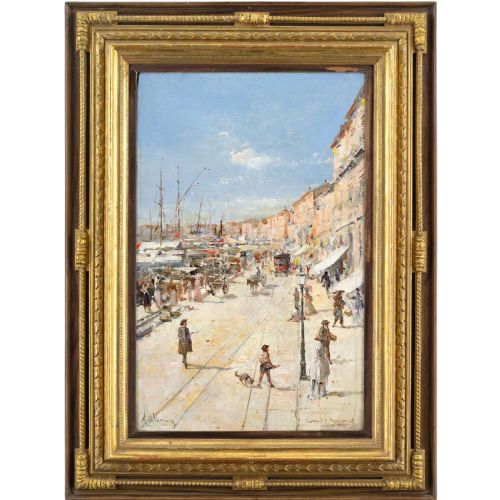
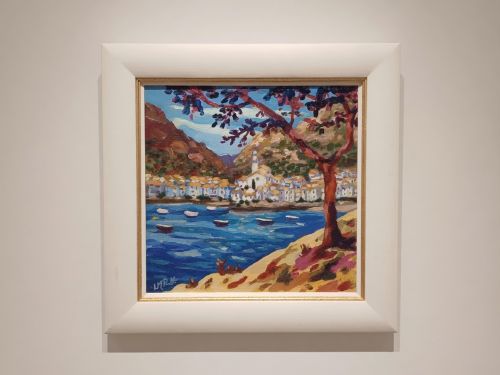
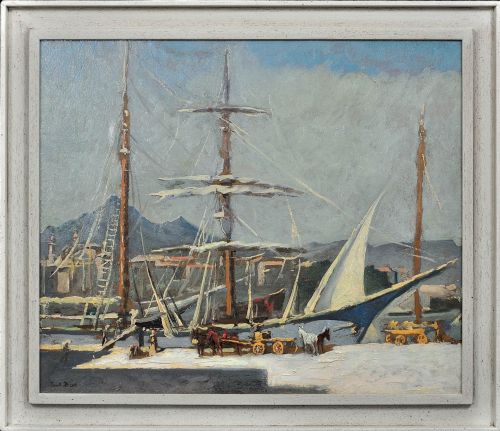
When searching for mediterranean landscape artwork, buyers encounter framed oil paintings, watercolours, and gouache pieces depicting coastal scenes, harbours, and southern towns. These works span from the nineteenth century through the mid-twentieth century, capturing regions such as the French Riviera, Provence, Italy, and Spain.
The versions most commonly met on this page include oil on canvas and oil on board, rendered in post-impressionist, modernist, and colourist styles. Subjects range from busy Sicilian ports and fishing villages to quiet olive groves and sunlit streets.
How They Were Made
Artists painted primarily with oil paint on canvas, wood panels, or paper mounted to canvas, building texture with brushwork or applied pigment. Watercolours on paper also appear, utilising fluid washes to render light and atmosphere.
Many works sit within gilded wood or simple period frames that complement the paintings, while others incorporate textured painted prints on board.
Several artists packed their boxes with gouache to chase the blinding sun of the Alpilles.
What Varies in Quality
Quality rests in the handling of light and the surety of brushwork, distinguishing observed atmosphere from formulaic repetition. Stronger examples convey the intense palette and distinct shadow of southern regions with conviction.
The distinction also lies in the strength of composition and the integrity of the original support, whether canvas, board, or paper.
Augusto Alberici·Paul Bret·Erich Mercker·Gustave Vidal·Jean-Baptiste Olive·Cecil Rochfort D'Oyly-John·Charles Malfroy·Edith E Caswall·Augustus William Enness·John William Gilroy
The Mediterranean Landscape Artwork Glossary
- Post-Impressionism
- A French art movement developing roughly from the late nineteenth century that rejected strict naturalism in favour of expressive form and colour. It heavily influenced subsequent depictions of southern light.
- Fauvism
- A style associated with early twentieth-century artists who used bold, non-naturalistic painterly colours directly from the tube. These works emphasise flat planes and vibrant emotional resonance.
- Gouache
- An opaque water-based paint that dries to a matte finish, often used on paper to achieve rich, saturated colour. It appears in dynamic mid-century modernist works.
- Provenance
- The documented history of ownership or origin for a work of art. It provides context for attribution and dating.
- Colourist
- An artist whose work prioritises harmonious or vibrant colour relationships over precise draftsmanship. Southern European scenes frequently inspired this approach.
Mediterranean Landscape Artwork: Frequently Asked Questions
What periods do these paintings cover?
The works span from the nineteenth century through the mid-twentieth century, encompassing periods like the 1910s, 1930s, and 1950s.
Individual pieces reflect stylistic shifts across these decades, moving from traditional realism to post-impressionism and modernist abstraction.
Where do these scenes usually depict?
The artworks focus predominantly on southern European locations, including the French Riviera, Provence, Sicily, Corsica, and coastal regions of Spain and Italy.
Subjects typically feature harbours, fishing ports, olive groves, and sunlit southern streets.
How should I frame an antique painting?
Many pieces arrive in their original or period frames, such as gilded wood, which often suit the aesthetic of the era. Preserving these original housings maintains the historical integrity of the artwork.
If framing an unframed work on canvas or paper, select a simple profile that complements the palette without overwhelming the composition.
What materials are common in these artworks?
Oil paint on canvas or wood board forms the majority of the available pieces, providing rich texture and depth. Watercolours and gouache on paper also appear frequently among the selections.
Supports occasionally include paper mounted on canvas alongside traditional wooden panels.