


Mechanical Repeating Clock
A mechanical repeating clock brings the rhythmic chime of the nineteenth century into a room on demand.
Mechanical Repeating Clock
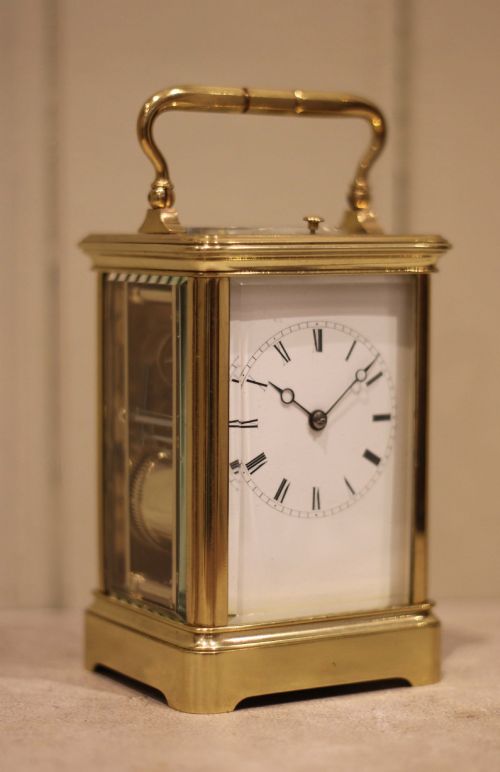
A mechanical repeating clock is primarily encountered as a carriage clock originating from nineteenth-century France or the Victorian era. These portable timepieces house complex escapements and strike trains designed to sound the hours and quarters when a button or pendant is pressed.
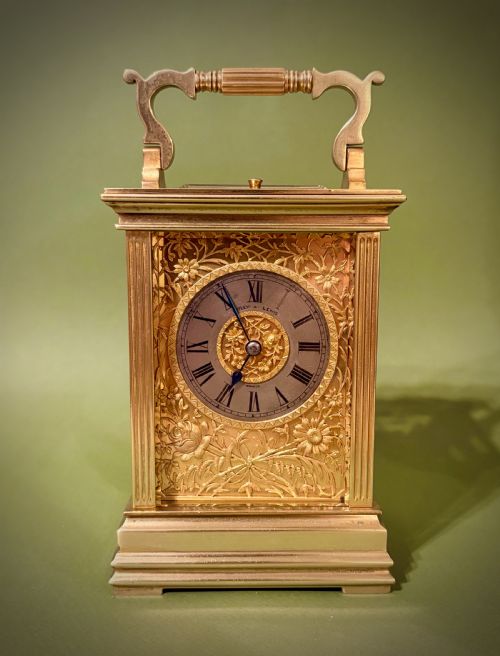
The prevailing form on this page is the brass and glass carriage clock, frequently presented in traditional gorge cases or engraved mountings. Makers from the period, including Drocourt and Henri Jacot, shaped these brass frameworks to display the internal escapement through bevelled glass panels.
Examples range from standard striking models to sophisticated grand sonnerie and petite sonnerie movements capable of playing changes without human intervention. Collectors select these objects for their combination of heavy cast brass housings, enamelled dials, and audible mechanical complexity.
Quality and Finish
Quality in a mechanical repeating clock rests upon the complexity of its movement and the crispness of its exterior cast brass or gilt bronze case. Finer examples feature grand sonnerie or petite sonnerie capabilities alongside fully engraved dial masks rather than plain white enamel.
One listed clock includes documented race horse interest from 1894, hinting at past days spent at the track.
Dwerrihouse And Bell·Drocourt·Captain Henry·Henry Jacot·J W Benson·Hunt And Roskell·L Epee·Henri Jacot·E White
The Mechanical Repeating Clock Glossary
- Carriage clock
- A small, portable spring-driven timepiece designed for travelling during the nineteenth century. They are fitted with a handle on top and enclosed in brass and glass cases.
- Gorge case
- A stepped, rectangular brass case style commonly found on nineteenth-century carriage clocks. The distinctive mouldings frame the bevelled glass panels on the top and sides.
- Grand sonnerie
- A complex striking train that sounds both the hours and the quarters automatically as time passes. It can also repeat the strikes upon depressing a button.
- Petite sonnerie
- A striking system that sounds the hours on the hour and the quarters at each quarter without repeating the preceding hours. This movement represents a high tier of nineteenth-century horology.
- Ting tang
- A two-hammer striking system that sounds two different pitches on bells or gongs to indicate half-hours or quarters. It adds an alternative acoustic quality to the repeating function.
Mechanical Repeating Clock: Frequently Asked Questions
What is a repeating carriage clock?
A repeating carriage clock is a portable nineteenth-century timepiece equipped with a mechanism that sounds the last struck hour or quarter when a plunger or button is pressed.
This function allowed owners to check the time audibly in the dark without striking matches or viewing the dial directly.
How do I wind a mechanical repeating clock?
Winding is typically performed via arbours located on the backplate of the movement using a matching key. Separate springs govern the timekeeping, striking, and alarm trains.
Care must be taken not to over-wind the springs, and the hands should be advanced cautiously according to the maker's instructions.
What is the difference between grand and petite sonnerie?
A grand sonnerie strikes both the hours and the current quarters automatically at every quarter-hour interval. A petite sonnerie strikes only the quarters at the quarter-hour and reserves the full hour strike for the top of the hour.
Both systems represent advanced mechanical achievements found in top-tier nineteenth-century horology.
How do I care for a brass carriage clock?
Keep the clock away from direct sunlight, extreme temperature fluctuations, and damp environments to protect the enamel dial and internal steel components. The heavy brass case benefits from occasional dusting with a soft dry cloth without using abrasive metal polishes.
Professional servicing every few years ensures the train oils do not gum up the delicate gear teeth and escapement.