

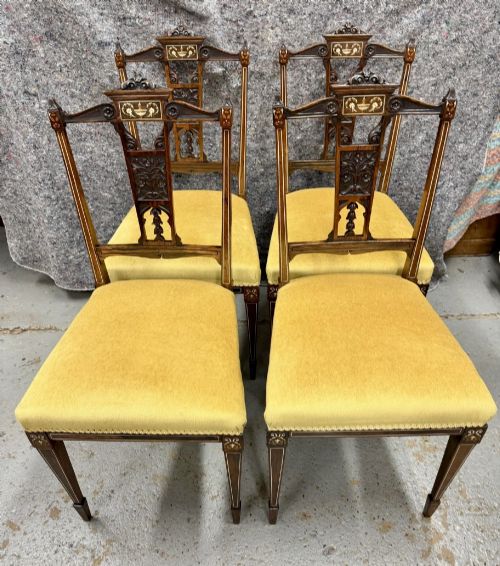


Marquetry Wood Dining Chair
These marquetry wood dining chair options bring together intricate botanical motifs and time-honoured cabinetmaking to elevate any formal dining room.
Marquetry Wood Dining Chair
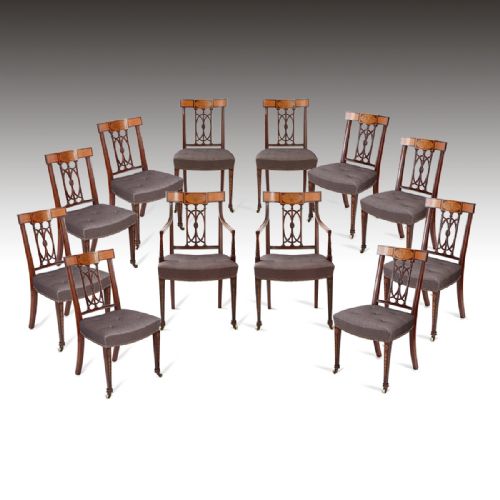
A marquetry wood dining chair combines structural timber framing with decorative pictorial veneers applied to the backrest or seat rail. These seating options emerge across multiple eras, ranging from early nineteenth-century Regency examples to Edwardian revival pieces.
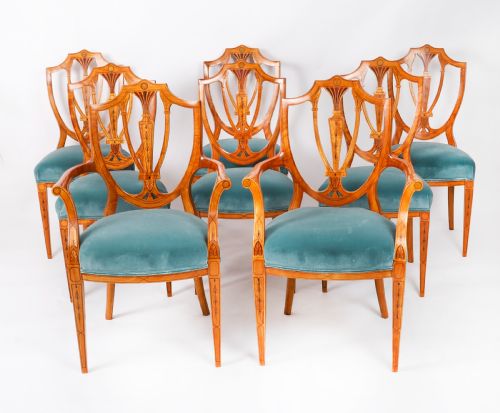
The primary forms on this page include standard side chairs, carver armchairs, and salon hybrids designed for both dining and parlour use. Mahogany, rosewood, and satinwood serve as the main carcase timbers, enriched with contrasting boxwood and wood inlay.
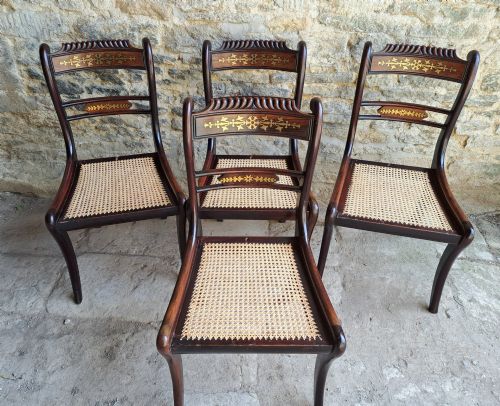
Buyers will most frequently encounter Edwardian mahogany designs alongside Regency brass-inlaid rosewood sets. Each variation offers distinct regional and stylistic interpretations of classical ornament, from Sheraton Revival lines to French Rococo influences.
Materials and construction
Cabinetmakers construct the foundational frames using dense hardwoods like mahogany, walnut, and rosewood, ensuring structural integrity for daily seating. Faux rosewood graining also appears on select Regency frames to simulate exotic timbers.
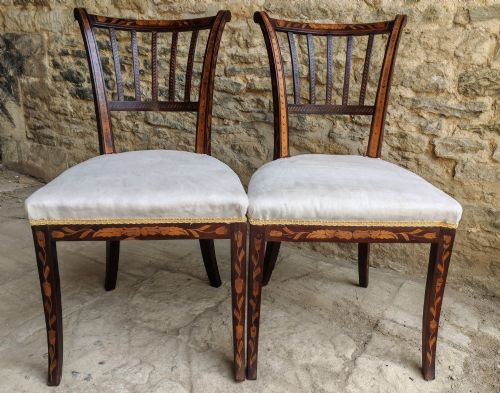
Intricate surface decoration relies on fine wood inlay and parquetry, wherein contrasting veneers such as satinwood and boxwood are precisely fitted together. Brass stringing and ormolu mounts further accentuate the timber surfaces on specific Regency and nineteenth-century pieces.
Upholstery elements incorporate traditional textiles including velvet and patterned fabric, secured over padded seats that complement the timber tones.
Marquetry Wood Dining Chair Retail Price Guide 2026
Typical asking prices for marquetry wood dining chair among the pieces listed under this phrase on Sellingantiques today, from the lower quarter to the upper quarter. They describe what is for sale here now, not the wider market.
Listings feature timbers including mahogany, satinwood, rosewood, walnut, and boxwood, paired with fabric and velvet upholstery.
Distinctions in craftsmanship
The refinement of the veneer work largely dictates the standing of a marquetry wood dining chair, distinguishing crisp botanical details from simpler geometric banding. Tighter tolerances in the fitted wood sections demonstrate superior cabinetmaking skill.
The choice of primary timber and secondary framing timbers significantly impacts the integrity of the piece, with dense rosewood and well-figured mahogany representing the upper tiers. Maker attribution, such as documented cabinetmakers like Cowtan & Sons, adds distinct historical pedigree.
The preservation of original brass inlay, ormolu mounts, and structural joinery without excessive timber replacement ensures a higher standard of authenticity.
Cowtan & Sons
The Marquetry Wood Dining Chair Glossary
- Marquetry
- Decorative veneer work assembled in pictorial patterns on a timber ground. This technique uses contrasting woods to create elaborate floral or geometric designs across the backrest.
- Parquetry
- Geometric mosaic woodwork formed by small pieces of veneer arranged in repeating patterns. It differs from marquetry through its strict reliance on regular angles and lines.
- Ormolu
- Gilt-bronze decorative mounts applied to furniture frames. These cast metal details appear on nineteenth-century pieces to highlight structural joints.
- Stringing
- Thin inlaid lines of contrasting timber set into the surface of the primary wood. This linear detail defines the edges of panels and chair rails.
- Carver
- An armchair designed with elbow supports, typically placed at the head of a dining table. These seating pieces match the aesthetic of accompanying side chairs in a set.
Marquetry Wood Dining Chair: Frequently Asked Questions
How do I care for antique marquetry chairs?
Keep wooden seating away from direct sunlight and rapid temperature fluctuations to prevent the delicate veneer from lifting or drying out. Apply a quality microcrystalline wax periodically to nourish the timber grain.
Avoid using modern liquid polishes that contain silicone, as these can damage historical French polish surfaces over time. Gentle dusting with a soft, dry cloth is sufficient for routine maintenance.
Can these chairs be used for daily dining?
Many nineteenth-century and Edwardian examples remain structurally robust enough for regular use around a dining table. Checking the stability of the joinery ensures they can safely accommodate daily seating.
For exceptionally fragile or heavily inlaid pieces, lighter use or placement in low-traffic rooms preserves the intricate veneer work. Consulting a conservator helps determine the load capacity of older frames.
What is the difference between side chairs and carvers?
Side chairs are armless dining seats built with narrow profiles to allow multiple pieces to fit compactly around a table. They form the majority of standard dining sets.
Carvers feature integrated armrests and generous proportions, traditionally reserved for the head and foot of the dining table. They share matching design motifs with the accompanying side chairs.