
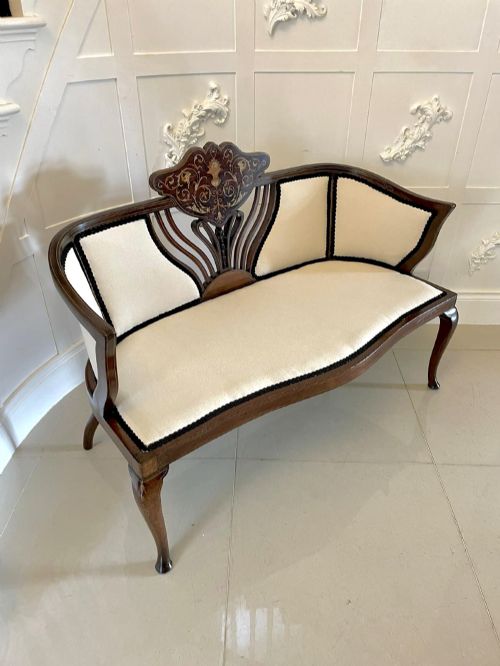
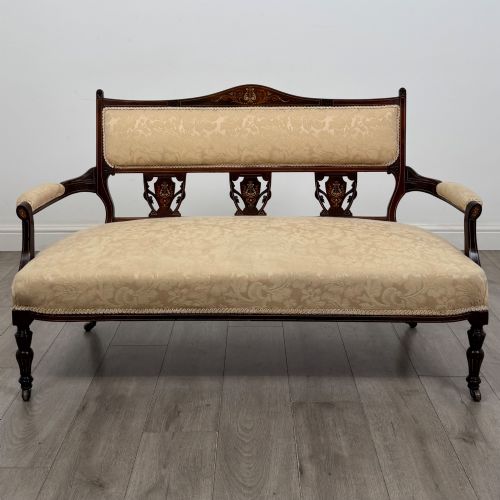
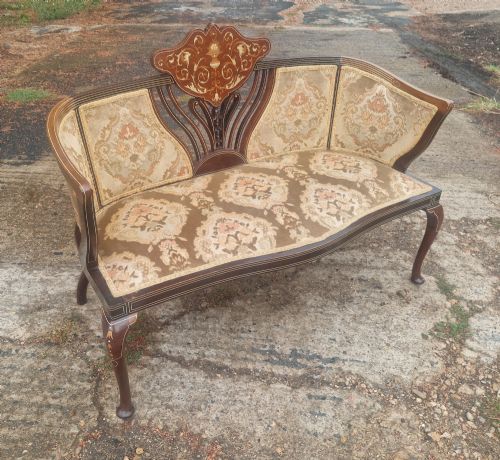


Marquetry Salon Bench
These marquetry salon bench selections are gracious seating forms designed for formal rooms, offering intricate timber ornamentation and period character.
Marquetry Salon Bench
When you search for a marquetry salon bench, you are looking at sophisticated Victorian and Edwardian seating designed for formal interiors, including salon settees, end-of-bed sofas, and multi-piece seating suites. The examples you encounter on this page span the late nineteenth century through to the Edwardian period, capturing diverse revival movements such as Sheraton, Egyptian, and Moorish styles.
The primary forms take shape as two-seater settees and sofas, often fashioned with decorative inlay work across the timber frame. These pieces function as decorative focal points within a room, combining practical seating with ornamental woodcraft that reflects the taste of nineteenth-century and early twentieth-century makers.
How They Were Made
The foundational frames are constructed from dense timbers such as mahogany, rosewood, and satinwood, providing a sturdy structural base for detailed decorative work. Artisans applied intricate boxwood inlay and marquetry patterns directly onto the wood surfaces to create contrasting geometric and floral designs.
Many examples incorporate delicate bone details alongside the marquetry inlay, enhancing the visual depth of the timber work. Upholstery elements typically feature fabric or damask, completing the construction of these decorative salon seats.
Several Edwardian sofas find a second life at the foot of the bed, proving that Victorian parlour seating makes an exceptional bedside companion.
What Varies in Quality
The standard of timber selection and the complexity of the marquetry inlay determine the visual distinction of each piece. Finer examples display meticulous contrast in the boxwood and satinwood elements, whereas simpler versions rely on more straightforward decorative banding.
The intricacy of the revival styling, whether leaning toward Sheraton Revival elegance or Moorish Revival complexity, influences the character of the seating frame. Furthermore, the condition of the original timber and the retention of detailed bone inlay separate standard production pieces from higher-tier items.
The Marquetry Salon Bench Glossary
- Marquetry Inlay
- Decorative wood veneers applied to a structural base in detailed pictorial or geometric patterns. This technique defines the surface ornamentation of the timber frames.
- Satinwood
- A hard, lustrous timber originating from tropical trees, valued for its pale yellow colour. It is frequently utilised for contrasting inlay work.
- Damask Upholstery
- A reversible figured fabric woven on a jacquard loom, commonly employed for covering period salon seating. It provides a textured surface that complements polished wood.
- Sheraton Revival
- A late nineteenth-century design movement inspired by the classical furniture of George Sheraton. It is characterised by refined proportions and delicate inlay.
Marquetry Salon Bench: Frequently Asked Questions
Where were salon benches placed?
These settees were traditionally positioned in formal drawing rooms, reception spaces, or grand parlours where guests were entertained.
Later Edwardian examples often served as end-of-bed seating within private chambers, combining decorative timber work with functional resting places.
How do I care for the woodwork?
Maintain the timber by keeping the surface away from direct sunlight and excessive temperature fluctuations, which can dry out the polished finish.
Apply a traditional wax polish occasionally to nourish the mahogany, rosewood, or satinwood without building up heavy residues.
Can I reupholster these settees?
Many salon benches are suitable for re-upholstery, allowing you to update worn fabric or damask while preserving the historic timber frame.
Select traditional upholstery materials that respect the period aesthetic of the nineteenth-century or Edwardian design.
How do I date these pieces?
Dating relies on observing the stylistic markers, such as the transition from heavy Victorian proportions to lighter Edwardian or Sheraton Revival forms.
Materials like satinwood inlay and bone detailing also point towards specific manufacturing decades spanning the late nineteenth and early twentieth centuries.