

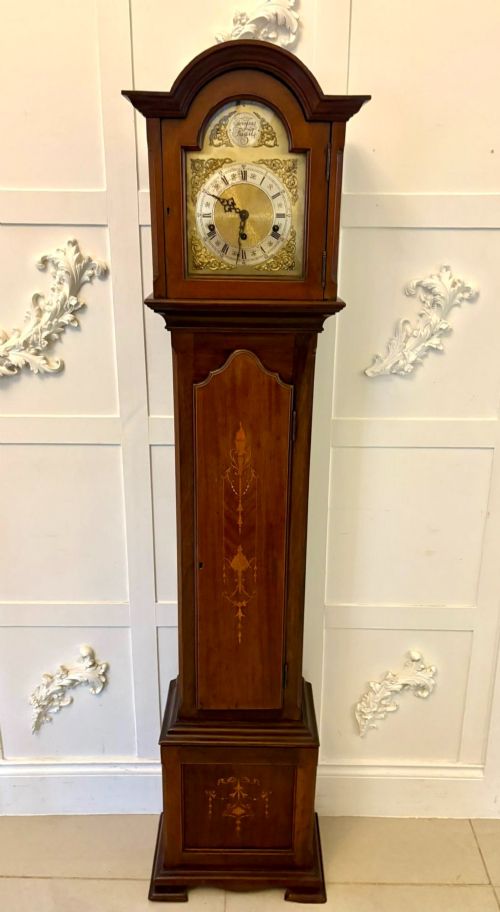
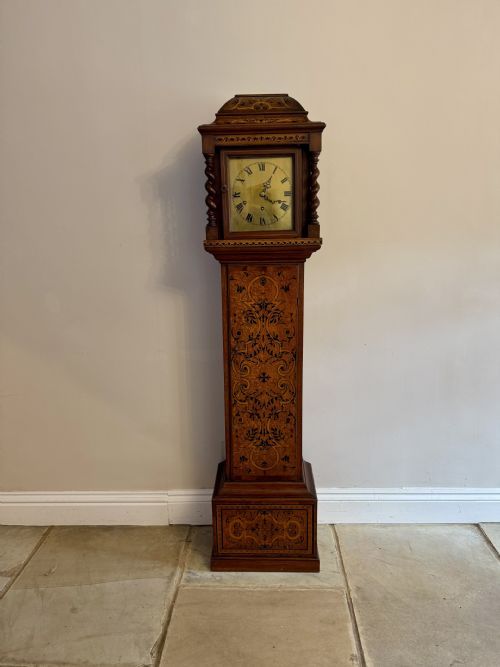


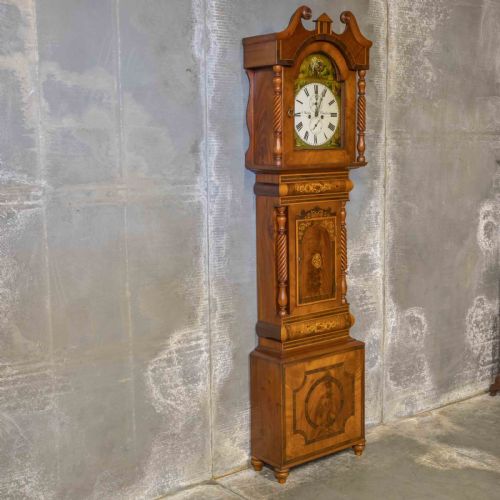

Marquetry Mahogany Longcase Clock
These marquetry mahogany longcase clocks combine tall architectural timber cases with intricate inlaid floral or geometric panels and precision timekeeping movements.
Marquetry Mahogany Longcase Clock
When you search for a marquetry mahogany longcase clock, you encounter tall floor-standing timepieces spanning the Georgian, Victorian, and Edwardian periods.
The selection ranges from traditional Scottish longcase clocks and 18th-century examples to later Edwardian musical and chiming grandfather clocks.
Makers and regional clockmakers housed these complex movements in substantial mahogany housings decorated with contrasting satinwood or marquetry inlay.
How they were made
Cabinetmakers constructed the tall housing using solid mahogany and oak, applying delicate satinwood and marquetry inlay to create pictorial or geometric surface patterns.
Clockmakers fitted brass dials, painted metal faces, and glass hoods to protect the mechanical eight-day or musical gear trains inside.
Marquetry Mahogany Longcase Clock Retail Price Guide 2026
Typical asking prices for marquetry mahogany longcase clock among the pieces listed under this phrase on Sellingantiques today, from the lower quarter to the upper quarter. They describe what is for sale here now, not the wider market.
The listings span multiple eras, encompassing Georgian, Regency, Victorian, and Edwardian periods alongside specialised Scottish regional examples.
What varies in quality
The distinction between standard and superior examples lies in the crispness of the marquetry cutting and the complexity of the internal movement, such as musical or chiming mechanisms.
Proportion and timber selection dictate the visual balance of the case, with finer pieces retaining distinct grain patterns and intricate dial signature work.
David Morice of Auchtermuchty·William Warren·Sam Robson·Rowntree York
The Marquetry Mahogany Longcase Clock Glossary
- Marquetry
- Decorative woodwork where small pieces of veneer are fitted together to form pictorial or geometric patterns on the mahogany surface.
- Longcase clock
- A tall, weight-driven pendulum clock housed in a protective wooden case, commonly called a grandfather clock.
- Moon dial
- A specialised clock face mechanism that tracks the phases of the moon alongside the standard time.
- Satinwood inlay
- Contrasting light timber insertions used to outline panels, drawers, and borders on the darker mahogany case.
- Grandfather clock
- A colloquial term for a tall floor-standing pendulum clock.
Marquetry Mahogany Longcase Clock: Frequently Asked Questions
How do I wind a longcase clock?
Winding involves using a specialised crank key to draw up the internal weights via the winding holes on the dial face.
Care must be taken not to over-wind the mechanism, ensuring the weights reach their correct operational height without straining the internal chains or cords.
What is the difference between a grandfather and grandmother clock?
Grandmother clocks are simply scaled-down versions of the traditional tall longcase clocks, built with shorter and narrower proportions.
These smaller variants appeared more frequently during later periods like the Edwardian era while retaining similar chiming or musical movements.
How do I date a mahogany longcase clock?
Dating relies on examining the construction methods of the mahogany case, the style of the dial, and any maker signatures inscribed on the brass or painted face.
Stylistic shifts from Georgian architectural simplicity to Edwardian marquetry and chiming complications help narrow down the period of manufacture.
Where should I place a longcase clock in my home?
These tall floor-standing clocks require a stable, level surface against a solid wall to ensure the pendulum swings evenly without interference.
Placing the timepiece away from direct sunlight and fluctuating heat sources protects the mahogany veneer and delicate internal wooden components.