
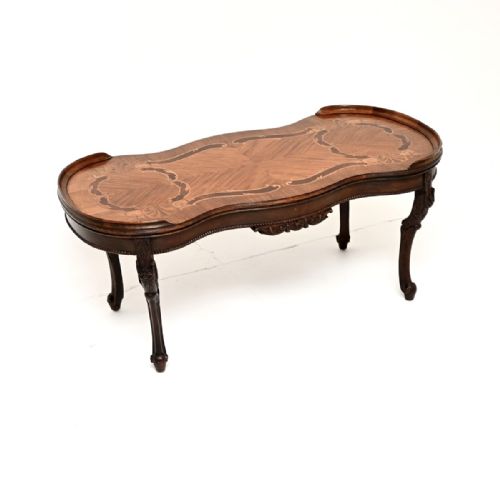
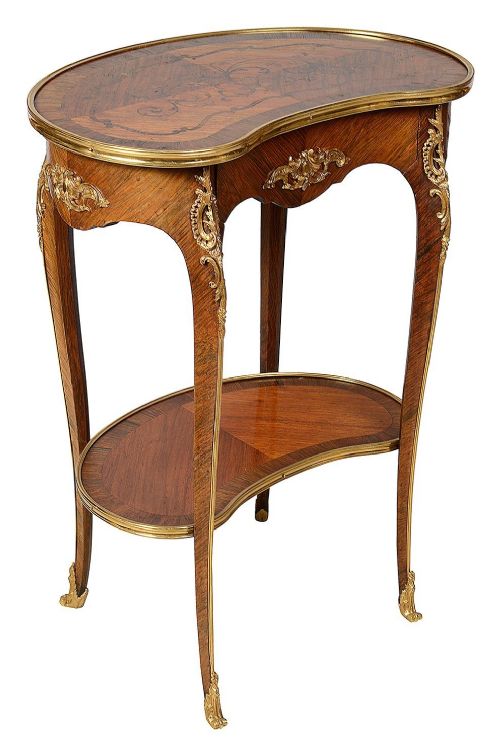
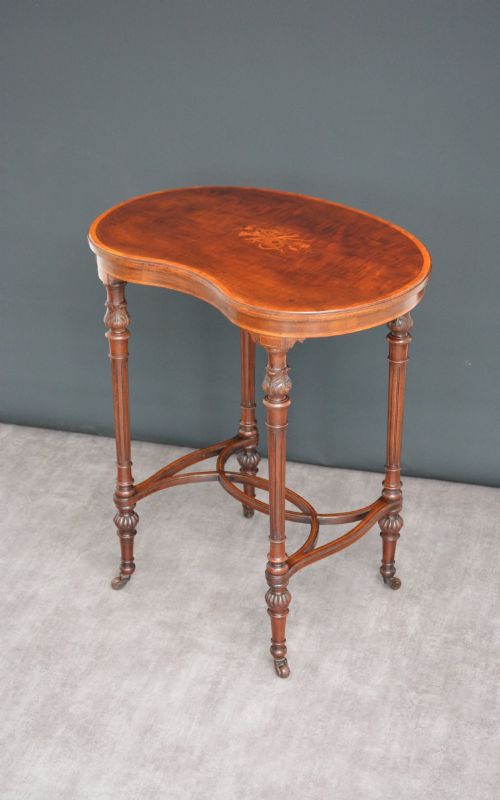
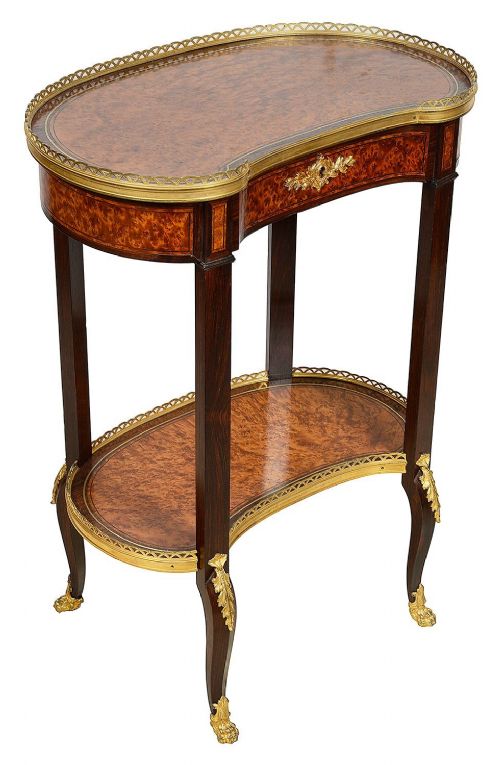



Marquetry Kidney Table
A marquetry kidney table offers a graceful, indented curve designed to fit comfortably against the body while seated at a desk or beside a chair.
Marquetry Kidney Table
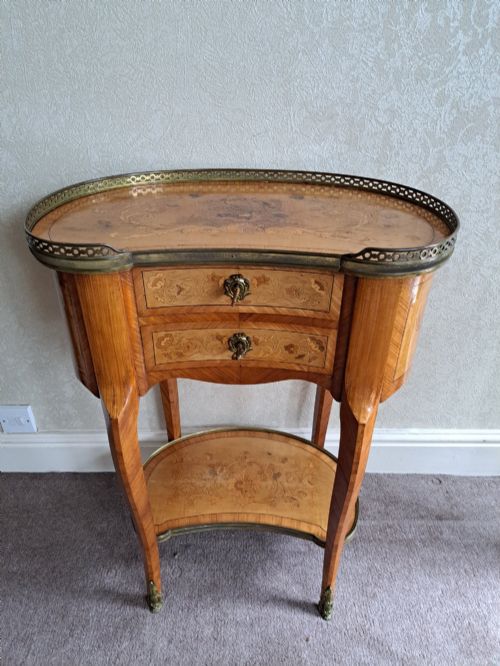
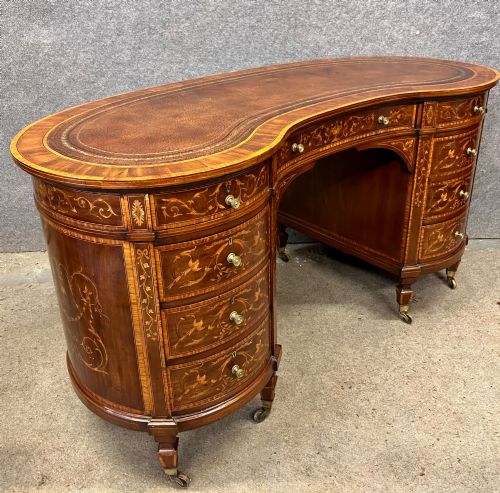
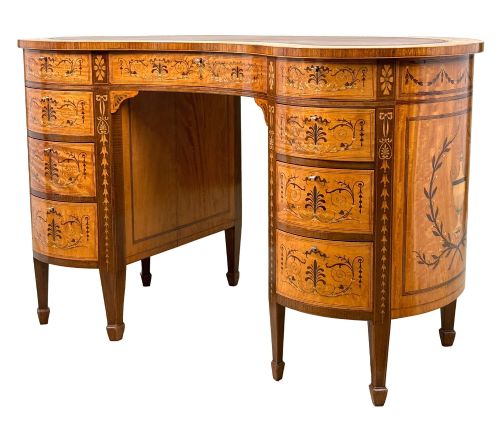
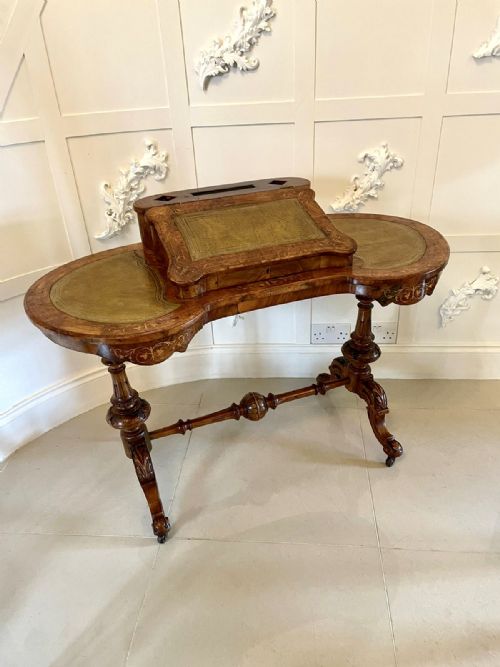
A marquetry kidney table is defined by its characteristic curved top resembling a kidney bean, appearing in forms such as writing desks, side tables, occasional tables, and jardiniere tables. These pieces emerge predominantly from the nineteenth century, the Edwardian period, and up to nineteen thirty, taking inspiration from French Louis styles and Sheraton Revival designs.
Most examples met on this page are constructed from mahogany, burr walnut, rosewood, or satinwood, frequently embellished with floral or geometric wood inlays. They function practically as writing surfaces, bedside tables, or decorative centrepieces within a room, combining curved woodwork with slender supports.
How They Were Made
Cabinetmakers constructed the curved tops using fine timbers like mahogany, satinwood, kingwood, and burr walnut as a base for intricate marquetry picture panels. Contrasting veneers were meticulously hand-cut and fitted together to create floral motifs or geometric patterns before being applied to the core structure.
Many pieces incorporate cast or chased ormolu mounts and brass galleries along the edges, paired with leather inset writing surfaces where the form serves as a desk. Frameworks rested on slender legs, occasionally linked by lower tiers or stretchers for added stability.
Periods represented span from mid nineteenth-century Victorian examples through Edwardian revivals up to nineteen thirty.
What Varies in Quality
The sophistication of the marquetry design sets apart finer examples, distinguishing simple banded borders from elaborate floral pictorial scenes composed of diverse exotic woods. The choice of primary timber also dictates the grade, with burr walnut, satinwood, and kingwood demanding greater skill in selection and placement than standard mahogany.
Execution of subsidiary details such as fire-gilt ormolu mounts, leather toolings on writing surfaces, and the overall crispness of the curved joinery separate standard production pieces from exhibition-grade cabinetmaking.
Edwards and Roberts·Tehan·Gillows
The Marquetry Kidney Table Glossary
- Marquetry
- A technique where small pieces of veneer are assembled into pictorial or decorative patterns on a wooden backing. This differs from inlay by covering the entire surface rather than being set into recesses.
- Ormolu
- Gilded bronze mounts applied to furniture for decoration and edge protection. The term derives from French phrasing meaning ground gold.
- Kidney shape
- A plan form curving inward on one long side to accommodate the user. This ergonomic profile became particularly popular for writing desks and side tables.
- Satinwood
- A luminous hardwood with a golden yellow sheen often utilised for detailed veneering. It was favoured by Sheraton Revival and eighteenth-century makers alike.
- Jardiniere table
- A specialised small table incorporating a metal liner designed to hold potted plants or flowers. These items often feature waterproof wells and gallery edges.
Marquetry Kidney Table: Frequently Asked Questions
What rooms suit a kidney table?
These tables adapt well to sitting rooms as occasional surfaces or bedrooms as writing desks and bedside companions due to their compact, curved profile.
Their shallow depth allows them to sit comfortably behind sofas or beside chairs without blocking pathways.
How do I care for marquetry surfaces?
Protect the veneered surfaces from direct sunlight and excessive heat fluctuations to prevent the woods from drying and lifting.
Apply high-quality paste wax sparingly and buff gently with a soft cloth to maintain the natural sheen of the timber.
Were these tables made in England or France?
Both origins appear frequently, with English makers producing satinwood and mahogany pieces under Sheraton Revival influence, while French workshops specialised in kingwood and ormolu-mounted Louis styles.
Construction details and secondary timbers often help distinguish between London cabinetmakers and Parisian ateliers.
What is the difference between a desk and a side table?
Desks feature fitted drawers beneath the kidney-shaped top and often include inset leather writing surfaces for functional daily use.
Side tables omit the heavy drawer construction, prioritising decorative marquetry tops and open lower tiers or slender legs.