

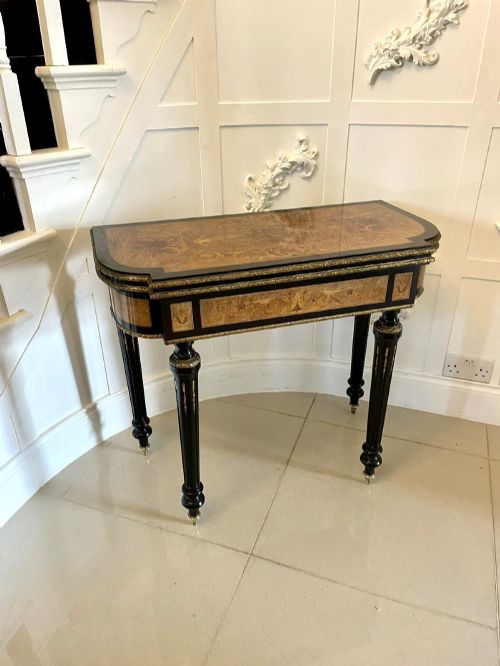

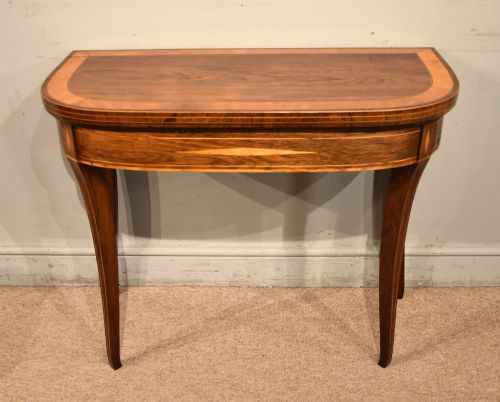
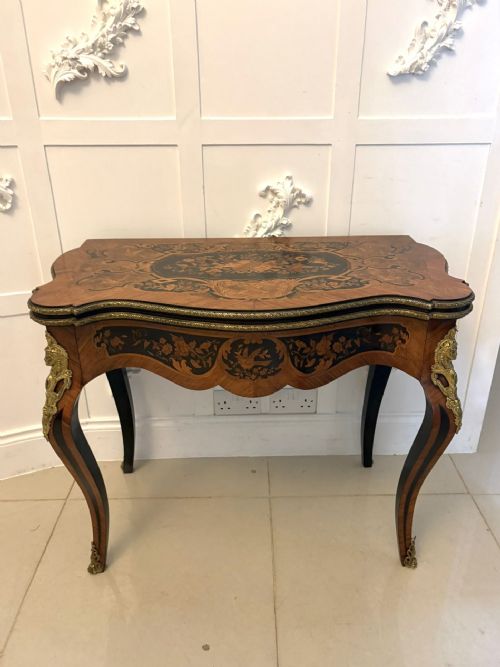
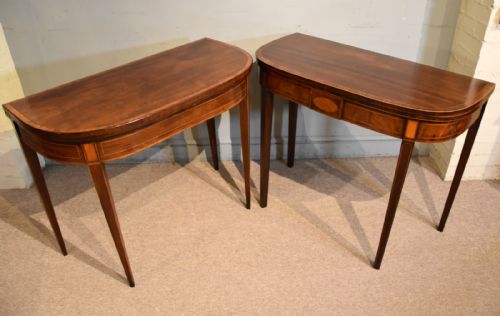
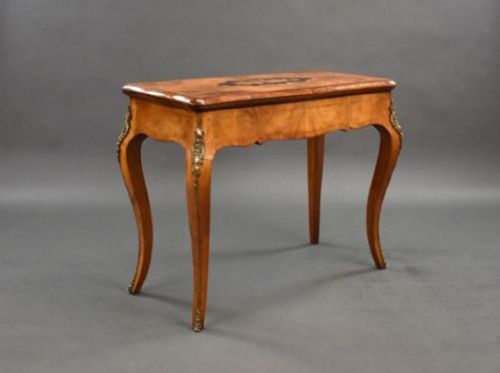


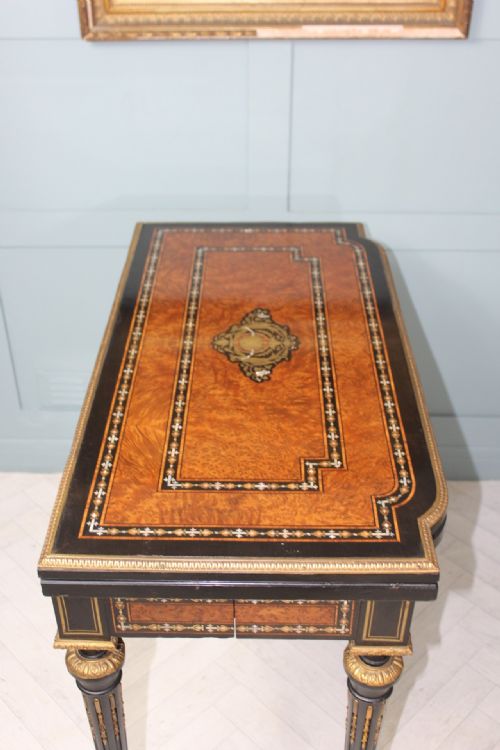


Marquetry Foldover Table
These marquetry foldover table examples combine clever folding tops with intricate wood veneers, offering a practical surface that transforms from a console into a card or games table.
Marquetry Foldover Table
When you search for marquetry foldover table, you find pieces that double as console surfaces and card or games tables. The folding tops open to reveal baize or polished wood interiors designed for pastimes.
You are most likely to meet examples in mahogany, walnut, and rosewood originating from Georgian, Regency, and Victorian periods. French and Dutch variants frequently employ kingwood alongside elaborate floral and geometric veneers.
Formats range from demi-lune half-moon consoles to rectangular games tables with concertina actions. These adaptable furnishings served reception rooms and parlours across the eighteenth and nineteenth centuries.
How they were made
Cabinet makers utilised dense hardwoods like mahogany and walnut for structural stability, applying fine veneers of satinwood, rosewood, and kingwood to the surfaces. Marquetry cutters sliced contrasting timbers to form intricate pictorial or geometric patterns.
Ormolu mounts, brass stringing, and mother-of-pearl details decorated the exterior borders and friezes. Specialist hinges and concertina actions allowed the dual tabletops to pivot and support their own weight securely.
Marquetry Foldover Table Retail Price Guide 2026
Typical asking prices for marquetry foldover table among the pieces listed under this phrase on Sellingantiques today, from the lower quarter to the upper quarter. They describe what is for sale here now, not the wider market.
Several tables hide secret compartments beneath their folding tops, originally intended for stashing stray playing cards and elusive guineas.
What varies in quality
The precision of the marquetry cutting and the choice of contrasting timbers dictate the visual hierarchy. Subtle tonal variations in the grain elevate certain floral motifs above simpler geometric arrangements.
The sophistication of the opening mechanism, from basic folding leaves to complex concertina actions, marks the standard of construction. Heavy brass mounts and finely cast ormolu details separate standard workshop production from finer cabinet work.
George Bullock
The Marquetry Foldover Table Glossary
- Marquetry
- Decorative veneer work where pieces of wood and other materials are fitted together to form pictorial designs. This technique creates complex patterns across the folding top.
- Demilune
- Half-moon shape common in console and card tables designed to sit flush against a wall. These pieces feature a straight back edge and a curved front.
- Concertina action
- An expandable frame structure that stretches out when the table top unfolds to provide solid support. This mechanism allows the rear legs to move outwards in tandem with the leaf.
- Ormolu
- Gilt bronze mounts applied to furniture for decorative effect. These cast metal ornaments edge the friezes and legs of French style pieces.
- Satinwood
- A durable timber with a characteristic golden yellow sheen used extensively for contrasting inlay work. It catches the light and adds brightness to darker mahogany surfaces.
Marquetry Foldover Table: Frequently Asked Questions
What is a marquetry foldover table?
A marquetry foldover table is a dual-purpose piece of furniture featuring a hinged top decorated with inlaid wood veneers. When closed, it functions as a slim console against a wall; when opened, it reveals a baize-lined surface for card games.
These tables date primarily from the eighteenth and nineteenth centuries, reflecting changing domestic fashions in entertaining. The clever engineering allowed homeowners to maximise living space without sacrificing utility.
How do you open the top?
The upper leaf pivots on hinges, swinging through a semicircle to rest flat upon the extended frame or support legs. Some designs utilise a concertina action where the framework itself pulls outward to bear the weight.
Users should lift the top leaf gently and check the alignment of the pivoting hinges before securing it in place. Forcing a stiff mechanism can damage the underlying timber framework.
Where should I place it?
These tables suit hallways, living rooms, and drawing rooms where a compact console profile is useful against a blank wall. Pulling the table into the centre of the room allows guests to gather around the unfolded top.
Direct sunlight should be avoided to protect sensitive satinwood and rosewood veneers from fading. Keeping the piece away from radiators prevents the old timber and marquetry from drying out.
How do I care for the veneer?
Dust the surface regularly with a soft, dry cloth to prevent dirt accumulation in the intricate grain and inlay lines. Occasional application of a suitable furniture wax maintains the moisture and natural lustre of the wood.
Water and harsh chemical cleaners must be kept away from the polished timber and any applied ormolu or mother-of-pearl. Using coasters and mats protects the French polished top from moisture rings and scratches.